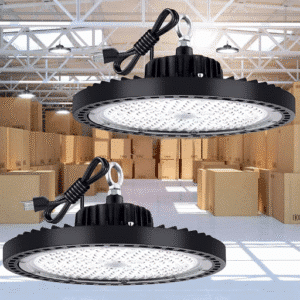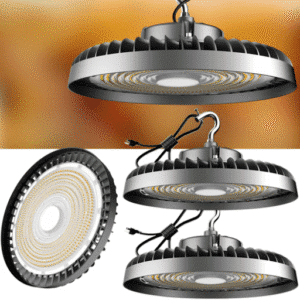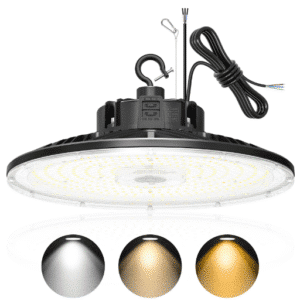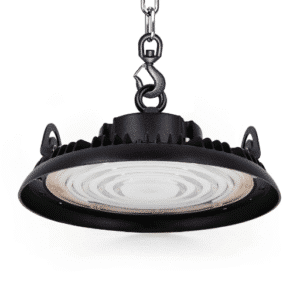

The lights went out at 6:47 p.m. on a Tuesday. Marcus watched his Houston distribution center drop into darkness. A summer storm had knocked out the grid.
Again. It was the third outage that month.
His forklift operators stopped mid-aisle. The loading dock went idle. Forty minutes later, the power returned. He’d lost $3,200 in productivity.
He’d considered pure solar. But Houston’s cloudy stretches in winter and spring meant his battery bank would need to be enormous and expensive to guarantee light every night. He’d also considered staying grid-only. But his electricity bills kept climbing, and the outages weren’t stopping.
That’s the dilemma hybrid solar high bay lighting solves. You get the cost savings of solar generation without gambling your operations on weather. You keep the grid as a backup, not as your primary expense. In this guide, you’ll learn how hybrid systems work, what they cost, and why they’re the right choice for facilities that can’t afford to go dark.
Key Takeaways
- Hybrid systems combine solar generation with grid backup for 24/7 reliability.
- Batteries in hybrid systems can be 50-70% smaller than in off-grid systems.
- Automatic transfer switches switch power sources in under 20 milliseconds.
- Peak shaving can cut demand charges by 25-40% in high-rate regions.
- Hybrid costs more upfront than grid-only but far less than full off-grid systems.
What Is a Solar Hybrid Lighting System?

The Basic Architecture
A hybrid solar lighting system generates power from solar panels, stores excess in batteries, and connects to the utility grid as a backup. The hybrid inverter is the brain. It decides where power comes from moment to moment.
During daylight, solar panels charge the batteries and power the lights directly. When solar drops (clouds, evening), the system draws from batteries. If batteries run low or demand spikes, the grid steps in seamlessly. The facility never knows the switch happened.
This architecture is fundamentally different from both grid-tie solar (no batteries, no backup) and off-grid solar (no grid connection, entirely battery-dependent). You can think of hybrid as the insurance policy that also pays dividends.
How the Power Flow Works
Solar panels produce DC power. The charge controller manages battery charging. The hybrid inverter converts DC to AC for your LED high bays. When solar plus battery can’t meet demand, the inverter pulls from the grid automatically.
The critical component that makes this seamless is the automatic transfer switch (ATS). It monitors both solar/battery output and grid availability. If one source fails, it transfers the load to the other in milliseconds. For LED lighting, even a 20-millisecond transfer is fast enough that the human eye won’t detect a flicker.
For a deeper understanding of complete solar system design, see our (complete solar high bay lights guide).
Why Industrial Facilities Choose Hybrid Solar High Bays
24/7 Reliability Without Generator Costs
Marcus didn’t want a diesel generator. Generators need fuel, maintenance, and weekly testing. They make noise. They emit fumes.
They take 10-30 seconds to start. You’d still need battery bridging.
His hybrid system solved the outage problem with no diesel. When the grid failed during that August storm, his ATS transferred the lighting load to solar and battery in 16 milliseconds. The forklifts kept moving. The night shift never noticed.
The battery bank in his hybrid system only needs to cover brief gaps, not entire nights. That’s why hybrid batteries can be half the size of off-grid systems. For more on battery sizing and chemistry choices, read our (LiFePO4 battery selection guide).
Peak Shaving and Demand Charge Reduction
Jennifer runs a 200,000-square-foot warehouse in San Diego. Her utility charges 22 per kilowatt-hour of peak demand, measured in 15-minute windows. On hot afternoons when all her lights and HVAC run simultaneously, her peak hits 480kW. That′s22 per kilowatt-hour of peak demand, measured in 15-minute windows. On hot afternoons when all her lights and HVAC run simultaneously, her peak hits 480kW. That′s 10,560 in demand charges every month.
She installed a hybrid solar high bay system sized to handle her lighting load during peak afternoon hours. The solar panels power the high bays directly. The grid handles everything else. Her peak demand dropped from 480 kW to 310 kW.
Her monthly demand charge fell by 3,740.Over the year,that′s3,740.Over a year,that′s44,880 in savings from peak shaving alone. The solar offset saved another $8,400 annually. Total payback: 4.2 years.
Peak shaving works because lighting is a predictable, consistent load. You know exactly when your high bays are on and how much they draw. That predictability makes lighting the perfect candidate for demand reduction strategies.
Solar Savings Without the Weather Risk
Pure off-grid solar forces worst-case sizing. December clouds. Three-day storms.
You buy 40% more panels and triple the batteries. That gets expensive fast.
Hybrid systems let you size for average conditions. The grid covers the edge cases. You still capture 60-80% of the energy savings from solar. But you don’t need a $40,000 battery bank to feel safe. NREL’s solar plus storage research confirms that hybrid configurations consistently outperform pure off-grid systems on cost-effectiveness in grid-connected locations.
This risk reduction matters for facilities with 24/7 operations. If you’re running two or three shifts, you can’t tell the night crew to work in the dark because the batteries are empty. Hybrid eliminates that risk entirely.
Hybrid System Architecture for High Bay Lighting

Component Layout
A hybrid solar high bay system has six core components:
- Solar panel array (DC output)
- Charge controller (manages battery charging)
- Battery bank (LiFePO4 recommended)
- Hybrid inverter (DC to AC conversion + grid management)
- Automatic transfer switch (source selection)
- LED high bay fixtures
Power flows from panels to charge controller to battery. The hybrid inverter draws from the battery to create AC power for the lights. The ATS sits between the inverter and the grid, monitoring both sources.
The grid connection serves two purposes. It provides backup power when solar and battery can’t keep up. It also allows the system to sell excess solar back to the utility if net metering is available.
Sizing Logic: Different From Off-Grid
Off-grid systems must survive the longest cloudy period without grid help. Hybrid systems only need to bridge short gaps. This changes every sizing calculation.
| Sizing Factor | Off-Grid Requirement | Hybrid Requirement |
|---|---|---|
| Battery autonomy | 12-16 hours minimum | 2-4 hours typical |
| Panel oversizing | 30-40% for winter/clouds | 10-15% for efficiency |
| Inverter capacity | Must handle entire load | Can split load with grid |
| Winter performance | Critical design driver | Grid covers shortfall |
Battery autonomy is the biggest difference. An off-grid system for a 50-fixture warehouse might need 60 kWh of storage. A hybrid system for the same warehouse runs on 15-20 kWh. The grid handles the gaps.
The Transfer Switch: The Critical Component
Not all transfer switches are equal. The type you choose determines whether your lights flicker during a transfer and how fast your system recovers. IEEE standards for power transfer devices define the performance categories that separate consumer-grade switches from industrial-grade units.
| Transfer Switch Type | Transfer Time | Best For | Approximate Cost |
|---|---|---|---|
| Static Transfer Switch (STS) | <4 ms | Critical lighting, no flicker | $800-1,500 |
| Automatic Transfer Switch (ATS) | 2-10 seconds | General industrial, generator backup | $300-800 |
| Manual Transfer Switch | 30+ seconds | Non-critical areas, maintenance | $100-300 |
In active facilities, static transfer switches are worth the investment. LEDs have no warm-up time. But they need consistent power.
A 10-second transfer means 10 seconds of darkness. That’s dangerous with active forklifts.
Static switches use semiconductor devices instead of mechanical relays. They monitor both sources continuously and transfer instantly when voltage drops. The LEDs never dim.
Cost Comparison: Hybrid vs Off-Grid vs Grid-Only

Upfront Investment
Let’s compare a 50-fixture LED high bay installation for a 24/7 distribution center. Each fixture draws 150W. Total lighting load: 7.5 kW.
| Cost Component | Grid-Only | Off-Grid Solar | Hybrid Solar |
|---|---|---|---|
| LED fixtures (50x) | $7,500 | $7,500 | $7,500 |
| Solar panels (15 kW array) | $0 | $18,000 | $18,000 |
| Battery bank | $0 | $24,000 | $9,000 |
| Hybrid inverter | $0 | $0 | $4,500 |
| Standard inverter | $0 | $3,000 | $0 |
| Charge controller | $0 | $1,200 | $1,200 |
| Transfer switch | $0 | $0 | $1,200 |
| Installation labor | $2,500 | $6,000 | $5,000 |
| Total Upfront | $10,000 | $59,700 | $46,400 |
The hybrid system costs $13,300 less than off-grid. The savings come from the smaller battery bank and reduced installation complexity.
10-Year Total Cost of Ownership
Upfront cost tells only part of the story. Let’s add 10 years of energy and maintenance.
| Cost Over 10 Years | Grid-Only | Off-Grid Solar | Hybrid Solar |
|---|---|---|---|
| Upfront cost | $10,000 | $59,700 | $46,400 |
| Electricity (10 years) | $52,000 | $0 | $18,200 |
| Battery replacement | $0 | $18,000 | $6,500 |
| Maintenance | $2,000 | $4,000 | $3,000 |
| 10-Year Total | $64,000 | $81,700 | $74,100 |
Assumptions: Grid electricity at $0.14/kWh average. Off-grid battery replacement at year 8. Hybrid battery replacement at year 10 (shallower cycling extends life). Annual maintenance covers cleaning, inspections, and minor repairs.
The grid-only system looks cheapest. Until you add energy costs. The off-grid system avoids electricity bills.
But it requires expensive battery replacement. Hybrid balances both. It delivers the lowest 10-year total cost in high-rate regions.
When Hybrid Pays Off Fastest
Hybrid systems deliver the strongest ROI when four conditions align:
- High electricity rates ($0.15/kWh or above, per EIA commercial rate data)
- Unreliable grid (more than 4 outages per year)
- Peak demand charges ($15/kW or above)
- Long runtime (16-24 hours per day)
If your facility hits three of these four conditions, hybrid should be your default architecture. If you only hit one or two, a pure grid-tie solar system or improved grid reliability might make more sense. For a full comparison, see our analysis of (solar high bay lights vs grid-powered) systems.
Real-World Challenges and Solutions
Transfer Switch Failure Modes
Transfer switches are the single point of failure in a hybrid system. When they stick or malfunction, the system can’t move between power sources.
The most common failure is contact welding in mechanical ATS units. High inrush current when the grid returns can weld relay contacts together. The system ends up locked to grid power even when solar is available.
The solution is preventive maintenance. Test the transfer switch quarterly under load. Monitor transfer cycle counts. Replace mechanical switches every 5-7 years in heavy-cycling environments.
Static switches have no moving parts. They last longer. But they cost more upfront.
Battery Cycling in Hybrid vs Off-Grid

Off-grid batteries deep-cycle every night. They discharge 60-80% of capacity, then recharge the next day. That stress shortens life.
Hybrid batteries shallow-cycle. They might discharge only 20-30% on a typical day because solar covers most of the load and the grid provides backup. Shallower cycling means more cycles before capacity degrades.
LiFePO4 batteries in hybrid configurations often last 10-12 years versus 6-8 years in off-grid setups. That’s why the hybrid battery replacement cost in our TCO table is lower and occurs later.
Utility Interconnection Requirements
Utilities treat hybrid systems differently depending on configuration. A net-metered hybrid system sells excess solar back to the grid. A backup-only system doesn’t export power but still needs utility approval.
Interconnection paperwork typically takes 4-8 weeks. Some utilities require external disconnect switches visible to linemen. Others mandate specific inverter certifications such as UL 1741 SA for advanced grid support.
Check with your utility before specifying equipment. The wrong inverter certification can delay your project by months. For installation best practices, see our (solar high bay installation guide).
Frequently Asked Questions
What is a solar hybrid lighting system?
A solar hybrid lighting system combines solar panels, batteries, and grid power into a single architecture. Solar powers the lights during the day and charges batteries. Batteries cover brief gaps. The grid provides backup for extended low-solar periods.
An automatic transfer switch manages seamless transitions between sources.
How much does a hybrid solar high bay system cost?
A hybrid system for a 50-fixture industrial facility typically costs 45,000−55,000installed.That′s45,000−55,000installed.That′s12,000-15,000 less than an equivalent off-grid system. The 10-year total cost of ownership is usually 15-20% lower than grid-only when electricity rates exceed $0.14/kWh.
Will lights flicker during grid-to-solar transfer?
With a static transfer switch, no. Transfer happens in under 4 milliseconds, faster than the human eye can detect. With a mechanical automatic transfer switch, transfer takes 2-10 seconds, which will cause a visible outage. For active industrial facilities, static switches are strongly recommended.
How long do hybrid system batteries last?
LiFePO4 batteries in hybrid configurations typically last 10-12 years. Shallow cycling (20-30% daily depth of discharge) reduces stress compared to off-grid systems that deep-cycle nightly. Most manufacturers warranty hybrid-duty batteries for 6,000 cycles or 10 years.
Can I add a hybrid inverter to existing LED high bays?
Yes, if your existing high bays are DC-compatible or if the hybrid inverter produces standard AC output. Many facilities retrofit existing LED fixtures by adding a solar array, battery bank, and hybrid inverter upstream. The fixtures don’t need replacement. For retrofit strategies, read our (solar LED high bay retrofit guide).
Is hybrid better than off-grid for industrial lighting?
For most 24/7 industrial facilities, yes. Hybrid systems cost less upfront than off-grid, require smaller batteries, and eliminate the risk of running out of power during extended bad weather. Off-grid only makes sense when grid connection is physically impossible or prohibitively expensive.
For a detailed comparison of solar-only approaches, see our (off-grid industrial lighting solutions guide).
What size battery bank does a hybrid system need?
Hybrid battery banks are typically 50-70% smaller than off-grid banks for the same facility. Size for 2-4 hours of lighting load, not 12-16 hours. The grid covers extended gaps. For a 7.5 kW lighting load, 15-20 kWh of LiFePO4 storage is usually sufficient.
Can hybrid systems reduce peak demand charges?
Yes. By powering lighting loads from solar during afternoon peak rate windows, hybrid systems reduce the facility’s peak demand reading. Demand charge reductions of 25-40% are common in facilities with high lighting loads and time-of-use rate structures.
Do hybrid systems work with motion sensors?
Yes. Motion sensors integrate with the lighting fixtures independently of the power source. Whether the lights run on solar, battery, or grid, the sensors still control on/off and dimming. For motion sensor strategies, see our (solar high bay motion sensor guide).
What IP rating do hybrid system components need?
All outdoor components — panels, battery enclosures, inverters — need IP65 minimum. Cable glands should be IP68. For a complete system protection strategy, read our (IP65 solar high bay protection guide).
Conclusion
Pure solar saves money but adds risk. Grid-only is reliable but expensive. Hybrid solar high bay lighting captures the best of both: solar generation that cuts your energy bills, grid backup that guarantees the lights stay on.
The math works when electricity rates are high, the grid is unreliable, or peak demand charges sting your monthly budget. The technology works when you spec the right transfer switch, size batteries for hybrid duty (not off-grid duty), and maintain the system like any other critical infrastructure.
Marcus hasn’t had a lighting outage in 14 months. Jennifer cut her demand charges by 38%. Both spent less than they would have on off-grid systems. Both sleep better knowing their facilities won’t go dark.
If you’re planning a solar high bay system and can’t afford downtime, hybrid isn’t a compromise. It’s the smartest architecture for the job.
Ready to size a hybrid system for your facility? Use our (solar high bay sizing methodology) to calculate the right panel array, battery bank, and inverter for your lighting load. For warehouse-specific layouts, check our (solar warehouse lighting design) guide.