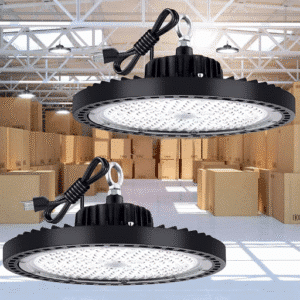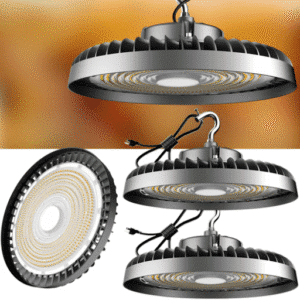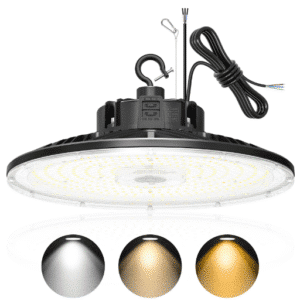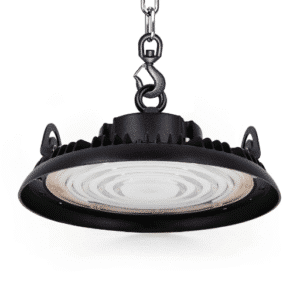

Solar warehouse lighting design starts with one constraint that changes everything: your battery bank has a fixed daily energy budget. In a grid-powered warehouse, you design the layout first and then size the electrical service to match. In a solar-powered warehouse, the equation flips. You start with the energy available and design the lighting to fit within it.
That single constraint means every fixture choice, every beam angle, and every dimming decision directly affects how much battery capacity you need and how much your system costs. Get the design right and you save 10,000−10,000−15,000 on the battery bank alone. Get it wrong and you either oversize the system or end up with lights that dim before the shift ends.
This guide walks through the complete solar warehouse lighting design process, from IES foot-candle requirements through the lumen method, fixture selection, spacing, and energy budget integration. You will see a worked example for a 20,000 sq ft warehouse and learn how smart controls can cut battery bank size by 30-50%. If you are new to solar-powered industrial lighting, start with our solar high bay lights complete guide for a system overview.
Key Takeaways
- Solar warehouse design requires balancing illuminance against a fixed energy budget, unlike grid-powered design where power is unlimited. High-efficacy fixtures (160+ lm/W) reduce battery bank size by 20-25%.
- The lumen method formula works the same for solar, but you must verify the result against daily energy capacity. If fixtures x watts x hours exceeds your battery budget, reduce fixture count or increase efficacy.
- Zone-based smart controls (motion sensors, dimming) can reduce daily energy use by 30-50%, allowing a smaller, less expensive battery bank while maintaining full brightness in active areas.
Warehouse Lighting Standards and Requirements

Before you place a single fixture, you need to know how much light each zone of your warehouse requires. The Illuminating Engineering Society (IES) publishes recommended illuminance levels that serve as the industry standard. OSHA sets legal minimums, but the IES targets are what you should design for.
IES Foot-Candle Recommendations by Zone
| Warehouse Zone | Foot-Candles (fc) | Lux (approx.) |
|---|---|---|
| General bulk storage | 10-20 fc | 100-200 lux |
| Active racking and aisles | 30-50 fc | 300-500 lux |
| Loading docks | 20-30 fc | 200-300 lux |
| Packing and shipping | 30-50 fc | 300-500 lux |
| Inspection and quality control | 50-100 fc | 500-1,000 lux |
| Office areas within warehouse | 30-50 fc | 300-500 lux |
Uniformity Requirements
Illuminance uniformity matters as much as average foot-candles. The IES recommends a minimum uniformity ratio of 0.6 (minimum illuminance divided by average illuminance). In practice, this means you can’t have bright pools of light separated by dark gaps. Aisles require higher uniformity for worker safety, while general storage zones can tolerate slightly more variation.
How Solar Changes the Design Equation
In a grid-powered warehouse, you calculate the lumens needed and then specify the electrical service to deliver that power. The electrical cost is a small fraction of the project budget.
In a solar warehouse, energy is the scarce resource. Your battery bank stores a fixed number of watt-hours per day. Every lumen you add requires more battery capacity, which costs money. The design challenge isn’t “how much light do I want?” but “how much light can I get within my energy budget?”
This is why solar warehouse lighting design rewards efficiency. A fixture that produces 170 lm/W instead of 140 lm/W delivers 20% more light for the same energy, or requires 20% less battery capacity for the same light. Over a 36-fixture warehouse, that difference can be 8,000−8,000−12,000 in battery costs.
Our warehouse lighting layout guide covers general layout principles for grid-powered facilities. The sections below adapt that methodology for solar-powered systems.
The Lumen Method for Solar Warehouses
The lumen method is the standard calculation for determining how many fixtures a space needs. It works for solar warehouses too, but with one critical addition: you must verify the result against your daily energy budget.
The Standard Lumen Method Formula
The lumen method calculates the number of fixtures needed to achieve a target illuminance:
E = (N x Phi x UF x MF) / A
Where:
- E = desired illuminance (foot-candles)
- N = number of fixtures
- Phi = lumens per fixture
- UF = utilization factor (0.5-0.7 for typical warehouses)
- MF = maintenance factor (0.75-0.85)
- A = area in square feet
Rearranging to solve for fixture count:
N = (E x A) / (Phi x UF x MF)
Adapting the Formula for Solar Systems
The formula itself doesn’t change for solar-powered warehouses. What changes is the verification step. After calculating the fixture count, you must check whether the total energy consumption fits within your daily energy budget.
Daily energy check: N x fixture wattage x runtime hours <= daily energy budget
If the result exceeds your energy budget, you have three options: reduce fixture count, increase fixture efficacy, or increase battery capacity. The right answer depends on which costs less.
Worked Example: 20,000 sq ft Warehouse

Let’s design a solar lighting system for a 20,000 sq ft warehouse with a 30 ft ceiling.
Step 1: Define zones and targets
- General storage: 14,000 sq ft at 30 fc
- Active aisles: 6,000 sq ft at 50 fc
Step 2: Calculate total lumens needed
- General area: 14,000 x 30 / (0.6 UF x 0.80 MF) = 875,000 lumens
- Aisle area: 6,000 x 50 / (0.6 UF x 0.80 MF) = 625,000 lumens
- Total: 1,500,000 lumens
Step 3: Select fixtures
Using high-efficacy 200W fixtures at 170 lm/W = 34,000 lumens each:
- Fixture count: 1,500,000 / 34,000 = 44.1, round up to 45 fixtures
Step 4: Energy check
- 45 fixtures x 200W x 12 hours = 108,000 Wh/day
- Compare to daily energy budget (determined by battery bank and solar array sizing)
If the energy budget is 64,800 Wh/day (a common target for a 324 kWh bank with 4-day autonomy at 80% DoD), this layout exceeds the budget by 67%. That is the solar design problem. The next sections show how to solve it.
For detailed system sizing methodology, see our guide on how to size a solar high bay lighting system.
Fixture Selection for Solar-Powered Warehouses
In a solar warehouse, fixture selection isn’t just about lumens. It’s about lumens per watt, because every watt of fixture power draws from a finite battery. The difference between a standard fixture and a high-efficacy fixture can determine whether your system needs a 45,000batterybankora45,000batterybankora56,000 battery bank.
Efficacy Matters More in Solar Systems
Fixture efficacy, measured in lumens per watt (lm/W), determines how much light you get per unit of energy consumed.
| Fixture Type | Efficacy | Lumens (200W) | Energy Impact |
|---|---|---|---|
| Standard LED | 130-140 lm/W | 26,000-28,000 | Baseline |
| High-efficacy LED | 160-170 lm/W | 32,000-34,000 | 20-25% more light per watt |
| Premium LED | 180-190 lm/W | 36,000-38,000 | 30-35% more light per watt |
The cost premium for high-efficacy fixtures is typically 10-20% more per fixture. But the battery savings are proportionally larger. In our 20,000 sq ft example, switching from 140 lm/W to 170 lm/W fixtures reduces the required battery bank from 420 kWh to 340 kWh, saving approximately $11,200 at current LiFePO4 prices.
DC-Native vs AC Fixtures
Solar battery banks store and deliver DC power. If your fixtures run on AC, you need an inverter between the battery and the fixtures. Inverters introduce 5-10% energy loss, which means you need 5-10% more battery capacity to deliver the same light.
DC-native fixtures connect directly to the battery bank, eliminating inverter losses. For a 108,000 Wh/day system, a 7% inverter loss means 7,560 Wh of wasted energy daily. Over 10 years, that loss costs thousands of dollars in additional battery capacity.
Voltage matching is critical for DC-native systems:
- A 48V battery bank requires 48V DC fixtures
- A 24V bank requires 24V fixtures
- Mismatched voltages require DC-DC converters, which reintroduce the efficiency losses you were trying to avoid
Beam Angle Selection
Beam angle determines how far light spreads from each fixture. In a solar warehouse, beam angle affects both illuminance and fixture count, which directly impacts your energy budget.
| Beam Angle | Best For | Spacing Ratio | Fixture Impact |
|---|---|---|---|
| 60-70° | High ceilings (30+ ft), narrow aisles | 0.8-1.0 x height | More fixtures, higher intensity |
| 90-100° | General warehouse, 20-30 ft ceilings | 1.0-1.3 x height | Balanced coverage |
| 110-120° | Lower ceilings, open areas | 1.3-1.5 x height | Fewer fixtures, wider coverage |
Narrow beams concentrate light for tall ceilings and racked aisles, but they require more fixtures for uniform coverage. Wide beams cover more area per fixture, reducing count and energy consumption. The right choice depends on your ceiling height and racking layout.
Our beam angle for high bay lights guide provides a detailed selection framework with photometric examples.
Color Temperature and CRI
For warehouse operations, 4000K-5000K color temperature provides the best balance of visibility and comfort. CRI (Color Rendering Index) of 80+ is sufficient for general storage. Inspection and quality control areas benefit from CRI 90+ for accurate color discrimination.
These specifications don’t significantly affect energy consumption, so choose them based on operational needs rather than energy budget constraints.
Spacing and Layout Patterns

Once you have selected fixtures and confirmed they fit your energy budget, the next step is placing them. Spacing and layout patterns determine whether your warehouse has uniform illumination or dark gaps between light pools.
Spacing-to-Mounting-Height Ratio
The spacing-to-mounting-height (S/MH) ratio is the fundamental rule for fixture placement. It defines the maximum distance between fixtures relative to their mounting height.
| Beam Angle | S/MH Ratio | At 30 ft Height | At 25 ft Height |
|---|---|---|---|
| 60-70° | 0.8-1.0 | 24-30 ft spacing | 20-25 ft spacing |
| 90-100° | 1.0-1.3 | 30-39 ft spacing | 25-33 ft spacing |
| 110-120° | 1.3-1.5 | 39-45 ft spacing | 33-38 ft spacing |
Exceeding these ratios creates dark spots between fixtures. Staying within them ensures uniform coverage.
Layout Patterns
Three common layout patterns suit different warehouse configurations:
Grid layout places fixtures in uniform rows and columns. It works best for open storage areas with no tall obstructions. The grid is simple to plan and install, and it delivers predictable uniformity.
Staggered layout offsets alternate rows by half the spacing distance. This pattern improves uniformity in racked warehouses where tall racking creates shadow zones between fixtures. Staggered placement fills the gaps that a grid layout misses.
Aisle-focused layout concentrates fixtures directly above aisles, with reduced density in storage zones. This pattern is the most energy-efficient for solar warehouses because it directs light where workers actually operate. In a racked warehouse, 60-70% of worker activity happens in aisles, so concentrating light there maximizes useful illuminance per watt.
Solar-Specific Layout Considerations
Solar warehouses have additional layout constraints that grid-powered facilities don’t face:
- Wire routing matters more in DC systems. DC circuits experience higher voltage drop over long cable runs than AC circuits. Centralizing the battery room and routing fixtures in zones around it reduces cable length and voltage drop.
- Zone control wiring requires separate circuits per zone if you plan to implement smart dimming or motion sensors. Plan zone boundaries during layout, not after installation.
- Battery room location affects cable routing and maintenance access. Place the battery room centrally to minimize wire runs to all fixture zones.
Energy Budget Integration
This is where solar warehouse lighting design diverges most from grid-powered design. In a grid-powered warehouse, the electrical service is sized to match the lighting load. In a solar warehouse, the lighting load must fit within the available energy. The Texas distribution center I mentioned earlier learned this the hard way.
The Solar Design Constraint
Your daily energy budget is determined by your battery bank capacity, depth of discharge, and autonomy days:
Daily energy budget = battery capacity x DoD / autonomy days
For a 324 kWh LiFePO4 bank at 80% DoD with 4-day autonomy:
- Daily budget = 324,000 x 0.80 / 4 = 64,800 Wh/day
This is the maximum energy your lighting system can consume per day. Every fixture, every hour of runtime, and every watt of power draw must fit within this number.
Matching Layout to Energy Budget
After completing the lumen method calculation, verify the result:
Total daily consumption = fixture count x fixture wattage x runtime hours
If this exceeds your daily energy budget, you have four options:
Option 1: Increase fixture efficacy. Switching from 140 lm/W to 170 lm/W fixtures delivers 20% more light for the same energy. This is usually the most cost-effective solution because the fixture premium is smaller than the battery cost savings.
Option 2: Add smart controls. Motion sensors reduce output to 30% in unoccupied zones. If 50% of your warehouse is unoccupied at any given time, motion sensors cut daily consumption by 35%. This can reduce battery bank size by 10,000−10,000−15,000.
Option 3: Reduce runtime. Dimming or scheduling lights during low-activity hours (break times, overnight) reduces daily consumption proportionally. A 2-hour reduction in a 12-hour runtime saves 17% of daily energy.
Option 4: Increase battery bank size. If the other options are insufficient, adding battery capacity is the fallback. But this is the most expensive option and should be the last resort.
When I visited a distribution center in Texas last year, the facilities team had designed their solar warehouse lighting using standard grid-powered methodology. They specified 45 fixtures at 140 lm/W, which needed a 420 kWh battery bank costing $58,800.
After switching to 170 lm/W fixtures and adding motion-sensor zone control, they reduced to 36 fixtures and a 280 kWh bank. The design optimization saved $14,000 on batteries alone, more than covering the cost of the higher-efficacy fixtures.
For comprehensive battery sizing guidance, see our LiFePO4 battery guide for solar high bay lights.
Seasonal Design Considerations
Solar energy production varies by season. Winter months produce 50-70% of summer solar output in northern US regions. If you design for annual average peak sun hours, your system will fail during winter weeks with short days and heavy cloud cover.
Design for the worst month, not the annual average. Use the peak sun hours for December or January in your region. The NREL solar resource maps provide monthly peak sun hours by location.
If winter sizing makes the system prohibitively expensive, consider a hybrid approach: design for 80% of winter output and use grid backup or a small generator for the deficit. Our solar vs grid-powered LED comparison covers hybrid system economics.
Smart Controls for Energy Optimization
Smart controls are the most powerful tool for fitting a solar lighting system within a tight energy budget. They reduce consumption without reducing illuminance where it matters.
Motion sensors reduce fixture output to 20-30% in unoccupied zones. In a warehouse where racking aisles are occupied 40-60% of the time, motion sensors cut energy use by 25-40%. The sensors pay for themselves within months through battery cost savings.
Daylight harvesting dims fixtures near skylights or windows based on available ambient light. Warehouses with skylights can reduce daytime energy use by 15-30%.
Time-based scheduling reduces output during low-activity periods. If your warehouse operates at 50% capacity overnight, scheduling 50% dimming during those hours halves the energy consumption for that period.
Priority zones maintain full output in safety-critical areas (loading docks, inspection stations) while reducing output in storage zones. This ensures compliance with OSHA lighting requirements while minimizing total energy use.
Smart Controls for Energy Optimization
Smart controls are the most powerful tool for fitting a solar lighting system within a tight energy budget. They reduce consumption without reducing illuminance where it matters.
Motion sensors reduce fixture output to 20-30% in unoccupied zones. In a warehouse where racking aisles are occupied 40-60% of the time, motion sensors cut energy use by 25-40%. The sensors pay for themselves within months through battery cost savings.
Daylight harvesting dims fixtures near skylights or windows based on available ambient light. Warehouses with skylights can reduce daytime energy use by 15-30%.
Time-based scheduling reduces output during low-activity periods. If your warehouse operates at 50% capacity overnight, scheduling 50% dimming during those hours halves the energy consumption for that period.
Priority zones maintain full output in safety-critical areas (loading docks, inspection stations) while reducing output in storage zones. This ensures compliance with OSHA lighting requirements while minimizing total energy use.
Integration with Existing Warehouse Infrastructure

Solar warehouse lighting doesn’t exist in isolation. It must integrate with the building’s roof, electrical infrastructure, and operational layout.
Roof Space Allocation
Solar panels require 100-150 sq ft per kW of capacity. A 20kW system needs 2,000-3,000 sq ft of south-facing roof area. This competes with HVAC equipment, skylights, roof access paths, and fire suppression infrastructure.
Plan panel placement early in the design process. If roof space is limited, higher-efficacy fixtures reduce the required solar array size, which reduces the required roof area. This creates a virtuous cycle:
- Better fixtures mean fewer panels
- Fewer panels mean less roof space
- Less roof space means more room for skylights
- More skylights mean more daylight harvesting
- More daylight harvesting means even less energy consumption
Electrical Infrastructure
DC wiring from the battery room to fixture zones follows different rules than AC wiring. DC circuits experience higher voltage drop over distance, requiring larger gauge wire or shorter runs. Plan zone boundaries to keep cable runs under 100 ft where possible.
Overcurrent protection and grounding must comply with NEC Article 690 (Solar Photovoltaic Systems) and Article 480 (Storage Batteries). If you’re mixing DC fixtures with any AC equipment, ensure proper separation and labeling per code.
Battery Room Requirements
LiFePO4 batteries require minimal ventilation compared to lead-acid, but a dedicated battery room is still recommended for industrial installations. The room should maintain temperatures between 50-85°F (10-30°C) for optimal battery life:
- Cold climates: insulation and a small heater prevent capacity loss
- Hot climates: ventilation or air conditioning prevents accelerated degradation
Fire suppression requirements vary by jurisdiction. Check local codes for battery room fire suppression and signage requirements.
Coordination with Warehouse Operations
Fixture placement must work around racking, conveyor systems, and material handling equipment. Aisle lighting must align with racking layout, not just ceiling geometry. Loading dock fixtures must provide adequate illuminance for safety without creating glare for forklift operators.
Emergency lighting requirements apply to solar-powered facilities the same as grid-powered ones. Egress paths must maintain minimum illuminance even during battery depletion. Plan emergency lighting circuits with separate battery backup or ensure the main battery bank includes reserve capacity for egress lighting.
Emergency lighting requirements apply to solar-powered facilities the same as grid-powered ones. Egress paths must maintain minimum illuminance even during battery depletion. Plan emergency lighting circuits with separate battery backup or ensure the main battery bank includes reserve capacity for egress lighting.
Frequently Asked Questions
How many solar high bay lights do I need for my warehouse?
Use the lumen method: divide the total lumens needed (square footage x target foot-candles) by the product of lumens per fixture, utilization factor, and maintenance factor. For a 20,000 sq ft warehouse at 30 fc with 170 lm/W fixtures, you need approximately 36-45 fixtures depending on ceiling height and beam angle.
What foot-candles are required for a warehouse?
The IES recommends 20-30 fc for general storage, 30-50 fc for active aisles and loading docks, and 50-100 fc for inspection areas. OSHA minimums are lower, but designing to IES standards improves safety and productivity.
How does solar power change warehouse lighting design?
Solar design adds an energy budget constraint. Every fixture draws from a finite battery bank, so fixture efficacy, beam angle, and smart controls directly affect system cost. High-efficacy fixtures and zone-based controls can reduce battery bank size by 30-50%.
Can I use the same layout for solar as grid-powered?
The layout principles are similar, but solar design requires verification against the energy budget. A layout that works on grid power may exceed the solar system’s daily capacity, requiring fixture reduction, higher efficacy, or smart controls.
What beam angle is best for warehouse high bay lights?
Use 60-70° for ceilings above 30 ft or narrow aisles, 90-100° for general warehouse use at 20-30 ft, and 110-120° for lower ceilings or open areas. Beam angle affects both illuminance and fixture count.
How do I calculate battery runtime for warehouse lighting?
Divide your battery bank’s usable capacity (kWh x DoD) by the total fixture wattage. A 324 kWh bank at 80% DoD running 7,200W of fixtures provides 36 hours of runtime, or 3 days at 12 hours per day.
Should I use DC-native or AC fixtures for solar warehouses?
DC-native fixtures eliminate inverter losses (5-10% energy savings) and are recommended for solar warehouses. Ensure voltage matching between fixtures and battery bank (48V fixtures for 48V systems).
How much roof space do solar panels need for warehouse lighting?
Plan for 100-150 sq ft per kW of solar capacity. A 20kW system needs 2,000-3,000 sq ft of south-facing roof area. Higher-efficacy fixtures reduce the required array size and roof space.
Can solar warehouse lighting meet OSHA requirements?
Yes. Solar-powered lighting must meet the same OSHA illuminance standards as grid-powered systems. Design to IES recommended levels and include emergency lighting on egress paths.
What is the best color temperature for warehouse lighting?
4000K-5000K provides the best balance of visibility and worker comfort for most warehouse operations. Use CRI 80+ for general areas and CRI 90+ for inspection and quality control zones.
Conclusion
Solar warehouse lighting design requires a different mindset than grid-powered design. You’re not just calculating lumens and spacing. You’re balancing illuminance requirements against a fixed daily energy budget. Every design decision, from fixture efficacy to beam angle to smart controls, directly affects the size and cost of your battery bank.
The most effective approach is to start with high-efficacy fixtures, apply the lumen method to determine fixture count, verify against your energy budget, and then add smart controls to close any gap. Zone-based motion sensors alone can reduce energy consumption by 30-50%, often eliminating the need for a larger battery bank.
Design for worst-case conditions (winter sun hours, full-shift operation) and use smart controls to optimize during better conditions. This ensures reliable operation year-round without oversizing the system.