
A factory LED lighting retrofit typically cuts energy costs by 50 to 75 percent, eliminates annual relamping cycles, and pays for itself in 18 to 36 months. The process involves auditing your current lighting, choosing between retrofit kits or full fixture replacement, and installing in phases to avoid production shutdowns.
Mike is a facilities manager at an automotive parts plant in Ohio. His 60,000-square-foot facility runs 120 metal halide high bays, 400W each. Every March, his maintenance team spends two weekends relamping. Every July, he winces at the energy bill. In 2024, he finally ran the numbers. The retrofit would cost 72,000.Theannualsavingswouldbe72,000.Theannualsavingswouldbe36,000. The payback was 24 months. He presented it to his plant manager as a capital project with predictable returns, and it was approved on the spot.
That is how factory LED retrofits get done. Not with vague promises of “going green,” but with hard numbers, a clear timeline, and a plan that keeps production running. This guide gives you the complete framework: how to audit your current lighting, decide between retrofit kits and full replacement, calculate real costs and savings, manage installation without shutting down, and capture every available rebate and tax incentive.
For the broader strategic framework on factory lighting design, see our complete guide to factory lighting solutions.
Key Takeaways
- A factory LED lighting retrofit reduces energy consumption by 50 to 75 percent and typically pays back in 18 to 36 months.
- Choose retrofit kits for budget-constrained projects with compatible housings under 10 years old; choose full replacement for aged fixtures, layout changes, or smart control integration.
- Phased installation by zone or weekend shift eliminates production downtime and spreads labor costs.
- Utility rebates, Section 179D tax deductions, and on-bill financing can reduce out-of-pocket costs by 30 to 50 percent.
- Adding motion sensors, dimming, and daylight harvesting during retrofit costs 40 to 60 percent less than retrofitting controls later.
Why Factories Are Retrofitting to LED Now

The HID Problem in Factory Environments
Metal halide and high-pressure sodium fixtures have been the standard in factories for decades. They are also the problem. A typical 400W metal halide high bay consumes 454W with ballast losses and delivers about 36,000 lumens. That is roughly 79 lumens per watt. A modern 150W LED high bay delivers the same 36,000 lumens at 150-plus lumens per watt. You get identical light output using one-third the power.
The inefficiency does not stop at the fixture. Metal halide lamps take 10 to 15 minutes to reach full brightness. If there is a power blip, you wait another 10 to 15 minutes for restrike. In a 24/7 operation, that delay is lost production. And the heat load is significant. Each 400W metal halide fixture radiates about 280W of heat into your facility. In summer, your HVAC system works harder to remove it.
Then there is maintenance. Metal halide lamps last 10,000 to 15,000 hours. In a factory running 5,000 hours per year, that is a relamp every two to three years. Each relamp requires a lift, a technician, and a production pause. At 75 per fixture, a 100-fixture factory spends 75 per fixture in labor and materials, a 100-fixture factory spends 7,500 every three years just to change lamps.
The Business Case
Energy costs are not going down. According to the U.S. Energy Information Administration, the average industrial electricity rate in the United States ranges from 0.10to0.10to0.14 per kWh, with some states exceeding 0.18.Forafactoryrunning100metalhalidefixtures24/7,thatis0.18.Forafactoryrunning100metalhalidefixtures24/7,thatis40,000 to $55,000 per year in lighting energy alone.
Beyond energy, sustainability mandates are pushing manufacturers to report carbon reductions. A lighting retrofit is one of the fastest, most visible wins. Insurance carriers and OSHA auditors also look favorably on facilities with documented LED upgrades. Better illumination reduces accident rates, and lower surface temperatures reduce fire risk.
For the detailed energy comparison between technologies, see our analysis of LED vs metal halide retrofit savings.
Retrofit vs. Replace: Which Approach for Your Factory?
Retrofit Kits
Retrofit kits replace the lamp and ballast inside your existing fixture housing. LED corn lamps and magnetic retrofit modules are the most common types. They work best when your existing housings are in good condition, under 10 years old, and compatible with the retrofit module size and heat dissipation requirements.
The advantage is lower upfront cost. A retrofit kit might cost 80to80to150 per fixture versus 250to250to400 for a full LED fixture. The disadvantage is compromise. Old reflectors were designed for omnidirectional HID lamps. LED modules are directional. Light distribution suffers. Heat management is also a concern. LED drivers need space to dissipate heat. Cramming one into an old housing can shorten lifespan and void warranties.
Full Fixture Replacement
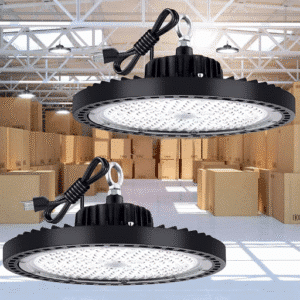
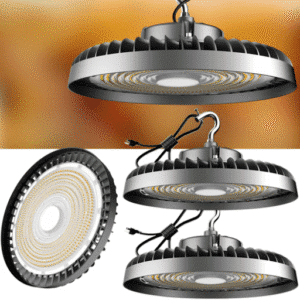
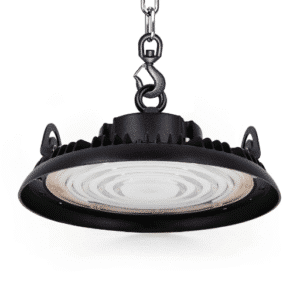
Full replacement removes the old fixture entirely and installs a new LED high bay. This is the right choice when housings are corroded, reflectors are degraded, or you want to reconfigure your lighting layout. It is also the only practical path if you want integrated smart controls like motion sensors, Bluetooth Mesh, or daylight harvesting.
The long-term value is higher. New fixtures come with 5-year warranties, modern optics designed for LED output, and compatibility with controls. If your existing fixtures are more than 10 years old, full replacement is almost always the better investment.
Decision Matrix
| Factor | Retrofit Kit | Full Replacement |
|---|---|---|
| Existing fixture age | Under 10 years | Over 10 years |
| Housing condition | Good, no corrosion | Damaged or corroded |
| Budget | Limited capital available | Capital budget allocated |
| Smart controls desired | No | Yes |
| Warranty priority | Accept shorter coverage | Want 5-year warranty |
| Operating hours per year | Under 3,000 | Over 4,000 |
Sarah is a plant engineer at a food processing facility in California. Her existing fixtures were 8 years old and in decent condition, but the plant needed IP65-rated fixtures for washdown compliance. Retrofit kits would not meet the rating. She specified full replacement with IP65 LED high bays and added motion sensors in the packaging area. The sensors alone cut runtime by 30 percent in a zone that was only occupied 60 percent of the day.
How to Calculate Factory LED Retrofit Costs and Savings

Current State Energy Audit
Start with the basics. Count every fixture. Record the wattage of each, including ballast losses. A “400W” metal halide actually draws 454W. Note the operating hours per year. If your factory runs two shifts, five days per week, that is about 4,160 hours. If you run 24/7, it is 8,760 hours.
Calculate current annual kWh: total fixture count times actual wattage per fixture times operating hours, divided by 1,000. Multiply by your electricity rate to get annual lighting energy cost.
Cost Components
A complete retrofit budget includes four categories:
- Fixtures and materials: 250to250to400 per fixture for quality LED high bays; 80to80to150 per fixture for retrofit kits
- Labor and installation: 50to50to100 per fixture depending on ceiling height and access
- Disposal: 5to5to15 per fixture for metal halide lamp and ballast recycling
- Electrical upgrades: Panel capacity checks, new circuits, or conduit work if needed; budget 500to500to2,000 for typical factory panel verification
Savings Calculation Framework
Energy savings are straightforward. Subtract the new fixture wattage from the old fixture wattage. Multiply by fixture count, operating hours, and electricity rate. For a 100-fixture factory:
- Before: 100 fixtures times 454W times 6,000 hours equals 272,400 kWh per year
- After: 100 fixtures times 150W times 6,000 hours equals 90,000 kWh per year
- Savings: 182,400 kWh per year
- At 0.12perkWh:0.12perkWh:21,888 annual energy savings
Add maintenance savings. If you relamp every three years at 75 per fixture, that is 75 per fixture, that is 2,500 per year in avoided maintenance. Add HVAC savings. The 304W reduction per fixture times 100 fixtures equals 30.4 kW less heat load. In air-conditioned spaces, that reduces cooling costs by 10 to 20 percent of the lighting energy saved.
For guidance on selecting the right wattage for your retrofit, see our high bay light wattage guide.
Step-by-Step Factory LED Retrofit Process
Phase 1: Pre-Retrofit Assessment (Weeks 1 to 2)
The audit phase prevents surprises. Walk every production area with a lux meter and record current light levels at work surfaces. Compare against IES recommended illuminance levels for your task type. General assembly needs 300 to 500 lux. Fine inspection work needs 750 to 1,500 lux.
Check your electrical panel capacity. LED fixtures draw less current, so capacity is rarely a problem. But verify anyway. A 20-amp circuit that served ten 454W metal halide fixtures at 37.8 amps will only need 12.5 amps for ten 150W LED fixtures. You may be able to consolidate circuits.
Coordinate with production. Map your installation zones to areas that can be shut down or bypassed during specific shifts. Weekend and holiday installations are common for 24/7 facilities.
Phase 2: Fixture Selection and Procurement (Weeks 3 to 4)
Match lumen output to current levels or target improvement. Do not undersize. If your 400W metal halide delivers 36,000 lumens, specify an LED fixture that delivers at least that. For help calculating lumen requirements, see our guide on how many lumens for high bay lighting.
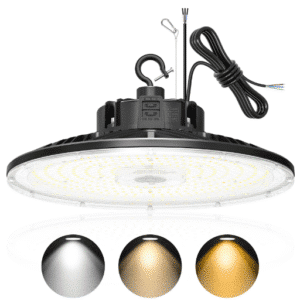
Select color temperature and CRI. Most factories use 4000K to 5000K. Higher CRI (80-plus) improves color recognition for inspection tasks. Verify certifications: UL, DLC Premium listing for rebate eligibility, and IP/IK ratings for your environment.
Phase 3: Installation Planning (Week 5)
Develop a phased schedule. Install by zone, not by circuit. This keeps adjacent production areas fully lit. Plan temporary lighting for zones under construction. Portable LED work lights on tripods are sufficient for most areas.
Establish safety protocols. Lockout/tagout for every circuit. Fall protection for work above 6 feet. Dust containment in food and pharma facilities.
Phase 4: Installation and Commissioning (Weeks 6 to 8)
Install fixtures during planned downtime. Verify every fixture is level, securely mounted, and properly grounded. After installation, measure lux levels at the same points you measured during the audit. Document the before-and-after comparison. Capture photographs for rebate documentation and internal reporting.
Payback Period and ROI: Real Factory Numbers

Typical Payback Scenarios
Payback depends on operating hours and electricity rates. Here are three realistic scenarios for a 100-fixture factory retrofit:
| Scenario | Operating Hours | Electricity Rate | Annual Savings | Payback Period |
|---|---|---|---|---|
| Best case | 8,760 (24/7) | $0.16/kWh | $38,000 | 12 to 18 months |
| Typical | 6,000 (2 shifts) | $0.12/kWh | $24,000 | 18 to 30 months |
| Conservative | 4,000 (1 shift) | $0.08/kWh | $12,000 | 36 to 48 months |
Beyond Energy: Total Cost of Ownership
The 10-year picture is where LED really wins. A metal halide system over 10 years requires three to four relamping cycles, ballast replacements, and escalating energy costs. An LED system requires zero relamping, minimal maintenance, and stable energy consumption.
Consider a 100-fixture factory over 10 years:
- Metal halide total cost: 280,000 in energy plus 280,000 in energy plus 30,000 in maintenance equals $310,000
- LED total cost: 95,000 in energy plus 95,000 in energy plus 5,000 in maintenance equals $100,000
- 10-year savings: $210,000
Productivity gains are harder to quantify but real. Better light quality reduces eye strain and errors. Instant-on eliminates restrike delays. Uniform illumination eliminates dark spots where accidents happen.
David is an operations director at a Texas warehouse. He retrofitted 200 fixtures in 2024, replacing 400W metal halide with 150W LED high bays and adding motion sensors throughout the shipping area. His energy reduction was 68 percent. His maintenance entries for lighting went from 24 per year to zero. The project paid back in 22 months. Two years later, he still opens every operations meeting with the same line: “That lighting project was the best capital decision we made.”
Incentives, Rebates, and Financing for Factory Retrofits
Utility Rebates
Most U.S. utilities offer rebates for LED retrofits. Prescriptive rebates pay a fixed amount per fixture, typically 20to20to60 per LED high bay. Custom rebates pay based on verified energy savings, often 0.08to0.08to0.12 per kWh saved. Custom rebates require pre-approval, metering, and documentation, but they yield larger payments for big projects.
Apply before you purchase. Most utilities require pre-approval to qualify. Submit your audit data, fixture specifications, and projected savings. A lighting contractor experienced with your utility can handle the paperwork.
Tax Incentives
The federal Section 179D Energy Efficient Commercial Building Deduction offers up to 5.00 per square foot for retrofits that achieve 25 to 50 percent energy savings. A 50,000-square-foot factory could qualify for a 5.00 per square foot for retrofit that achieves 25 to 50 percent energy savings. A 50,000-square-foot factory could qualify for a 250,000 deduction. The deduction requires certification by a qualified professional and applies to projects placed in service after 2022.
Many states offer additional incentives. California’s Self-Generation Incentive Program, New York’s Clean Energy Standard, and Texas utility rebates are among the most generous.
Financing Options
If capital is constrained, consider these alternatives:
- Utility on-bill financing: The utility pays upfront; you repay through your monthly bill over 3 to 5 years
- ESCO performance contracts: The ESCO installs the system and is paid from the energy savings over a contract term
- Equipment leasing: Finance the fixtures over 3 to 5 years; lease payments may be tax-deductible
These options let you achieve positive cash flow from month one if the monthly savings exceed the financing payment.
Smart Control Upgrades During Retrofit
The cheapest time to add smart controls is during a retrofit. The wiring is already being modified. The fixtures are new and control-compatible. Adding motion sensors or dimming later means another installation project, more labor, and more production disruption.
Motion sensors are ideal for intermittent-use areas: shipping docks, storage zones, break rooms. They can reduce runtime by 30 to 50 percent in partially occupied spaces.
Daylight harvesting dims fixtures near skylights and windows when natural light is sufficient. It works best in facilities with consistent daylight access.
0-10V dimming lets you adjust output for different tasks or shifts. A 50 percent dim reduction cuts energy by roughly 40 percent.
Bluetooth Mesh enables zone-based control and scheduling from a smartphone or tablet. You can create scenes for different shifts, adjust dimming by area, and monitor energy consumption in real time.
Adding these controls during retrofit costs 40 to 60 percent less than retrofitting them later. If your budget allows, include at least motion sensors in low-occupancy zones.
Common Factory Retrofit Mistakes to Avoid

Undersizing fixtures. A 100W LED is not always the right replacement for a 400W metal halide. Match lumen output, not wattage. A 150W LED at 150 lm/W delivers 22,500 lumens. A 400W metal halide at 79 lm/W delivers 31,600 lumens. If you need equivalent light, you may need a 200W LED.
Ignoring color temperature. 3000K creates a warm, yellow appearance that can reduce alertness. 5000K is crisp and energizing. Most factories prefer 4000K to 5000K for production areas.
Forgetting emergency lighting. Retrofit projects must maintain compliance with OSHA egress lighting requirements. Verify that your emergency lighting plan still covers all exit paths after fixture relocation.
Not verifying electrical panel capacity. LED fixtures draw less power, but verify your panel can handle any new circuits or relocated loads. An electrician should inspect the panel before procurement.
Skipping post-installation verification. Measure lux levels after installation. Document the improvement. This data supports rebate applications and proves project success to management.
For the compliance baseline that underpins any retrofit project, see our guide to OSHA factory lighting requirements.
Frequently Asked Questions
How long does a factory LED retrofit take?
A typical factory retrofit takes 6 to 8 weeks from audit to commissioning. The assessment and procurement phases take 3 to 4 weeks. Installation takes 2 to 4 weeks depending on facility size and whether work is done during production hours or planned shutdowns.
Can we retrofit without shutting down production?
Yes. Phased installation by zone or during off-shifts and weekends eliminates production shutdowns. Temporary lighting maintains safe illumination in areas under construction. Most 24/7 facilities complete retrofits without a single day of lost production.
Will LED fixtures work with our existing mounting hardware?
Often yes, but verify before ordering. Hook-mounted high bays typically use the same hooks. Pendant-mounted fixtures may need new stems if the weight or mounting pattern differs. Always check the new fixture’s mounting specifications against your existing infrastructure.
How do we dispose of old metal halide fixtures?
Metal halide lamps contain mercury and must be recycled through a licensed handler. Ballasts manufactured before 1980 may contain PCBs and require special disposal. Many electrical contractors include disposal in their installation bid. Never throw HID lamps in standard dumpsters.
Do LED retrofits qualify for tax deductions?
Yes. The federal Section 179D deduction offers up to $5.00 per square foot for energy-efficient retrofits. Most LED retrofits easily exceed the 25 percent energy reduction threshold. State and local incentives may provide additional benefits. Consult a tax professional familiar with energy efficiency deductions.
Conclusion
A factory LED lighting retrofit is not a maintenance project. It is a capital investment with predictable, measurable returns. The framework is simple: audit your current state, calculate the savings, choose between retrofit kits and full replacement, install in phases without stopping production, and capture every rebate and tax incentive available.
The numbers are compelling. A typical factory saves 50 to 75 percent on lighting energy. Maintenance costs drop to near zero for the first five years. And payback periods of 18 to 36 months mean the fixtures are paying for themselves while they are still under warranty.
The most common mistake is waiting. Every month you delay is another month of inflated energy bills and unnecessary relamping costs. Run the audit. Get the quote. Present the numbers. The decision practically makes itself.
For the complete strategic framework on factory lighting, from layout design to fixture selection, see our factory lighting solutions guide.
Ready to plan your factory LED retrofit? Probapro engineers can conduct a no-obligation lighting audit, calculate your specific savings, and deliver a phased installation plan that keeps your production running. Request your free retrofit assessment.