
Solar high bay lights win on lifecycle cost for remote facilities and high-sunlight regions with expensive electricity. Grid-powered LED wins for existing buildings in low-sunlight areas with cheap utility rates. Hybrid systems split the difference for 24/7 operations in variable climates. The decision comes down to three variables: your location, your electricity rate, and how long you plan to keep the facility.
A 50,000 sq ft warehouse in Phoenix eliminated its $18,000 annual lighting bill with solar high bays. A similar warehouse in Seattle would have needed 2.3x the solar array for the same result. Location changes everything.
Every buyer considering solar high bays asks the same question: is it worth the upfront premium versus simply upgrading to grid-powered LED? This guide compares real costs over 10 years, factors in regional differences, and shows you exactly when solar wins and when grid is the smarter move. You’ll get per-fixture cost breakdowns, a regional payback matrix, and three real case studies with actual numbers.
Key Takeaways
- Solar high bay systems cost 6-10x more upfront than grid LED (1,700−2,950vs1,700−2,950vs150-400 per fixture), but 10-year TCO is often 60% lower.
- 10-year TCO per fixture equivalent: solar ~3,300,gridLED 3,300,gridLED 8,700, hybrid ~$5,150.
- Payback period ranges from 2.5 years (Southwest) to 7 years (Pacific Northwest) depending on sun hours and utility rates.
- Remote facilities win instantly when trenching costs exceed $50,000 per mile for grid extension.
- Hybrid systems reduce battery bank size by 40-60% while maintaining reliability for 24/7 cold storage and critical facilities.
Upfront Cost Comparison

Solar High Bay System Costs
A solar high bay system includes four components per fixture equivalent: photovoltaic panel, battery bank, charge controller, and the LED fixture itself. Per-fixture equivalent pricing allows direct comparison even though solar components are shared across multiple lights.
Panel costs range from 180to180to350 per fixture equivalent depending on wattage and efficiency. The battery bank adds 400to400to900. The charge controller contributes 80to80to200. The LED fixture itself runs 150to150to350.
Installation runs higher than grid systems because it includes DC wiring, panel mounting, and battery enclosure setup.
Total installed cost per fixture equivalent: 1,700 to 1,700 to 2,950. The wide range reflects regional labor rates, roof access complexity, and whether the system uses ground-mounted or rooftop panels.
Grid-Powered LED Costs
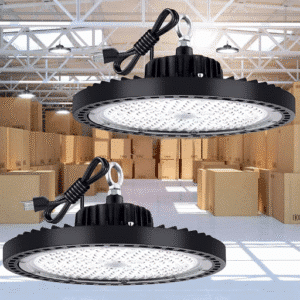
Grid-powered LED high bays require only the fixture and electrical connection. A 150W UFO high bay with 22,500 lumen output costs 120to120to280. Installation assuming grid is already available runs 30to30to120 per fixture depending on ceiling height and existing conduit.
Total installed cost per fixture: 150to150to400. New construction without electrical infrastructure adds 800to800to1,500 per fixture for conduit, wiring, and panel capacity. Existing facilities almost always have spare capacity in the electrical panel.
The Solar Premium
Solar costs 6-10x more upfront per fixture. That gap surprises buyers who compare fixture prices alone. But the comparison is misleading if you stop at installation day. Third-party analysis from Solar Lighting confirms this pattern across outdoor and street lighting applications.
Grid-powered LED commits you to 10-30 years of electricity bills. Solar front-loads the cost but eliminates ongoing electricity expense. The math only works when you model total cost of ownership, not purchase price.
Want to see how grid-powered LED economics work first? Use our factory lighting energy savings guide to establish your current cost baseline before comparing to solar.
Annual Operating Costs
Electricity Costs
Grid-powered LED electricity cost depends on two variables: fixture wattage and your utility rate. A 150W fixture running 12 hours daily consumes 657 kWh annually. At the national average industrial rate of 0.104/kWh,that′s0.104/kWh,that′s68 per fixture per year. But rates vary dramatically.
California industrial rates average 0.218/kWh. Hawaii hits 0.218/kWh. Hawaii hits 0.394/kWh. Texas averages 0.12/kWh. The same fixture costs 0.12/kWh. The same fixture costs 143/year in California and $79/year in Texas.
A 20-fixture warehouse pays 2,860 annually in California versus 2,860 annually in California versus 1,580 in Texas. Regional rate differences drive payback period more than any other factor. For official regional rate data, see the EIA Electric Power Annual.
Solar high bays consume near-zero ongoing electricity. The sun provides the energy. The only electrical cost is occasional battery charging from grid backup in hybrid systems, which typically adds under $5 per fixture annually.
Maintenance Costs
Grid LED maintenance is minimal. LEDs last 50,000-100,000 hours. At 12 hours daily, that’s 15-30 years before failure.
Occasional dusting and driver replacement at year 10-15 are the primary costs. Budget $20-40 per fixture annually.
Solar systems require panel cleaning, battery monitoring, and connection inspection. Panels lose efficiency when dusty. Battery management systems need firmware checks. Budget $30-50 per fixture equivalent annually for maintenance.
The critical difference is battery replacement. LiFePO4 batteries last 4,000-6,000 cycles. At daily cycling, that’s 10-15 years. Budget $600-1,400 per fixture equivalent for mid-life battery replacement. This cost must appear in any honest solar TCO model.
10-Year Total Cost of Ownership

TCO Comparison Table
Per-fixture equivalent costs over 10 years:
| Cost Factor | Solar | Grid LED | Hybrid |
|---|---|---|---|
| Initial equipment | $2,200 | $300 | $1,800 |
| Installation | $300 | $100 | $250 |
| 10-year electricity | $0 | 1,580−1,580−2,860* | 400−400−800 |
| Battery replacement | $600 | $0 | $400 |
| Maintenance (10 yr) | $200 | $400 | $300 |
| 10-Year TCO | $3,300 | 8,380−8,380−9,660 | 5,150−5,150−6,550 |
*Range reflects Texas (0.12/kWh) to California(0.12/kWh) to California (0.218/kWh) rates for a 150W fixture at 12 hrs/day. National average (0.104/kWh) yields 0.104/kWh) yields 8,700 TCO for grid LED.
Solar wins decisively on 10-year TCO despite the upfront premium. The gap narrows in low-rate regions but solar still leads. Hybrid sits between the two, offering lower battery costs with grid backup for cloudy periods.
Regional Payback Matrix
Payback period = solar premium divided by annual savings. Annual savings = grid electricity cost minus solar maintenance cost.
| Region | Peak Sun Hours | Avg Industrial Rate | Annual Savings* | Payback Period |
|---|---|---|---|---|
| Southwest (AZ, NV, NM) | 6.5 hrs | $0.15/kWh | $750 | 2.5-3.5 years |
| Southeast (FL, GA, SC) | 5.0 hrs | $0.12/kWh | $600 | 3.5-5.0 years |
| Midwest (IL, OH, MI) | 4.0 hrs | $0.13/kWh | $650 | 4.5-6.0 years |
| Northeast (NY, MA, PA) | 4.0 hrs | $0.18/kWh | $850 | 3.5-5.0 years |
| Pacific NW (WA, OR) | 3.5 hrs | $0.12/kWh | $580 | 5.5-7.0 years |
*Savings per fixture equivalent vs grid at stated rate, accounting for solar maintenance.
The Southwest wins on both sun hours and reasonable rates. The Pacific Northwest struggles on both metrics. Northeast facilities pay back faster than Midwest despite equal sun hours because electricity rates are 38% higher. Peak sun hour estimates are based on NREL solar resource data.
Carlos is the facilities director at a 50,000 sq ft distribution center in Phoenix. In 2023, he faced a choice: upgrade 20 aging metal halide fixtures to grid LED or go solar. Grid LED quoted at $6,000 installed.
Solar quoted at 57,600. The solar premium was 57,600. The solar premium was 51,600.
Carlos ran the numbers. Arizona’s 0.14/kWh rate and 6.5 peak sun hours mean that a solar fixture equivalent saves 0.14/kWh rate and 6.5 peak sun hours, meaning that a solar fixture equivalent saves 730 annually in electricity. Across 20 fixtures, that’s $14,600 per year.
At 2,500 annual maintenance, net savings hit 2,500 annual maintenance, net savings hit 12,100 yearly. His payback: 3.2 years. Over 10 years, Carlos has saved $69,400 after recovering the premium.
The solar system eliminates his lighting bill entirely.
When Solar Wins
Solar high bays make financial sense in five specific scenarios.
Remote facilities win instantly. Trenching primary power costs 50,000 to 50,000 to 150,000 per mile depending on terrain, permitting, and utility company. A facility two miles from the grid faces 100,000−100,000−300,000 just for electrical infrastructure before buying a single light. Solar eliminates that cost entirely.
New construction without grid access follows the same math. If the building pad has no electrical service, solar avoids the connection fee and infrastructure build-out.
High electricity rate regions accelerate payback. At $0.20+/kWh, annual savings compound faster. California, Hawaii, and parts of the Northeast see payback under 4 years even with moderate sun hours.
High sunlight regions reduce required panel area. The Southwest’s 6.5 peak sun hours means smaller arrays produce the same energy as larger arrays in the Pacific Northwest. Less panel area means lower equipment cost per fixture equivalent.
Sustainability mandates add non-financial value. Companies with net-zero commitments or LEED targets may prioritize solar regardless of pure ROI. The financial case still holds in most regions, but mandates remove the payback debate entirely.
For a deeper look at system sizing for your region, see our complete guide to solar high bay systems.
When Grid-Powered LED Wins
Grid LED remains the smarter choice in five scenarios.
Existing facilities with grid already in place face no infrastructure premium. The electrical panel, conduit, and wiring already exist. You’re buying fixtures only. Solar’s upfront premium has no offsetting trenching savings, so payback stretches to 5-7 years in marginal regions.
Low sunlight plus low rate regions double the penalty. The Pacific Northwest combines 3.5 peak sun hours with $0.10-0.12/kWh rates. Solar arrays must be oversized to compensate for limited sun, but savings are small because electricity is cheap. Payback exceeds 6 years, pushing TCO advantage into question.
Budget-constrained projects simply can’t absorb the solar premium. A 20-fixture warehouse needs 35,000−35,000−60,000 for solar versus 3,000−3,000−8,000 for grid LED. If capital is limited, grid LED delivers 80% of the energy savings at 15% of the upfront cost.
Short facility lease terms under 5 years break the payback math. Solar requires 3-7 years to recover the premium. If you’re leasing the building and uncertain about renewal, grid LED avoids stranded capital.
Temporary installations such as construction lighting, event venues, or seasonal operations don’t run long enough to capture solar’s lifecycle advantage.
Hybrid: The Middle Ground

Hybrid systems combine solar generation with grid backup. They use a smaller solar array and battery bank than pure solar, with the grid covering extended cloudy periods and peak demand.
How Hybrid Works
A hybrid system sizes the solar array for average daily load, not worst-case winter load. The battery bank covers 1-2 days of autonomy instead of 3-5 days for pure solar. When batteries deplete, the grid kicks in automatically.
This reduces battery cost by 40-60% and panel cost by 20-30%. The trade-off is ongoing electricity bills, though they’re 60-80% lower than pure grid.
When Hybrid Makes Sense
24/7 operations can’t risk downtime from multi-day cloudy stretches. Cold storage, data centers, and critical manufacturing need guaranteed lighting regardless of weather.
Cold climates reduce battery capacity. At -10°F, lithium batteries lose 20-30% of rated capacity. A Wisconsin winter with 2.8 peak sun hours and subzero temperatures makes pure solar prohibitively expensive. Hybrid covers the gap.
Facilities with existing grid can add solar incrementally without full infrastructure replacement. Start with 30% solar coverage and expand as budget allows.
Robert is the maintenance manager at a 30,000 sq ft cold storage expansion in Wisconsin. His team evaluated pure solar for the new freezer wing. The numbers were discouraging. Winter brought 2.8 peak sun hours and -10°F operation. A pure solar system needed triple the battery bank to maintain 24/7 lighting through a January cold snap.
Robert recommended a hybrid approach instead. The system uses solar for 70% of annual lighting load with grid backup for winter nights and extended cloudy periods. Battery cost dropped by half.
The facility still cuts annual lighting electricity by $11,400. Payback hit 4.1 years. Pure solar would have needed 8+ years.
Real-World Case Studies
Case 1: Phoenix Distribution Center — Solar Wins
- Facility: 50,000 sq ft distribution center, 20 fixtures.
- Location: Phoenix, Arizona (6.5 peak sun hours).
- System: Pure solar, 150W fixtures, 12-hour daily runtime.
- Installed cost: $57,600.
- Annual electricity savings: $18,000 (previously metal halide).
- Payback period: 3.2 years.
- 10-year net savings: $122,400 after all maintenance and battery replacement.
Carlos, the facilities director, monitored the system for two years. Panel output tracked within 2% of projections. The LiFePO4 battery bank maintained 95% capacity.
His only maintenance: quarterly panel washing during dust season. The system eliminated his lighting bill entirely.
Case 2: Wisconsin Cold Storage — Hybrid Wins
- Facility: 30,000 sq ft cold storage expansion, 12 fixtures.
- Location: Green Bay, Wisconsin (2.8 winter sun hours, -10°F operation).
- System: Hybrid solar-grid, battery covers 36 hours autonomy.
- Installed cost: $38,400.
- Annual electricity reduction: $11,400 (70% solar offset).
- Payback period: 4.1 years.
Robert’s hybrid recommendation proved correct. The grid backup activated 12-15 days each winter when solar couldn’t keep pace. Annual grid consumption for lighting dropped from 16,200 to 16,200 to 4,800. The facility met its sustainability targets without risking cold chain integrity.
Case 3: Remote Nevada Facility — Solar Wins Instantly
- Facility: Remote equipment yard and maintenance shop, 8 fixtures.
- Location: Rural Nevada, 2 miles from nearest grid connection.
- System: Pure solar, ground-mounted array.
- Installed cost: $62,000.
- Grid extension quote: $85,000 for trenching and transformer.
- Immediate savings vs grid: $23,000.
- Payback period: Instant (avoids grid extension).
Mei is the project engineer who scoped the job. Her initial assumption was grid power. The utility’s $85,000 extension quote changed the math completely.
Solar cost $23,000 less upfront and delivered zero ongoing electricity cost. The company didn’t just save money. They avoided a 6-month utility construction delay.
Decision Framework: Which System Is Right for You?

Answer these five questions in order:
- Is grid power already at the building? If no, solar likely wins due to avoided trenching costs.
- What is your blended electricity rate? Above 0.18/kWh favors solar.Below 0.18/kWh favors solar.Below 0.12/kWh favors grid LED.
- How many peak sun hours does your region get? Above 5.5 hours favors solar. Below 4 hours favors grid or hybrid.
- Do you need 24/7 lighting with no downtime risk? If yes, hybrid or grid wins over pure solar.
- How long will you operate this facility? Under 5 years favors grid LED. Over 7 years favors solar.
If questions 1-3 all point to solar but question 4 points to grid, choose hybrid. If question 5 points to grid despite favorable solar conditions, re-evaluate whether you’ll truly exit the facility that soon.
For step-by sizing methodology, see our guide on (how to size a solar high bay lighting system).
Frequently Asked Questions
Is solar worth it for existing warehouses?
Yes, if your electricity rate exceeds $0.15/kWh and you plan to stay for 5+ years. In high-rate regions like California or the Northeast, payback typically falls between 3-5 years. In low-rate regions with grid already in place, grid LED delivers faster short-term value.
What is the average payback period?
Nationwide average is 4-6 years for pure solar versus grid LED in existing facilities. Remote facilities with trenching costs see instant payback. Southwest regions average 2.5-3.5 years. Pacific Northwest averages 5.5-7 years.
Can I start with grid and add solar later?
Yes, but it costs more than installing solar initially. Retrofitting requires additional labor, possible conduit upgrades, and integration work. Our (solar LED high bay retrofit guide) covers the specific steps and costs.
Does solar work in cold climates?
Solar panels actually operate more efficiently in cold temperatures. The challenge is reduced sun hours and battery capacity loss below freezing. Cold climates work for solar if you oversize the array or choose a hybrid system with grid backup.
What happens if the battery fails?
Quality LiFePO4 batteries include battery management systems (BMS) that prevent failure modes. Individual cell failures isolate automatically. In hybrid systems, grid backup maintains lighting during battery maintenance. Pure solar systems should include battery monitoring alerts for early issue detection.
Conclusion
Solar high bay lights vs grid-powered LED is not a one-size-fits-all decision. Solar wins on 10-year lifecycle cost in most scenarios, but the upfront premium matters. The exact payback depends on your location, runtime, and facility type.
For remote facilities, solar wins instantly by avoiding trenching costs. For high-sunlight, high-rate regions, payback arrives in 2.5-4 years. For existing buildings in low-rate regions, grid LED delivers better short-term value. For 24/7 critical operations, hybrid systems offer the reliability of grid with the savings of solar.
The key is running the numbers for your specific facility. Generalizations about “solar being expensive” or “grid being outdated” miss the point. What matters is your electricity rate, your sun hours, and your operational requirements. Get those three variables right, and the decision becomes obvious.
Ready to calculate your exact payback period? Probapro engineers provide customized ROI analysis for solar, grid, and hybrid lighting systems. Request your facility assessment and get a detailed 10-year cost projection tailored to your location and usage.