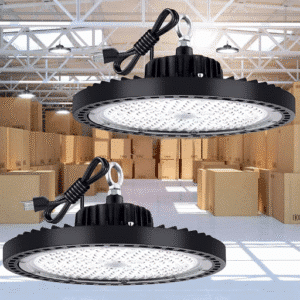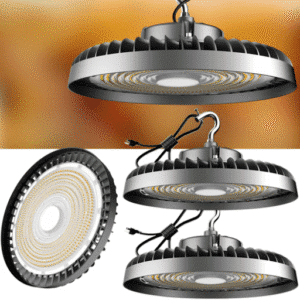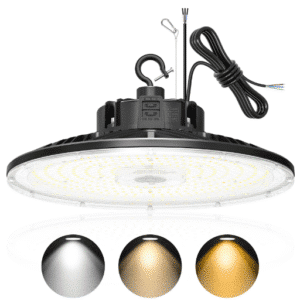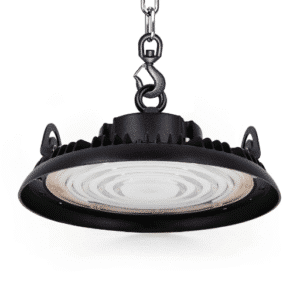

The XD5 high bay light for warehouse ceilings works best in spaces with 15–40 ft mounting heights where you need a round, high-efficacy LED fixture to replace metal halide or fluorescent high bays. Match the XD5 wattage to your ceiling height and task lighting needs, pick the right beam angle for your aisle layout, and add controls to shorten payback.
Mike, a facility manager in Dallas, learned that lesson after installing 100 generic 200W UFO fixtures in a 30 ft ceiling warehouse. The lights were bright, but the 120° beam spilled too much light onto the top of his racks. Picking accuracy stayed flat, and his energy bill dropped less than expected. When his team modeled the same space with XD5 150W fixtures and 90° optics, the project saved another $3,200 per year and put more usable light on the floor.
This guide shows you how to avoid Mike’s mistake. You’ll learn how to choose the right XD5 high bay light for warehouse layouts, calculate how many fixtures you need, decide between UFO and linear high bays, and capture rebates in 2026.
If you’re comparing the best ufo high bay light for warehouse use, the XD5 belongs on your shortlist. It combines high efficacy, DLC Premium rebate eligibility, and controls compatibility in one fixture.
Key Takeaways
- The XD5 high bay light for warehouse ceilings comes in 100W, 150W, 200W, and 240W models to match mounting heights from 15 ft to 40+ ft.
- XD5 150W (~24,000 lm) replaces a 400W metal halide and can save roughly 176perfixtureperyearat176perfixtureperyearat0.13/kWh running 12 hours a day.
- Use 60° optics for tall racks, 90° for general aisles, and 120° for open floors.
- Motion sensors and daylight controls can add 20–40% extra savings and qualify for 10–10–25+ per fixture rebate bonuses.
- A 40,000 sq ft warehouse with a 25 ft ceiling needs about 66 XD5 150W fixtures to deliver 30 foot-candles.
Need help choosing the right fixture first? Read our complete XD5 UFO high bay light guide to compare wattage, voltage, and beam angle options before you lay out your space.
What Is a UFO High Bay Light?

A UFO high bay light is a round, compact LED fixture built for ceilings between 15 and 50 feet. Its integrated driver and LED module sit inside a die-cast aluminum housing that dissipates heat without the bulky reflectors used by older metal halide fixtures. The design pushes light downward in a controlled cone, so it works well for open warehouse floors, bulk storage, and manufacturing areas.
UFO fixtures differ from linear high bays in shape and light pattern. A UFO unit mounts from a single point and produces a circular beam. A linear fixture hangs from two points and casts a rectangular beam, which suits narrow aisles. For many warehouses, the XD5 high bay light for warehouse open areas is the faster-installing, more flexible choice for industrial high bay lighting.
When to Choose an XD5 High Bay Light for Warehouse Work
The XD5 high bay light for warehouse environments works well when you need reliable, high-output lighting without the maintenance burden of HID lamps. You should consider it when:
- Your ceiling height is 15–40+ feet.
- You are replacing 250W–1000W metal halide or fluorescent high bays.
- You want DLC Premium eligibility for utility rebates.
- You need 0–10V dimming or sensor controls.
- You prefer a single-point hook or pendant mount over two-point chain rigs.
- You are evaluating warehouse led lighting solutions that scale from small storage to large distribution centers.
Jennifer manages a distribution center in San Diego with 24 ft ceilings and tall pallet racking. Her existing fluorescent high bays were corroded from coastal humidity, and the housings were failing. She chose full XD5 replacement with 90° optics because the fixtures pointed light between the racks instead of washing the tops. After installation, her picking team reported fewer shadowed aisles and her maintenance budget dropped by half.
XD5 Wattage and Lumens for Warehouse Ceilings
The right XD5 wattage depends on ceiling height and the light level your tasks require. The table below maps each model to common warehouse uses.
| XD5 Model | Approx. Lumens | Best Ceiling Height | Typical Warehouse Use |
|---|---|---|---|
| XD5 100W | ~16,000 lm | 15–20 ft | Small warehouses, low-rack storage |
| XD5 150W | ~22,500–24,000 lm | 20–30 ft | Standard warehouse, manufacturing aisles |
| XD5 200W | ~30,000–32,000 lm | 25–35 ft | Higher foot-candles, wide aisles |
| XD5 240W | ~36,000–38,400 lm | 30–40+ ft | High-rack aisles, high ceilings |
At about 160 lm/W, the XD5 delivers more lumens per watt than many generic UFO fixtures. That matters because a lower-wattage XD5 can replace a higher-wattage competitor. For example, the XD5 150W replaces a 400W metal halide in most 20–30 ft warehouses, while a lower-efficacy 200W UFO might be needed to hit the same level.
UFO vs. Linear High Bay: Which Fits Your Warehouse Layout

The XD5 is a UFO fixture, but not every warehouse job calls for a round beam. The choice between UFO and linear high bays depends on your floor plan.
| Factor | UFO High Bay (XD5) | Linear High Bay |
|---|---|---|
| Best layout | Open floors, bulk storage | Narrow aisles, tall racking |
| Beam pattern | Circular, symmetrical | Rectangular, aisle-focused |
| Mounting | Single hook/pendant | Two-point chain/cable |
| Install time | Faster | Slightly longer |
| Glare control | Good | Often better (UGR 19–25) |
| Dust/moisture | Typically IP65 | Varies, often IP54–IP65 |
A standard 120° UFO can waste 30–40% of its output on top of racks in a narrow aisle. In those cases, linear fixtures with aisle optics put light where pickers and scanners need it. Many large facilities use a hybrid design: UFO fixtures over open staging and bulk storage, linear fixtures over rack aisles. If your operation is mostly open floor with scattered racking, the XD5 high bay light for warehouse use is usually the better starting point.
Read our UFO vs linear high bay guide for a deeper comparison of light patterns and mounting options.
XD5 Beam Angle and Spacing for Warehouse Aisles
Beam angle controls where the lumens land. The XD5 offers 60°, 90°, and 120° optics.
| Beam Angle | Best Ceiling Height | Best Warehouse Layout |
|---|---|---|
| 60° | 30–40+ ft | High-rack aisles, narrow cones |
| 90° | 20–30 ft | Standard aisles, balanced coverage |
| 120° | 15–20 ft | Open floors, wide coverage |
Spacing should follow the mounting-height rule of thumb: keep fixture spacing between 1.0 and 1.5 times the mounting height. At 25 ft, that means 18–22 ft apart. Place the first row half the spacing distance from walls to reduce edge shadows.
For a 40,000 sq ft warehouse with a 25 ft ceiling targeting 30 foot-candles, the math works out to roughly 66 XD5 150W fixtures. A lower-efficacy competitor can require 76–82 fixtures to hit the same target, which adds upfront cost, wiring, and future maintenance.
Controls and Sensors That Boost Warehouse Savings
Controls turn an XD5 high bay light for warehouse spaces into a system that adapts to occupancy and daylight. The XD5 supports several options:
- Microwave motion sensors detect movement through racks and dim to 10–30% after 5–15 minutes of no occupancy.
- 0–10V dimming comes standard and pairs with most warehouse control systems.
- DALI 2.0 is available for facilities that want addressable, networked control.
- Daylight harvesting dims fixtures near skylights or loading doors when natural light is enough.
- Emergency battery backup provides 90 minutes of runtime for 100W, 150W, and 200W models.
Tom, a maintenance supervisor in Ohio, added microwave sensors to XD5 fixtures in his low-traffic storage zones. The sensors cut runtime enough to push total project payback from 22 months to 14 months. His utility also paid a $15 per fixture controls bonus on top of the base DLC Premium rebate.
Motion sensors alone can reduce energy use by up to 50% in areas where forklifts or pickers aren’t present all day. That’s on top of the 50–75% savings you already get from switching from HID to LED.
XD5 High Bay Light for Warehouse: Energy Savings and ROI

Lighting is one of the fastest ways to reduce warehouse operating costs. The XD5 makes the savings large enough to show up on the P&L.
Energy Savings Example: XD5 150W vs. 400W Metal Halide
| Metric | 400W Metal Halide | XD5 150W |
|---|---|---|
| Actual system wattage | ~458W (with ballast) | 150W |
| Annual kWh (12 hrs/day) | ~2,006 | ~657 |
| Annual cost (@ $0.13/kWh) | ~$261 | ~$85 |
| Annual savings per fixture | N/A | ~$176 |
That’s a 67% reduction in energy use for that fixture alone. Across a 100-fixture warehouse, you’re looking at about $17,600 per year in energy savings before rebates.
ROI Formula
Use this simple formula for a single fixture:
Payback (years) = Total installed cost per fixture ÷ Annual savings per fixture
A typical installed cost for an XD5 replacement ranges from 300–300–500 per fixture, including labor. With 176inannualenergysavingsplusa176inannualenergysavingsplusa75 rebate, payback lands around 12–15 months. Without the rebate, it’s closer to 20–28 months. Either way, the project pays for itself well within the fixture’s warranty period.
Installing an XD5 High Bay Light for Warehouse Ceilings
The XD5 high bay light for warehouse ceilings installs faster than most linear fixtures because it hangs from a single point. Common mounting options include:
- Hook mount for pre-installed hooks or chains.
- Pendant mount using 1/2″ NPT pipe or threaded rod.
- U-bracket mount for surface or sloped ceilings.
- Conduit mount for clean, code-compliant wiring runs.
Every suspended fixture needs a safety cable as secondary support. Inspectors will flag missing cables. Lockout/tagout, voltage verification, and proper grounding are mandatory. A qualified electrician should handle line-voltage connections and any new circuits.
For detailed mounting and wiring steps, see our XD5 UFO high bay installation guide.
DLC Rebates and Warranty for an XD5 High Bay Light for Warehouse Projects
The XD5 high bay light for warehouse projects is DLC Premium listed, which unlocks higher utility rebates than DLC Standard products. In 2026, typical DLC Premium rebates run 50–50–150+ per fixture. Controls bonuses add another 10–10–25+ per controlled fixture.
Most rebate programs require pre-approval before purchase or installation. The typical sequence is:
- Submit an application with fixture specs, project scope, and estimated energy savings.
- Receive approval with a reservation letter.
- Purchase and install qualifying fixtures.
- Submit invoices and completion documentation.
- Receive the rebate check.
Skipping step one is the most common rebate mistake. If you’re planning a large XD5 warehouse project, file the paperwork before you buy.
The XD5 also carries a 5-year warranty. That matters in warehouses where lift rentals and downtime make every service call expensive.
For cost context, read our XD5 UFO high bay light price guide.
Common Mistakes When Specifying Warehouse High Bays
Avoid these mistakes and you avoid callbacks:
- Choosing wattage over lumens. A 200W generic fixture at 130 lm/W produces less light than a 150W XD5 at 160 lm/W. Size by delivered lumens, not wattage.
- Wrong beam angle for the ceiling height. A 120° optic on a 40 ft ceiling wastes light on walls. A 60° optic on a 15 ft ceiling creates hot spots.
- Ignoring aisle layout. Narrow racking may need linear fixtures or narrow UFO optics for vertical illuminance.
- Skipping controls evaluation. Motion sensors and dimming can pay for themselves quickly and increase rebate value.
- Missing rebate pre-approval. Most utilities will not honor retroactive applications.
- Overlooking the safety cable. Suspended fixtures need secondary support.
Real-World Warehouse Scenarios

Mike in Dallas: Open Floor with the Wrong Optics
Mike’s 100-fixture warehouse had a 30 ft ceiling and mostly open floor. He installed 120° generic UFOs to maximize coverage. The result was bright walls and dim work areas. After switching to XD5 150W fixtures with 90° optics, horizontal foot-candles on the floor rose by 25% and energy use dropped by another 18%.
Jennifer in San Diego: Corroded Housings and Tall Racking
Jennifer’s distribution center had corroded fluorescent housings and 24 ft ceilings with tall racks. Retrofit kits looked cheaper on paper, but the failing housings made full replacement the safer choice. She chose XD5 150W fixtures with 90° optics. The installation took two weeks, but the facility gained brighter aisles and qualified for a strong DLC Premium rebate.
Tom in Ohio: Rebate-Driven Retrofit with Controls
Tom had tried cheap corn-cob retrofit lamps in a previous job. They failed within 18 months from heat buildup. On his new XD5 project, he added microwave motion sensors and applied for the controls bonus. The project paid back in 14 months, and two years later he had zero failures.
FAQ
What wattage XD5 do I need for my warehouse?
Match wattage to ceiling height and task lighting. For 15–20 ft ceilings, use XD5 100W. For 20–30 ft, use XD5 150W. For 25–35 ft, use XD5 200W. For 30–40+ ft, use XD5 240W.
How many XD5 fixtures for a 40,000 sq ft warehouse?
A 40,000 sq ft warehouse with a 25 ft ceiling targeting 30 foot-candles needs roughly 66 XD5 150W fixtures. Spacing should be about 18–22 ft apart.
Are UFO or linear high bays better for racking?
Linear high bays with aisle optics are usually better for narrow, tall racking because they focus light on the aisle floor and rack faces. UFO fixtures work well in open floors, bulk storage, and mixed layouts.
How much can I save with XD5 motion sensors?
Motion sensors can reduce energy use by up to 50% in low-traffic zones. That is on top of the 50–75% savings from switching from HID to LED. Sensors also qualify for 10–10–25+ per fixture controls bonuses.
What rebates are available for XD5 warehouse projects?
In 2026, typical DLC Premium rebates range from 50–50–150+ per fixture, with controls bonuses adding 10–10–25+. Programs differ by utility, and pre-approval is usually required.
What is the difference between high bay and low bay lighting?
High bay lighting is designed for ceilings 20 ft and above. Low bay lighting is designed for ceilings 12–20 ft and uses wider beam angles to avoid glare.
Conclusion
An XD5 high bay light for warehouse use is a straightforward choice when you match wattage to ceiling height, beam angle to layout, and controls to occupancy patterns. The biggest wins come from sizing by lumens instead of watts, choosing the right optic for your aisles, and applying for rebates before you buy.
The payoff is real: lower energy bills, reduced maintenance, better light quality, and faster payback than most facility upgrades. Get the layout right, and the XD5 does the rest.
Ready to move forward? Use our LED high bay ROI calculator to model your savings, read our best UFO high bay lights for warehouses comparison, or see our XD5 vs other UFO high bay lights breakdown to confirm the specs for your space.