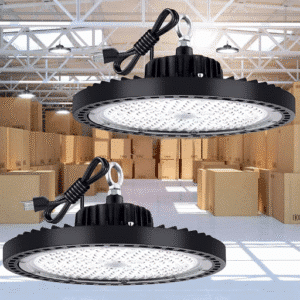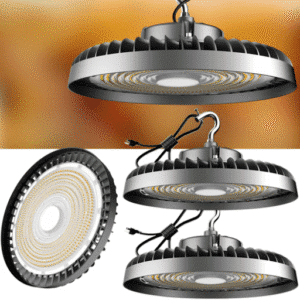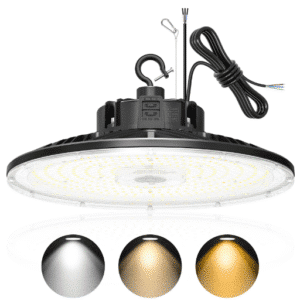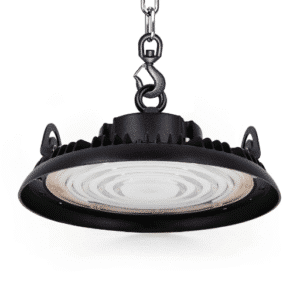

The best 150W UFO high bay for most industrial buyers is the one that balances real lumen output, driver reliability, and total cost of ownership. The XD5 competes well against Philips, Haichang, Hyperlite, Sunco, LEDVANCE, and generic imports, but it isn’t the right choice for every project.
Marcus Chen runs a 200,000-square-foot distribution center in Houston. He replaced 400-watt metal halides last year and now faces the next decision: which LED UFO brand can survive sixteen-hour days, six days a week, in a facility where a dark aisle stops production.
Spec sheets from every manufacturer look identical. Every page claims “high lumens,” “IP65,” and “five-year warranty.” The differences only show up when you dig into driver brands, tested efficacy, and what happens at hour 20,000.
In this guide, you’ll get an honest XD5 vs other UFO high bay lights comparison. We cover Philips GreenPerform, Haichang UA9, Hyperlite, Sunco, Lepro, LEDVANCE, and generic imports, with clear winners and losers, not marketing fluff. By the end, you’ll know which fixture fits your budget, your ceiling height, and your maintenance tolerance.
Key Takeaways
- The XD5 150W delivers 22,500–24,000 lumens at 160 lm/W, with Meanwell or Philips driver options and an IP66 upgrade.
- Haichang UA9 leads on published efficacy (up to 190 lm/W), while Philips leads on brand recognition and smart controls.
- Budget brands like Sunco, Hyperlite, and Lepro win on upfront price but often use unspecified drivers and lower real efficacy.
- Generic imports cost less on day one but usually cost more over five years due to driver failures and energy losses.
- For 24/7 facilities, TCO usually favors XD5 or Haichang; for small shops, budget brands can be adequate.
What Actually Matters When Comparing UFO High Bays

Specs vs. Real-World Performance
Lumens are the starting point, not the finish line. A fixture advertised at 24,000 lumens only matters if it still produces 24,000 lumens after two years of heat cycling and dust accumulation.
Efficacy tells you how efficiently watts turn into lumens. The U.S. Department of Energy LED lighting fact sheet explains why efficacy and lumen maintenance matter more than raw wattage in industrial fixtures. Driver quality tells you whether it’ll keep running in year four. Thermal design and optics tell you whether the light actually reaches the floor or just looks bright from below.
Driver failure is the most common cause of premature LED high bay death in 24/7 facilities. An unbranded driver may cost 8 to manufacture. A Meanwell HLG series driver costs 8 to manufacture.A Meanwell HLG series driver costs $35 to $50. That gap shows up in failure rates, surge tolerance, and lumen maintenance over time.
Certifications matter too. DLC Premium certification unlocks utility rebates. UL/ETL listing confirms electrical safety. LM-79 and LM-80 reports prove the manufacturer tested the fixture instead of copying a spec sheet.
The Six Dimensions That Decide
Here’s the framework used for every comparison in this guide:
- Lumen output and efficacy, how much light, and how efficiently
- Driver brand and reliability, the part most likely to fail
- Build quality and protection ratings, IP, IK, housing material, thermal design
- Warranty and support, what happens when something breaks
- Certifications, DLC, UL/ETL, CE, LM-79/LM-80
- Price-per-lumen and TCO, upfront cost plus ten years of operating cost
For a broader foundation on how to evaluate these fixtures, see our complete UFO high bay light guide.
150W UFO High Bay Spec Comparison
The table below compares the XD5 150W against the most common alternatives. Prices are approximate price bands based on manufacturer and retail listings. Verify them at quote time.
| Brand / Series | Wattage | Lumens | Efficacy | CCT | Driver | IP / IK | Warranty | Price Band |
|---|---|---|---|---|---|---|---|---|
| XD5 150W | 150W | 22,500–24,000 | 160 lm/W | 4000K / 5000K | Meanwell / Philips | IP65 / IP66 / IK08 | 5 years | Mid-range |
| Philips GreenPerform BY698P LED150 | ~98W | 15,000 | ~150 lm/W | 4000K / 6500K | Philips Xitanium | IP65 / IK08 | 5 years | Premium |
| Haichang UA9 | 150W | up to 28,500 | up to 190 lm/W | 3000K–6500K | Meanwell / in-house | IP65 / IK10 | 5 years | Mid-premium |
| Lepro UFO High Bay | 150W | 21,750 | 145 lm/W | 5000K | Unspecified branded | IP65 / IK10 | 5 years | Budget |
| Hyperlite Hero Series | 150W | 21,750 | 145 lm/W | 4000K / 5000K / 6000K | Unspecified | IP65 | 5 years | Budget |
| Sunco Pro UFO | 150W | 21,000 | ~140 lm/W | 5000K | Unspecified | IP65 | 5 years | Low |
| Parmida UFO | 150W | 19,500 | 130 lm/W | 5000K / 6000K | Unspecified | IP65 | 5 years | Budget |
| LEDVANCE SYLVANIA 4A / 5A | 150W | 21,000–22,500 | 140–150 lm/W | 3500K–5000K | LEDVANCE | IP65 / NEMA 4X | 5 years | Premium |
| Generic Import | 150W | 18,000–22,000 claimed | 120–140 lm/W claimed | 5000K / 6500K | Unbranded | IP54–IP65 | 1–2 years | Lowest |
Note: competitor data compiled from manufacturer-published specs and retail listings. XD5 specs should be verified against the latest Probapro datasheet before procurement.
The key takeaway from this table: most brands cluster between 130 and 160 lm/W. Haichang UA9 sits at the top of the published range. XD5 sits in the upper middle with consistent output across all wattages. Budget brands trade efficacy and driver transparency for lower upfront cost.
XD5 vs. Philips GreenPerform

Where Philips Wins
Philips GreenPerform is the safe choice for buyers who need a globally recognized brand. The Philips GreenPerform Highbay G5 family carries stronger distributor networks in Europe, broader smart-control integration, and DALI compatibility out of the box. The published LM-79 and LM-80 reports are easy to find, which matters for specification-grade projects.
Where XD5 Wins
At true 150W, the XD5 150W produces 22,500–24,000 lumens. The Philips GreenPerform BY698P LED150 package produces roughly 15,000 lumens at around 98 watts. That’s a different lumen class.
For facilities that need 150W-class output, XD5 delivers more light per fixture and a lower price-per-lumen. XD5 also offers an IP66 option for wash-down environments. Direct manufacturer availability usually shortens lead times too.
Bottom Line
Choose Philips if your project requires a specified brand, European distributor support, or integrated DALI controls. Choose XD5 if you need more output at a lower cost per lumen and faster delivery.
For the full XD5 product overview, see our complete XD5 UFO high bay light guide.
XD5 vs. Haichang UA9
Where Haichang Wins
The Haichang UA9 advertises up to 190 lm/W efficacy, which can reduce fixture count in large spaces. It also carries IK10 impact resistance, a step above XD5’s IK08, and offers a wider CCT range including 3000K warm white. For buyers who want maximum efficacy and the strongest published impact rating, Haichang has clear advantages.
Where XD5 Wins
XD5 offers a single, consistent 160 lm/W across all wattages. You don’t have to navigate multiple efficacy tiers or guess which configuration you’re actually buying. XD5 also provides an IP66 option and lets buyers specify Meanwell or Philips drivers. Direct manufacturer support and a single warranty path reduce confusion if something fails.
Bottom Line
Haichang UA9 is compelling when maximum efficacy and IK10 are priorities. XD5’s more straightforward for buyers who want one industrial-grade configuration with flexible driver choice and wash-down protection.
XD5 vs. Hyperlite, Sunco, Lepro, and Parmida
The Budget-Tier Reality
These brands sell a lot of fixtures because the upfront price is attractive. The Hyperlite Hero Series delivers 21,750 lumens at 145 lm/W. Sunco Pro UFO offers 21,000 lumens at roughly 140 lm/W.
Lepro matches Hyperlite on output. Parmida trails at 19,500 lumens and 130 lm/W. All are fine for small warehouses, shops, and garages.
The trade-off is usually the driver. Most budget brands don’t specify the driver manufacturer. In continuous industrial use, unspecified drivers fail more often and sooner than branded options. Real efficacy can also fall below published numbers once optics, thermal losses, and voltage variation are accounted for.
Where XD5 Wins
XD5 gives you a named driver, Meanwell or Philips, rated for 50,000+ hours. The IP66 option and die-cast aluminum housing are built for facilities that run long hours, not just occasional use. The five-year warranty is backed by the manufacturer, not a retail return window.
Where Budget Brands Win
Upfront cost is lower. Retail availability is faster, especially through Amazon and big-box stores. For buyers who only need a few fixtures and don’t run them twelve hours a day, the price difference can be worth the reliability trade-off.
Bottom Line
For facilities running 12+ hours daily, XD5’s lower failure rate and higher efficacy usually erase the upfront price gap within the first warranty period. Budget brands fit smaller, lower-use spaces where replacement is easy and downtime is cheap.
XD5 vs. LEDVANCE SYLVANIA

Where LEDVANCE Wins
LEDVANCE’s an established industrial brand with broad distributor access. Selectable wattage and CCT options on some SKUs add flexibility. NSF-certified variants exist for food-processing plants. Some models are rated for up to 100,000 hours, which looks strong on paper for specification projects.
Where XD5 Wins
XD5’s 160 lm/W exceeds the 140–150 lm/W typical of LEDVANCE 150W models. The IP66 option and direct manufacturer pricing give XD5 an edge in standard warehouse and factory applications. For buyers who don’t need NSF certification or selectable wattage, XD5 delivers more light per watt at a lower cost per lumen.
Bottom Line
LEDVANCE’s a strong choice for food-safe or specification-grade projects. XD5 offers better output and value for standard industrial applications.
XD5 vs. Generic Import Fixtures
The Hidden Cost of Cheap Fixtures
Tom in Ohio bought the cheapest 150W UFO fixtures he could find for his 40-fixture workshop. Eighteen months later, twelve of them had failed. Drivers died and lumen output dropped. The warranty was one year and the supplier stopped answering emails.
Generic imports often use unbranded drivers with little surge protection. Claimed lumens rarely match tested output. One independent test found a “200W” generic UFO that drew 178 watts and produced only 19,400 lumens, an actual efficacy of 109 lm/W, not the advertised 160 lm/W.
Why XD5 Costs Less Over Time
XD5 uses Meanwell or Philips drivers, die-cast aluminum housings, and integrated heat dissipation. The five-year warranty is backed by Probapro. DLC Premium certification unlocks utility rebates that generic fixtures often can’t qualify for.
Bottom Line
Generic imports are cheaper on day one. XD5’s cheaper over the first five years.
Real-World TCO: 100-Fixture Warehouse
Let’s put the comparison into dollars. Assume 100 fixtures, 12 hours per day, $0.13 per kWh based on recent U.S. Energy Information Administration commercial rates, and a 10-year horizon.
| Cost Factor | XD5 150W | Generic 150W |
|---|---|---|
| Fixture cost (100 units) | ~$8,500 | ~$6,000 |
| Annual energy cost | ~$5,700 | ~$7,000 |
| 10-year energy cost | ~$57,000 | ~$70,000 |
| Estimated driver replacements | ~$0 under warranty | ~8,000–8,000–12,000 |
| 10-year TCO | ~$65,500 | ~84,000–84,000–88,000 |
The generic fixture saves 2,500 up front. It costs 2,500 up front. It costs $18,500 to $22,500 more over ten years in energy and replacements. That’s the decision most buyers miss when they shop by sticker price.
Fixture Count Comparison: 40,000 sq ft Warehouse
Higher efficacy means fewer fixtures. Here’s how many 150W-class units you’d need for a 40,000-square-foot warehouse with a 25-foot ceiling and a 30 foot-candle target.
| Fixture | Lumens @ 150W | Estimated Fixture Count |
|---|---|---|
| Haichang UA9 | 28,500 | ~56 |
| XD5 150W | 24,000 | ~66 |
| Hyperlite / Sunco | 21,000–21,750 | ~76 |
| Parmida | 19,500 | ~82 |
| Generic 150W | 19,500 claimed | ~82 |
Fewer fixtures mean less installation labor, less mounting hardware, and fewer maintenance points over time. For help calculating your own layout, see our guide on how many lumens you need for high bay lighting.
Which Fixture Should You Choose?

Choose XD5 If…
- You need 150W-class output with industrial-grade reliability.
- You want branded driver options and a five-year manufacturer warranty.
- Your facility runs long hours and rebates matter.
- You may need IP66 or wash-down protection.
Choose Haichang UA9 If…
- Maximum efficacy and lowest fixture count are top priorities.
- You need IK10 impact resistance.
- You want the widest CCT flexibility.
Choose Philips GreenPerform If…
- Brand specification and European distributor support are required.
- You need integrated smart controls or DALI out of the box.
Choose Sunco, Hyperlite, or Lepro If…
- Upfront cost is the primary constraint.
- The installation is small and fixtures aren’t mission-critical.
- You can accept higher long-term maintenance risk.
Choose LEDVANCE If…
- You need NSF certification for food processing.
- You want selectable wattage or CCT in one SKU.
- You’re buying through a specification channel.
Frequently Asked Questions
Is XD5 better than Philips GreenPerform?
It depends on the project. XD5 delivers more lumens at true 150W and costs less per lumen. Philips wins on brand recognition, European distribution, and smart-control integration.
For raw output and ROI, XD5’s usually better. For specification-grade projects requiring a named global brand, Philips may be required.
How does XD5 compare to Haichang UA9?
Haichang UA9 advertises higher efficacy, up to 190 lm/W, and IK10 impact resistance. XD5 offers consistent 160 lm/W, an IP66 option, and Meanwell or Philips driver choice. Haichang’s ideal for maximum efficiency and impact protection. XD5’s simpler to specify and support.
Are Sunco UFO high bays as good as XD5?
Sunco fixtures are adequate for smaller, lower-use spaces. They cost less upfront but typically use unspecified drivers and lower efficacy than XD5. For 24/7 industrial use, XD5’s branded drivers and manufacturer-backed warranty usually deliver lower total cost of ownership.
Why are generic UFO high bays so much cheaper?
They use unbranded drivers, lower-grade housings, and thinner quality control. Claimed specs often don’t match tested performance. The real cost shows up in early driver failures, higher energy use, and warranties that are hard to enforce.
Which 150W UFO high bay has the best warranty?
Most major brands now offer five-year warranties, including XD5, Haichang, Lepro, Hyperlite, Sunco, and LEDVANCE. The difference is who backs it. A manufacturer-backed warranty from XD5 or a major brand is more reliable than a one- or two-year warranty from a generic import seller.
Is XD5 worth the extra cost over Hyperlite?
For facilities that run 12+ hours daily, yes. The branded driver option, IP66 availability, and higher efficacy usually offset the upfront difference through lower energy and maintenance costs. For a small shop with occasional use, Hyperlite can be a reasonable budget choice.
Can XD5 replace 400W metal halide better than competitors?
A 150W XD5 producing 22,500–24,000 lumens can replace a 400W metal halide in most 20–30 foot applications. Competitors in the same lumen class can do the same. Where XD5 typically wins is in driver reliability, warranty support, and rebate eligibility through DLC Premium certification.
Which UFO high bay is best for a 24/7 warehouse?
For continuous operation, prioritize branded drivers, high efficacy, and a manufacturer-backed five-year warranty. XD5 and Haichang UA9 are both strong choices. Budget brands and generic imports carry higher long-term failure risk.
Conclusion
The XD5 vs other UFO high bay lights debate isn’t about finding one winner. It’s about matching the fixture to the project.
XD5 competes best on price-per-lumen, driver choice, IP66 availability, and manufacturer-backed warranty. Haichang UA9 leads on published efficacy and impact resistance. Philips GreenPerform leads on brand recognition and smart controls.
Sunco, Hyperlite, and Lepro win on upfront price. LEDVANCE wins for food-safe and specification projects. Generic imports win only on the sticker price, and usually lose on everything else.
For most 24/7 industrial facilities, the decision comes down to XD5 or Haichang for reliability and TCO, with budget brands reserved for smaller or lower-use spaces. The right choice is the one that keeps your aisles lit, your maintenance budget intact, and your payback period short.
Ready to compare XD5 against the alternatives for your specific facility? Use our LED high bay ROI calculator to run the numbers, or contact Probapro for a project-specific quote and layout recommendation.