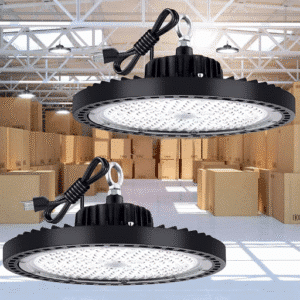

The Ohio warehouse with 100 fixtures operated its 400-watt metal halide lights for twelve hours each day. Their annual lighting bill: 21,024. The facility now pays 21,024 after switching to 150-watt UFOLED high bays. The facility now pays 9,072 per year after switching to 150-watt UFOLED high bays. The upgrade paid for itself in fourteen months.
This situation does not represent an uncommon occurrence. It happens to be the standard.
UFO high bay lights are the standard for industrial facilities with ceilings between 15 and 50 feet. Their compact, circular design delivers powerful, uniform illumination while cutting energy consumption by 50% to 70%. The appropriate UFO high bay system directly influences safety and productivity and financial performance for any distribution center or manufacturing floor or cold-storage facility.
The guide will provide you with information about UFO high bay lights which includes their definition and their comparison with other industrial lighting solutions and their appropriate wattage and beam angle selection based on ceiling height and their investment return calculation method.
What Is a UFO High Bay Light?

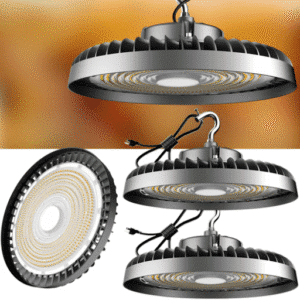
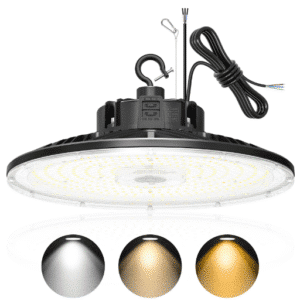
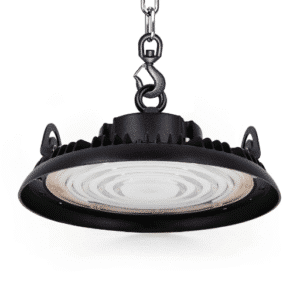
A UFO high bay light is a round disc-shaped LED fixture which designers created for installation in spaces with high ceilings. The name comes from its compact circular form. The sealed housing contains all components including LED chips and driver and heat-dissipation system which function as one complete unit.
This design matters for three reasons.
First, light distribution is highly efficient. UFO LEDs project light which companies require instead of older metal halide fixtures that send light in all directions and need reflectors to direct light downward. The system generates usable light which projects onto the ground while decreasing light that goes unused.
Second, installation is straightforward. The weight range for most UFO high bays falls between 8 and 15 pounds which allows users to install them through standard hook and chain or pendant rod methods. The system needs no special bracket systems or advanced reflector systems.
Third, thermal management is built in. High-quality units use die-cast aluminum fins or honeycomb heat sinks to keep LED temperatures low. The system operates at lower temperatures which results in longer lifespan and consistent performance throughout its operational life.
UFO high bay lights are typically used in warehouses factories gymnasiums logistics centers and retail spaces which have ceilings that range from 15 feet to 50 feet or more.
UFO High Bay vs. Other Industrial Lighting
UFO fixtures are necessary for certain high-ceiling environments but not all of them. The comparison of UFO high bays with linear and modular and traditional systems will enable you to select the most suitable system for your requirements.
UFO vs. Linear High Bay
Linear high bay lights are rectangular fixtures designed to distribute light across wide areas. They operate effectively in spaces that require precise illumination throughout their entire length.
UFO high bays direct their brightness through a downward light beam which spreads out in a circular pattern. This design suits open office spaces and gym facilities and large storage spaces which need bright lighting throughout their entire area.
Facilities with straight pathways that connect to storage areas should use linear fixtures because they deliver better light distribution. UFO lights provide superior efficiency for most situations except for the specific case of linear fixtures.
UFO vs. Modular High Bay
Modular high bays use a central hub with two to seven swappable LED modules. The system permits module replacement without the need to dismantle the complete lighting apparatus. The design of modular systems enables easy maintenance work in difficult-to-access areas.
UFO units contain smaller dimensions and lighter weight than modular fixtures which makes them more efficient. Premium UFO high bays reach 180 to 190 lumens per watt, while modular systems usually fall in the 130 to 150 lm/W range.
Modular high bays are essential for food-processing plants and chemical facilities and wash-down environments which require IP68-rated connectors and field serviceability. UFO high bays serve best in warehouses and factories and gyms which require straightforward operation and peak operational performance.
UFO LED vs. Metal Halide and Fluorescent
The traditional 400-watt metal halide fixtures actually consume 458 watts because ballast losses need to be considered. The modern UFO LED high bay which operates between 150 watts and 200 watts produces equivalent or superior usable light while using 55 percent to 67 percentless power.
The benefits from this solution extend beyond savings on electrical expenses.
The time required for metal halide lamps to achieve full brightness ranges between 10 and 20 minutes. The system starts with a 100% output which decreases to 80% after six months and reaches 50% by its halfway point. They produce high levels of thermal energy which increases the demand on HVAC systems within temperature-controlled environments.
UFO LED high bays turn on instantly. The system keeps 90% of its light output during 50,000 hours or longer. The minimal forward heat emission from LEDs allows them to operate without increasing the cooling system demands.
The actual usable light efficiency gap between LED technologies and existing systems extends beyond the wattage discrepancy. Metal halide fixtures lose a large percentage of their output to reflector absorption and upward spill. The UFO LED system provides 90% or more of its lumens as usable downlight.
For a complete comparison of LED and metal halide performance, read our (guide to LED vs metal halide savings).
How to Choose the Right UFO High Bay Light

Selecting a fixture requires more than matching wattage to ceiling height. The following criteria establish which industrial-grade lights provide reliable performance while all other options fail within two years.
Certifications and Rebates
The certification DLC Premium or DLC Standard is the required standard which users must find. This certification serves as the primary access point for North American utility rebate programs. The project costs will result in lost savings between 10% and 50% when the project lacks this certification.
The product requires both UL and ETL certification to confirm its electrical safety. The product requires CE and RoHS compliance as minimum standards to enter European markets.
IP and IK Ratings
The industrial UFO high bay needs to meet IP65 as its minimum protection requirement. The testing proves the fixture can block dust while it protects against water jet infiltration. For extreme conditions which include wash-down areas and outdoor canopies you should seek fixtures which meet IP66 standards.
A minimum of IK08 rating provides protection against impacts. The requirement becomes significant when the facility experiences forklift movement and crane operation and sports activities that can damage fixtures through equipment impact or ball strikes.
Beam Angle
UFO high bays typically offer three beam angles:
- 60° for ceilings 30 feet and higher. The narrow focus projects light farther without losing intensity.
- 90° for general industrial use with ceilings from 20 to 30 feet.
- 120° for lower ceilings or wide-area coverage where intensity can be slightly lower.
Facility managers commonly commit errors through their selection of inappropriate beam angles. The 120° light fixture installed at 35 feet will create uneven light distribution which produces bright spots beneath and shadowed areas at the edges.
Color Temperature
Most industrial UFO high bays are available in 4000K (neutral white) or 5000K (cool white).
The preferred lighting choice for detailed assembly work and retail environments and color-critical spaces is 4000K. The light maintains a comfortable warm appearance which reduces eye strain during extended work periods.
The standard lighting choice in warehouses and logistics centers and gymnasiums is 5000K. The cooler tone enhances alertness and provides crisp contrast for safety and navigation.
Driver Quality and Warranty
The LED driver serves as the most unreliable component in the majority of lighting fixtures. The drivers from Meanwell and Philips deliver superior performance because they maintain consistent output while protecting against power surges and enabling power-factor correction.
The minimum warranty duration for premium UFO high bays stands at five years. Products that provide only one or two years of warranty coverage should be approached with caution. The product reduction in warranty duration indicates that the manufacturer used substandard materials and implemented insufficient thermal management systems.
Need more guidance on selecting the perfect fixture? Check out our (complete UFO high bay light choices guide) for detailed specifications and applications.
Wattage, Lumens, and Beam Angle by Ceiling Height

The most common question facility managers ask is simple: what wattage do I need? The answer depends on ceiling height, desired light levels, and beam angle.
Here is the practical reference used by industrial lighting engineers in 2026.
| Ceiling Height | Recommended Wattage | Typical Lumen Output | Best Beam Angle | Common Applications |
|---|---|---|---|---|
| 15–20 ft | 100W–150W | 15,000–22,500 lm | 90°–120° | Workshops, retail, small warehouses |
| 20–25 ft | 150W–200W | 22,500–30,000 lm | 90° | General warehouses, gymnasiums |
| 25–35 ft | 200W–240W | 30,000–38,000 lm | 60°–90° | Distribution centers, factories |
| 35+ ft | 240W–300W+ | 36,000+ lm | 60° | Airports, exhibition halls, bulk storage |
These guidelines function as general principles which organizations should treat as non-binding standards. A 20,000-square-foot warehouse with its white floor and wall surfaces achieves sufficient brightness through lower lumen requirements than a dark-floored machine shop which shares its same dimensions.
Most general warehouse operations require lighting systems which produce between 30 and 50 foot-candles of illumination. Assembly and inspection areas require 50 to 75 foot-candles of illumination. Bulk storage areas can maintain efficient operations between 20 to 30 foot-candles of lighting.
For a deeper dive on matching wattage to ceiling height, see our (high bay light wattage guide).
Warehouse and Facility Lighting Layout Basics
Even the best fixture will underperform if it is poorly spaced. Layout design is where engineering meets real-world results. For high bay lighting for warehouse environments, proper spacing ensures safety, productivity, and energy efficiency.
Spacing Rules
A reliable rule of thumb for UFO high bays is:
Fixture spacing = 1.0 to 1.5 × mounting height
For example, if your fixtures hang at 25 feet, space them 25 to 37.5 feet apart on center. At 20 feet, space them 20 to 30 feet apart.
Closer spacing improves uniformity. Wider spacing reduces fixture count and upfront cost but may create dark spots and uneven illumination.
Looking to design your warehouse lighting layout? Check out our (warehouse lighting layout guide).
Uniformity Ratio
The work plane’s light levels are assessed through measurement which calculates the ratio between its highest and lowest light levels. A good industrial lighting design targets a max/min ratio of 3:1 or better. Poor designs which reach 10:1 or higher create eye fatigue and safety problems.
A Real Layout Example
The existing metal halide fixtures at a 40,000-square-foot distribution center in Texas had a fixture spacing of 45 feet and a mounting height of 22 feet when Jennifer Chen took over facilities. The result produced bright pools of light which extended directly under each fixture while dim aisleways existed between.
According to her system replacement she installed 150-watt UFO LEDs which she arranged at 28-foot spacing through a grid configuration. Light levels improved from an average of 18 foot-candles to 42 foot-candles. The uniformity level increased from 8:1 to 2.5:1. The upgrade led to a 6% increase in picking accuracy while forklift operators experienced fewer near-misses during the first quarter.
If you have not calculated total lumens yet, start with our guide on (how many lumens you need for high bay lighting) .
Energy Savings and Return on Investment
Lighting typically accounts for 15% to 40% of a facility’s total electricity use. Upgrading to UFO LED high bays is one of the fastest ways to reduce that load.
Per-Fixture kWh Savings
A traditional 400-watt metal halide fixture actually draws about 458 watts once you include ballast losses. A 200-watt UFO LED high bay producing equivalent or better usable light cuts that by 56%.
If you choose a 150-watt UFO LED instead, the savings jump to 67%.
Here is how that translates to annual consumption at different operating schedules.
| Operating Hours | 400W MH (kWh/yr) | 200W LED (kWh/yr) | Annual Savings | % Reduction |
|---|---|---|---|---|
| 12 hrs/day | 2,007 | 876 | 1,131 kWh | 56% |
| 18 hrs/day | 3,011 | 1,314 | 1,697 kWh | 56% |
| 24/7 operation | 4,012 | 1,752 | 2,260 kWh | 56% |
At an average commercial electricity rate of 0.12 per kWh∗∗, a single fixture operating 12 hours per day saves 0.12 per kWh∗∗, a single fixture operating 12 hours per day saves∗∗136 per year. A 100-fixture facility saves $13,600 annually on energy alone.
Run your own numbers with our (complete LED high bay ROI calculator guide) to see exact payback for your facility.
Maintenance Savings
Metal halide lamps last for approximately 15,000 to 20,000 hours. The lamps require replacement after two years because the facility operates continuously throughout the day and night. The annual maintenance costs for each fixture escalate to 50through50through100 when you include expenses for lift rentals and labor and disposal.
UFO LED high bays have a lifespan that ranges from 50,000 to 100,000 hours. The 24/7 facility can operate without maintenance for a period that ranges from six to twelve years.
Real-World ROI
Energy Solutions conducted a warehouse retrofit assessment in 2026 which showed that a cold-storage facility with 312 fixtures replaced its 400-watt metal halides with 180-watt UFO LEDs. The results:
- The annual energy reduction amounts to 552,960 kWh
- The cost savings total 66,355 dollars every year
- The payback period lasts 1.8 years
Most warehouse retrofits achieve complete payback within 1.5 to 3 years even in the absence of rebates. The payback period can decrease to less than 18 months when utility incentives are applied.
Smart Features and Controls for UFO High Bay Lights

The next generation of UFO high bays operates with two main objectives that include providing efficient lighting solutions and developing intelligent systems.
Motion Sensors
Microwave motion sensors detect movement through fixtures and obstacles, making them ideal for warehouses with tall racking. The lights decrease to 10% to 30% brightness when an aisle remains unoccupied for a preset time of 5 to 15 minutes.
Dimming Protocols
Most industrial UFO LEDs support one or more dimming methods:
- 0-10V dimming. This standard represents the most widely used dimming method which delivers dependable performance and works with most building control systems.
- DALI 2.0. This digital protocol enables users to control individual fixtures through scene programming while connecting to building management systems.
- PWM dimming. This dimming method serves specialized applications which need non-flickering light control at precise levels.
Daylight sensors measure ambient natural light and automatically reduce artificial output when the sun is contributing enough illumination. The facility reduces its energy consumption through daylight control systems which operate when natural light enters its spaces through skylights and large windows during midday hours.
Bluetooth Mesh and IoT Integration
Leading manufacturers now offer UFO high bays with built-in Bluetooth Mesh or Zigbee connectivity. The system provides users with wireless control over grouping and scheduling features while enabling them to monitor energy consumption and connect their equipment to factory automation systems.
ZC Lighting reported in Q1 2025 that their smart UFO high bays achieved 71% energy savings through integrated radar and daylight sensors when compared to standard metal halide systems used in warehouse applications.
For more on smart lighting systems and sensor integration, see our (guide on smart warehouse lighting strategies).
Best Applications and Use Cases for Industrial High Bay Lighting
UFO high bay lights offer multiple uses although they perform best in designated work spaces. The most effective results of industrial high bay lighting systems occur in this particular location.
Warehouses and Distribution Centers
UFO high bay lights work best in open spaces that have two-story heights. The light system directs its output straight down which eliminates all shadowing effects from high storage systems while delivering uniform light patterns throughout extensive corridor space. The high bay lighting system used in warehouse operations results in fewer errors during picking activities and increases safety for forklift movements.
Manufacturing and Assembly
High lumen output together with flicker-free operation enables workers to see everything clearly when they perform detailed tasks. High CRI options (80 to 90+) enable precise color recognition which is essential for quality control processes and electronics assembly work.
Gymnasiums and Sports Complexes
UFO fixtures with IK10 impact resistance together with 90° to 120° beam angles deliver continuous bright lighting which athletes and spectators require. The system provides immediate light activation without any required warm-up period for all events.
Need help sizing gym high bay lighting for your specific facility? Start with our (gym high bay lighting guide).
Cold Storage and Food Processing
Standard UFO high bays operate from -20°C to 40°C. The premium units constructed with aviation-grade aluminum housings establish an operational range that extends from -40°C to 65°C which enables usage in freezer systems and refrigerated warehouse environments.
Check wash-down areas to ensure they meet IP66 standards or higher. In authentic food-processing environments that require daily hose-downs, a modular IP68 system should be considered as the more secure permanent solution.
Want to know about (cold storage lighting requirements)? Click to view our related guidelines.
Retail and Big-Box Stores
UFO fixtures have a modern, clean design which matches the current aesthetic of contemporary retail spaces. The lights provide high CRI together with multiple color temperature options which enhance the visual appearance of products.
Installation and Maintenance Best Practices for UFO High Bay Lights

The correct process of installation work leads to three outcomes which are safety and performance and equipment longevity.
Mounting Options
UFO high bays typically ship with one or more mounting methods:
- Hook mount: The fixture suspends from a ceiling hook or eye bolt through a short chain which serves as the basic installation method.
- Pendant rod: The pendant rod system uses a metal rod which maintains a fixed drop height that functions best in environments which experience high air movement and equipment vibration.
- U-bracket: The U-bracket base system enables users to mount devices either on surfaces or walls when they cannot use ceiling suspension.
- Conduit: The system requires direct electrical installation through a threaded conduit entry which provides an installation method that meets both clean and code-compliant requirements.
Retrofit Considerations
When you replace metal halide or fluorescent fixtures. The process requires you to either skip the existing ballast or take it out. UFO LEDs require direct line voltage. The fixture will sustain damage while creating a fire hazard through this action.
People who lack experience in electrical work should hire an electrician who holds a valid license for their work. The minor expense becomes worthwhile because improper wiring creates serious hazards.
Our (high bay lighting installation guide) walks through mounting methods, electrical requirements, and safety protocols
Maintenance Schedule
The primary benefit of LED systems exists because their maintenance requirements remain minimal. The equipment needs a basic maintenance schedule which will improve both its performance and operational duration.
- Quarterly: The inspection requires the inspector to check for dust accumulation and visible damage. The cleaning process requires us to maintain the lenses which operate in environments that experience high dust levels.
- Annually: The technician needs to inspect both the mounting hardware and electrical connections. The technician will proceed to tighten all components which show signs of being loose.
- As needed: Replace only if output drops significantly or if the driver fails. The majority of quality units will operate for more than 50,000 hours without requiring any maintenance tasks.
Need help sourcing quality UFO high bay lights for your warehouse? Review our complete (best UFO high bay lights guide).
Frequently Asked Questions
What is a UFO high bay light?
A UFO high bay light is a round, disc-shaped LED fixture which functions in spaces with ceiling heights from 15 to 50 feet. The compact design of the product contains all components including LED chips and driver and heat sink inside a single sealed unit which enables efficient light distribution and simple installation.
How many lumens does a warehouse need?
Most need lumens 10,000-30,000 per fixture based on ceiling height and layout. Aim for 50 foot candles per warehouse job and 75 foot candles per assembly zone.
What are high bay and low bay lightings?
The distance between low bay and high bay lighting is height declaration. High bay lighting is designed for ceilings 20 plus feet but low bay, typically for heights less than 20 feet. High bays utilize focused beam angles for up-and-away projection of light, whereas low bays take advantage of more diverse angles for wider, closer coverage.
Are LED high bay lights worth it?
LED high bay lights can save 50% to 70% energy when compared with metal halide systems. Meanwhile, high bay UFO LEDs have a lifespan of over 50,000 hours, requiring minimal maintenance while instantaneously turning on. In 1.5 to 3 years, most facilities receive payback.
What is the life of highbay LED lights?
The highbay UFO LED good light will have a life of 50,000 hrs to 100,000hrs. This will be 11 years to 22 years of life as it functions for 12 hrs daily.
What wattage UFO highbay light is required for a 25-foot high ceiling?
Select a highbay UFO LED from 150W to 200W light for a 25-foot ceiling in most instances. These units are bound to consist of 22,500 lumens, another claiming 30,000 lumens, 90-degree beam angle for one side illumination spread, and a full drop.
Can I add motion sensors to UFO high bay lights?
Yes. Most modern UFO high bays support external microwave or PIR motion sensors. Many smart models contain built-in sensors together with dimming controls which enable automatic energy conservation.
What does IP65 mean for high bay lights?
IP65 indicates that the fixture provides complete dust protection while it safeguards against water jets which can reach any direction. It represents the basic standard which industrial UFO high bays must meet as their minimum requirement.
Conclusion
High bay UFOs seem to be expected as an item replacing more outdated metal halide systems. They are modifying this investment to reduce power expenditures throughout the years, creating a safer environment while minimizing future maintenance demands.
The key to setting up a positive UFO high bay project is in properly aligning your concerns with those of the high bay. One must take into account the ceiling height, desired light level output, and the beam’s angle; after that you need to consider whether any control system may be applied to further reduce your energy costs. Finally, one may calculate ROI based on the number of hours the entity operates and the facility’s localized energy rate.
When trying to modernize high bay and low bay lighting at your location, you will need a more transparent site layout and accurate number of units needed. Savings initiate operations from the moment you walk in and switch on while considering these matters.