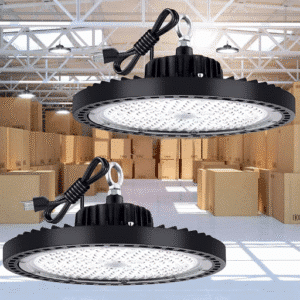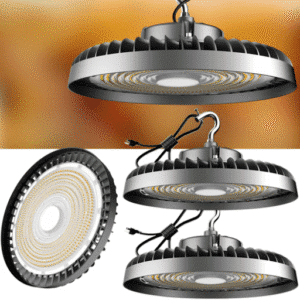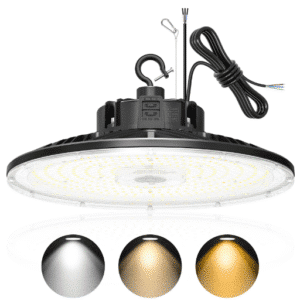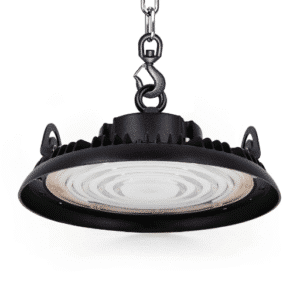

When the customer asked for the brightest option available in Ohio, Tom, a contractor, installed 240W UFO high bays in his 15-foot workshop. Three days later, the customer called back, unable to bear the glare and with workers nursing headaches, demanding that the fixtures be taken down. And Tom replaced the 240-watt forms with 100-watt fixtures from the same provider. The very different outcome in the same customer and the same amount of space.
Acts like this happen in the case of nearly the majority of conventional industrial lighting. Buyers maintain when purchasing; wattage is all of the things, with which specs refer to brightness. In fact, the wattage of a high-bay light tells the consumer how much electricity those fixtures consume. The wattage says nothing about how many lumens are produced, how those lumens are thrown around inside the fixtures, or whether the lumens in the end actually land on the workplane at the desired intensity.
You have to use a formula right from the beginning to choose high bay light wattage. Based on ceiling height, task requirements, and fixture efficacy, what will be the right wattage to go for high bay lights to see? Whether looking to calculate warehouse high bay wattage for a brand new build or retrofitting an existing facility, the same principles apply. This guide provides you with the formula, a good-sized wattage selection table, and worked warehouse example to be used in your own project. For a comprehensive look at fixture kinds, beam angles, and certifications, here is our full guide on how to choose UFO high bay lights.
What Is High Bay Light Wattage?

High bay light wattage, i.e., the power that a high bay consumes in watts, should not be mixed up with brightness. Brightness is measured by lumens. The comparison between the two is made by the luminous efficacy of the different fixtures (how efficiently a fixture produces each lumen per watt); therefore, a fixture delivering more lumen per watt is more efficient than one delivering fewer lumens per watt. As a consequence, if investing in high bay lights, the wattage is not the best reference point to consider.
Need fixtures with selectable wattage? Our UFO high bay lights let you adjust output at installation so you don’t have to guess.
Why Wattage Alone Is the Wrong Starting Point
A watt does not always imply brilliancy for the bulb. It is power consumption. In using the same fixture with the same wattage, the driver will achieve a light level that could be hugely contrasting.
Lumens First, Watts Second
A fixture’s luminous efficacy tells you how efficiently it converts electricity into light. Efficacy is measured in lumens per watt (lm/W). In the 2026 framework, results differ greatly:
- Budget fixtures: 130 lm/W
- Standard fixtures: 150 lm/W
- Premium fixtures: 170+ lm/W
Setting a fixture with 200 W at 130 lm/W brings to output 26,000 lumens. Using a 150 W fixture at 170 lm/W brings to output 25,500 lumens. The lesser-energy-consuming 150-W fixture would emit nearly the same light. You are not judging right if you buy on wattage alone. In our opinion, lumens should drive the choice. You can see how on the Internet: EcoLED Mart’s guide on selecting the right wattage for warehouses.
If you have not calculated total lumens yet, start with our guide on (how many lumens you need for high bay lighting) .
The 2026 Efficacy Baseline
The minimum effective efficacy for 2026 for new industrial installations is 150 lm/W-if you go below this, the energy saved costs empty. The defeated in the sense that it may not be qualified for rebates from utilities. DLC Premium luminaries are those that have been designed to attain very stringent efficacy thresholds and in most cases they give rebates between 20% and 50% larger than those for DLC Standard fixtures.
As a general rule, when selecting high bay fixture wattages, always check the manufacturer’s published lumen output and efficacy rating first. Wattage should be one of the last pieces of information considered.
Warehouse High Bay Wattage by Ceiling Height
Ceiling height is the single most vital factor in the selection of warehouse-luminary wattages. In taller spaces, more lumens are needed to maintain light intensity on the floor as lumens are the only thing of importance in the inverse-square law; for every doubling of the distance, lumens quadruple.
The Height-Wattage Relationship
This segment offers the approximation method employed by the majority of industrial luminary designers. These ranges assume standard warehouse tasks and fixtures rated near 150 lumen per watt:
| Ceiling Height | Recommended Wattage | Typical Lumens | Best Beam Angle | Metal Halide Equivalent |
|---|---|---|---|---|
| 12–15 ft | 100–150W | 15,000–22,500 lm | 90°–120° | 250W–400W |
| 15–20 ft | 150–200W | 22,500–30,000 lm | 90° | 400W–600W |
| 20–25 ft | 200–240W | 30,000–36,000 lm | 60°–90° | 600W–750W |
| 25–30 ft | 240–300W | 36,000–45,000 lm | 60°–90° | 750W–1000W |
| 30–40 ft | 300W+ | 45,000+ lm | 60° | 1000W+ |
Use this LED High Bay Wattage Chart as a baseline for establishing lumens-per-watt based on calculations and customize it to all requirements, including industrial luminaire lighting controls. For ceilings of 20′ to 25′, the most recommended option for our warehouse lights is the 200W UFO High Bay in the normal classification. Brand-wise, the UFO High Bay Watt Chart from Hyperlite can give you more info on lumens-per-watt, instead of usands of once-popular equivalents.
Planning a warehouse retrofit? Our high bay LED lights are engineered for 150+ lm/W efficacy across every wattage tier.
Foot-Candle Targets: The Missing Variable

As in ceiling height, foot-candles are also used to specify task requirements. Task tells you how many foot-candles you should light the floor with. This is where industrial lighting designers divide the efficacy given in fc according to their task with the right foot-candle amount, and their decision tells different options of low or high wattages which should be mounted in that situation.
Task Determines Brightness, Not Ceiling Height
- General storage / bulk warehouse: 10–20 fc
- Picking, packing, sorting: 20–30 fc
- Manufacturing / assembly: 30–50 fc
- Precision inspection / quality control: 50–100+ fc
A 25-foot warehouse used for basic storage might need only 15 fc. The same height used for picking operations might need 30 fc. That difference doubles your lumen requirement, which pushes you up one wattage tier or tightens your fixture spacing.
Why the Same Ceiling Height Needs Different Wattage
Maria operates a 50,000 square-foot distribution center with 25-foot ceilings. Her bulk storage area requires about 15 footcandles, so 200-watt fixtures installed 25 feet apart worked just fine. Her packing stations needed 30 fc so labeling would be legible.
With the 200W aid already installed, Maria could either increase their intensity to 240W or bring the fixtures closer to 20 feet. She chose the latter. She ended up using four extra fixtures than originally accounted for to keep wattage and the electricity bill at a minimum.
At the core of this, the brightest readers are obtained through watts, spacing, or a combination of these two. The smart designer likes to optimize this rather than just one variable.
High Bay Wattage Calculator: The Complete Formula
Think of this section as your high bay wattage calculator. You don’t need to be a lighting engineer to calculate wattage. You need four numbers and one formula.
Step 1, Measure and Target
Gather these inputs for your high bay wattage calculator:
- Ceiling height (floor to fixture, in feet)
- Floor area (length × width, in square feet)
- Target foot-candles (from the task table above)
- Fixture efficacy (from the manufacturer spec sheet, in lm/W)
Step 2, Calculate Total Lumens Needed
Use this high bay wattage calculator formula:
Total Lumens = (Target fc × Floor Area) ÷ (Utilization Factor × Maintenance Factor)
Where:
- Utilization Factor: 0.65 for standard warehouses with medium wall/ceiling reflectance; 0.55 for darker or older facilities
- Maintenance Factor: 0.8 to account for dust accumulation and LED lumen depreciation over time
Step 3, Convert Lumens to Wattage
Total Wattage = Total Lumens ÷ Fixture Efficacy (lm/W)
Step 4, Convert to Fixture Count
Number of Fixtures = Total Wattage ÷ Wattage per Fixture
Round up. Dark spots are a safety liability; extra fixtures are cheap insurance.
If you are unsure which wattage and lumen package fits your ceiling height and task requirements, read our (guide on how to choose UFO high bay lights) before finalizing your specification.
Worked Example: How Many Watts for High Bay Light in a 100 × 100 ft Warehouse?
Let us walk through a real scenario.
A facility manager needs to light a 100-foot by 100-foot warehouse. The ceiling is 25 feet high. The space is used for picking and packing, so the target is 30 fc. The chosen fixture is rated at 150 lm/W.
Step 1, Inputs:
- Floor area: 100 × 100 = 10,000 sq ft
- Target: 30 fc
- Utilization Factor: 0.65
- Maintenance Factor: 0.8
Step 2, Total Lumens:
- Total Lumens = (30 × 10,000) ÷ (0.65 × 0.8)
- Total Lumens = 300,000 ÷ 0.52
- Total Lumens = 576,923
Step 3, Total Wattage:
- Total Wattage = 576,923 ÷ 150
- Total Wattage = 3,846W
Step 4, Fixture Count:
- Using 200W fixtures: 3,846 ÷ 200 = 19.2 → 20 fixtures
- Using 240W fixtures: 3,846 ÷ 240 = 16.0 → 16 fixtures
The spacing of luminaires at a mounting height of 25 feet should be between 1.0 to 1.2 times the mounting height (25 to 30 feet) – hence, 20 pieces will do for 100 feet by 100 feet at a 4 x 5 grid on 25-foot centers. Viable.
To provide more light output, the 200W UHB option requires many fixtures to be used; however, on the other hand, its lower unit cost and energy consumption make it an economically sensible choice. The 150W UFO bay is for spaces on a budget, but with its superior performance it might fall under the above option. The 240W will require fewer fixtures, of higher wattage each; this second approach is as well a candidate for consideration. But in the end, it could be good to involve some new linear LED lights in the mix, but really, finding which lights will provide the best balance at the best price may only happen in hindsight.
Looking to design your warehouse lighting layout? Check out our (warehouse lighting layout guide).
Efficacy Matters: How Fixture Quality Changes Wattage

The same warehouse needs the same total lumens. The wattage required to deliver those lumens changes dramatically based on fixture quality.
Budget Fixtures (130 lm/W)
A 130 lm/W fixture needs more watts to reach the same lumen target. For the 100 × 100 ft example above:
- Total Wattage = 576,923 ÷ 130 = 4,438W
- Using 200W fixtures: 4,438 ÷ 200 = 23 fixtures
That is three more fixtures than the 150 lm/W option, plus higher energy bills for the life of the installation.
Standard Fixtures (150 lm/W)
This is the 2026 baseline. It balances upfront cost with operating efficiency.
- Total Wattage = 576,923 ÷ 150 = 3,846W
- Using 200W fixtures: 3,846 ÷ 200 = 20 fixtures
Premium Fixtures (170+ lm/W)
High-efficacy fixtures reduce UFO high bay wattage and fixture count.
- Total Wattage = 576,923 ÷ 170 = 3,394W
- Using 200W fixtures: 3,394 ÷ 200 = 17 fixtures
At 0.12 perkWh and 4,000 operating hours per year, the difference between 130lm/W and 170lm/Wisapproximately∗∗0.12 perkWhand 4,000 operating hours per year, the difference between 130 lm/Wand 170 lm/W is approximately∗∗520 per year** in energy cost alone for this single warehouse. Over a 10-year lifespan, premium efficacy saves over $5,000.
Why Higher Efficacy = Lower Wattage = Lower Bills
A bulb left on hourly adds a portion of electricity consumed to your unpaid bill. High-efficacy light objects deliver the same light but utilize a lower number of watts. This is why a lumen per watt is even more truly relevant when choosing the wattage of hall lighting. Have a look at our entire collection of high bay LED lights of over 150 lm/W.
Beam Angle and Spacing: Wattage’s Silent Partners
A high-wattage fixture placed poorly still underperforms. Beam angle and spacing control how lumens reach the floor. For a deeper technical overview of fixture types and optics, see 1000Bulbs’ complete guide to high bay fixtures.
Tight Beams on High Ceilings (60°)
At 30–40+ feet, light has a long way to travel. A 60° beam concentrates lumens into a tight cone, maintaining intensity where it is needed. Wider angles at this height disperse light too thinly.
Mid Beams for General Use (90°)
For 20–30 foot ceilings, the 90° beam is the most versatile. It delivers wide enough coverage to reduce fixture count while keeping light levels uniform across open floors and racking aisles.
Wide Beams for Low Ceilings (120°)
At 12–20 feet, a 120° beam spreads light across a broad area. This is ideal for open staging, gymnasiums, and low-bay manufacturing where you want fewer fixtures and softer edges.
Spacing-to-Height Ratio
They should have an optimal 1.0-1.5 time spacing relative to the mounting height:
- 20 ft ceiling → 20–30 ft spacing
- 25 ft ceiling → 25–38 ft spacing
- 30 ft ceiling → 30–45 ft spacing
Shorter spacing (1.0-1.2×) is an excellent choice for luminosity lux level needs and aisle racking, whereas wider spacing (up to 1.5×) caters to the open storage and lower targetenity ones.
The number one range of fixtures should be approximately half the distance off the walls to prevent perimeter darkness.
Want to know about (cold storage lighting requirements)? Click to view our related guidelines.
Energy Codes and Wattage Limits
Your wattage choice is not just a lighting decision. It is a compliance decision.
ASHRAE 90.1 Power Density Limits
ASHRAE 90.1 and the International Energy Conservation Code (IECC) limit warehouse lighting power density to roughly 0.41–0.50 watts per square foot. For a 10,000 sq ft warehouse, that means your total installed lighting wattage should not exceed 4,100–5,000W.
In our worked example:
- 20 fixtures at 200W = 4,000W total → 0.40 W/ft² (compliant)
- 16 fixtures at 240W = 3,840W total → 0.38 W/ft² (compliant)
- 23 fixtures at 200W (130 lm/W) = 4,600W total → 0.46 W/ft² (near the limit)
Choosing high-efficacy fixtures gives you headroom under the code. It also leaves capacity for future expansion without re-engineering the lighting system.
Utility Rebates Linked to Wattage and DLC Tier
Many utility rebate programs are based on MEP reductions below the baseline. The facility replacing 400W metal halide fixtures with 150W LED fixtures will receive more in rebates than the facility that replaces them with 200W LED fixtures. The higher the retrofit requires a higher-yielding DLC Premium fixture, the higher the rebate.
In another example, the facilities director for a Pennsylvania company retrofitted 400W metal halide fixtures with 150W high-bay LED fixtures. When his new fixtures achieved 165 lm/W, they helped James earn a utility rebate of $40 per fixture. His rebate check, for a total of $3,200, covered 30% of his material costs and shortened his investment payback period to 14 months from 2.1 years.
Common Mistakes When Selecting High Bay Wattage

Go without such mistakes will save you dollars and time, not to mention frustrations.
- Shopping by wattage while neglecting lumens
The low-priced 200W fixture may produce lesser lumens compared to a premium 150W fixture. Always compare lumen output, and efficacy.
2. Ignoring foot-candle requirements
A warehouse floor needs a lower brightness than one in the manufacturing area. To apply the wrong wattage on both would end up wasting one with energy and dangerously underlighting the other.
3. Use of wrong beam angles for the height of the mounting
A 120o beam at 35 feet spreads light very thin that the floor will look dim, no matter how many watts the fixture is drawing. Tight beams for when the ceiling is very high.
4. Over-lighting low ceilings
In every case, more lumens are not the better choice. On a 15-foot ceiling, sources of 240W will create a lot of glare and shadow. Definitive Height/Wattage Chart
5. Ignoring the layout calculation
Ordering fixtures before the layout estimation is only a small step less catastrophic than ordering lumber before measuring the room. Do the math or hire a lighting designer.
LED High Bay Wattage Chart: Quick Reference
| Ceiling Height | General Storage (10–20 fc) | Picking/Packing (20–30 fc) | Manufacturing (30–50 fc) |
|---|---|---|---|
| 12–15 ft | 100W | 100–150W | 150W |
| 15–20 ft | 100–150W | 150–200W | 200W |
| 20–25 ft | 150–200W | 200–240W | 240W |
| 25–30 ft | 200–240W | 240–300W | 300W+ |
| 30–40 ft | 240–300W | 300W+ | 300W+ |
These are starting points. Adjust for fixture efficacy, racking density, and local energy codes.
Conclusion
Selecting the best high bay light wattage stands at three steps: calculate lumens first, match wattage to efficacy second, and verify spacing and beam angle third. Ceiling height gets you in the right range. Foot-candle targets get you to the right number. Fixture quality determines whether you pay for that light efficiently or waste money for years.
The hard-learned lesson has since stayed him, from that time in the Ohio workshop. His customer who wanted “the brightest option” really meant to have the only-right one: 100-watt fixtures at 120° for the low-ceiling hall of widest coverage. Tom now operates when given any job.
Frequently Asked Questions
How Many Watts Do I Need for My High Bay Lighting for Varying Ceiling Height?
For ceilings between fifteen and twenty feet high, 100W to 200W will be more than enough. Between 20 and 25 ft, 200–240W work great. For 25 to 30 ft, 240-300W is the choice.
For 30–40 ft, 300 watts plus. Always verify lumens and efficacy (lm/W) with your supplier.
How Many Watts Differ Between UFO150 High Bay Wattage and Linear High Bay Wattages?
The wattage range between the two styles is pretty similar, while the main difference lies between their beam distribution.
UFO fixtures light from below in a cone angle, while linear fixtures illuminate horizontally in a rectangular manner. This kind of light helps in racking arrangements and huge empty spaces. Go for the form factor and then match wattage with your ceiling height and job requirement.
Can I use a high bay wattage calculator for gymnasiums?
Yes. Gymnasiums typically have 15–25 foot ceilings and need 50–75 foot-candles.
Use the same formula: (Target fc × Floor Area) ÷ (Utilization Factor × Maintenance Factor), then divide by fixture efficacy. Most gyms use 100–200W fixtures with 90°–120° beam angles.
For standard warehouse ceilings between 20 and 25 feet, a 150W UFO high bay light is the proven starting point. For taller facilities up to 30 feet, step up to the 200W UFO high bay for the lumen output and throw distance you need.
Can I use a high bay wattage calculator for gymnasiums?
Yes. Gymnasiums usually have ceilings with heights ranging from 15 to 25 ft and require a 50 to 75 foot-candle level.
Use the same formula: Fc × Floor Area) ÷ (Utilization Factor + Maintenance factor)) ÷ Efficacy .
Most gymnasiums are equipping 100-200W fixtures with 90°–120° beam angles.
Usually, a 150W UFO high bay light should do the trick for warehouse ceilings between 20 to 25 feet. For taller facilities up to 30 feet, make the leap to the 200W UFO high bay for the lumens you need to light up this place.