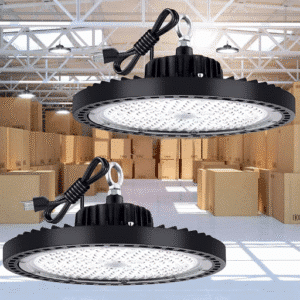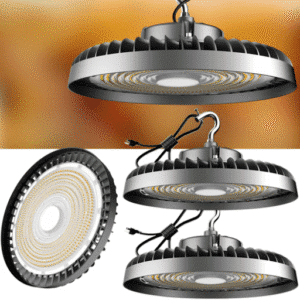

High bay lighting consists of a very powerful source of illumination that is designed for ceilings 20 feet and more in height. These fixtures come with one or another power of 15,000 Lumen to 50,000+ lumen by using specially-designed optics. Such kind of optics give light that spreads only downwards. This ensures that the illumination can get to the wall a further distance away without losing all its intensity.
When headquarters traded in 500 80W SHOP equipment and daylight lamps for his new 28-foot ceiling structure, the resident warehouse chief thought that brightness was brightness. Six months later, safety inspectors panned the packing floor, casting over 3 foot candles, one-tenth of the light recommended by the IES for operating warehouse tasks.
It won’t come off as anything shocking if one says lighting tall interiors is camping an office altogether. If you follow our guiding principle, it will teach you lighting for the interiors and give you the definition of what it is and the focus specifications, as well as incorporate sites on calculation methodology so you can select confidently without the feeling of confusion; to include the rule of 20 feet, we talk of the UFO type versus a linear one, calculations on lumens; the IES-like foot-candles, beam angle selection, controls, methodologies for mounting, and a plan for LED retrofitting.
Key Takeaways
- High bay lighting serves ceilings 20 feet and above with focused, high-intensity output
- UFO and linear are the two main LED fixture types, each suited to different layouts
- IES recommends 15 to 50 foot-candles for most industrial tasks depending on activity
- LED high bays deliver 50 to 75% energy savings versus Metal Halide with 50,000+ hour lifespans
- Fixture selection depends on ceiling height, task type, racking, and environmental conditions
What Is High Bay Lighting? (The Definition)

The 20-Foot Rule
High bay lighting by its simplest definition refers to fixtures designed for ceilings 20 feet and above. For a concise definition of high bay lighting to include in a specification document, light engineered for ceilings 20 feet and above, typified by 15,000 to 50,000 lumens or more delivered by directional optics. Practically, 15 feet has been in use as the lower height threshold according to some engineers and assigned through the Illuminating Engineering Society; however, 20 feet is the consensus figure adopted by manufacturers, engineers, contractors, and facility managers.
For less than 20 feet, low bay lighting provides better visual comfort and more homogeneous illumination. Standard canopy fittings or other light fixtures cannot deliver a useful amount of light at an acceptable quality level. Doubling the mounting height causes the squared decrease in the illuminating intensity while energy consumption remains stagnant or increases due to related adjustments such as the electrical hardware, for instance.
Why Standard Fixtures Fail at Height
A standard 2×2 recessed light with a raised lens designed for a 10-foot office ceiling effectively provides good desk light evenly spread across its surface. However, mounted at 30 feet above floor level, light intensity at the floor level drops to practically one-ninth of the original power. It’s just too diffuse.
At the high bay end, the luminaire is solved by three entries of engineering:
- Higher lumen output: 15,000 to 50,000+ lumens versus 3,000 to 5,000 for standard fixtures
- Focused optics: Narrower beam angles (60 to 120 degrees) that concentrate light rather than diffuse it
- Robust thermal management: Heat sinks and die-cast aluminum housings that maintain LED performance at high wattages
Key Performance Characteristics
| Characteristic | Typical Range |
|---|---|
| Ceiling Height | 20 to 45+ feet |
| Wattage | 100W to 400W+ |
| Lumen Output | 15,000 to 50,000+ lm |
| Beam Angle | 60°, 90°, 120° |
| Lifespan (LED) | 50,000 to 100,000 hours |
| Efficacy | 150 to 175+ lm/W |
| Color Temperature | 4000K to 5000K |
| CRI | 80 to 90+ |
For a deeper comparison of high bay versus other fixture categories, see our complete guide to (high bay vs low bay lighting).
Types of High Bay Lighting Fixtures
UFO High Bay Lights
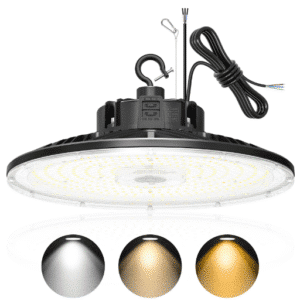
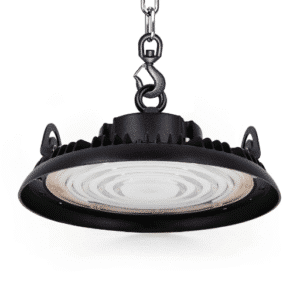
A single UFO high bay fixture is a similarly compact and circular apparatus that diffuses and projects light downwards towards the floor in a cone shape. These high bay lights concentrate lumen output in a tiny housing. A round yet high-lighting-optimized fixture that confines the lumen output in a tiny housing suitable for spaces that exhibit almost no tall shelving.
UFO fixtures are often hung from a hook or pendant drop. Their small size lessens wind load and hastens installation. Ceiling height is a crucial factor in applications involved with the development of UFO high bays in open warehouses, sports facilities, and factories. Our 150W UFO high bay light translates into 22500 lumens at 150 lm/W, good for lighting 20 to 25-foot ceilings, while the 200W UFO high bay lights accomodate instalation on 25 to 35-foot ceilings with an output of 30 000+ lumens.
Linear High Bays
Linear high bays are rectangular fixtures that distribute light across a wider footprint. They are like traditional fluorescent strips, but they use LED arrays and modern optics.
Linear fixtures are suitable for aisle configurations, production lines, and anywhere that uniform coverage is more important than straightforward intensity. They use a long, wide rectangular beam pattern that can effect long runs with fewer fixtures than UFO fixtures would in racking situations.
Traditional HID (Metal Halide / HPS)
Metal Halide and High-Pressure Sodium were the fixture standards for decades. They offer excellent lumen output while also having long warm-up times, frequent relamping, and are highly energy-dependent. There is bad color rendering, too.
Most HID operating facilities are currently retrofitting to LED. This is because energy savings alone are usually enough to justify the project, and the removal of all relamping schedules makes a significant decrease in maintenance workload.
Specification Comparison Table
| Specification | UFO LED | Linear LED | Metal Halide |
|---|---|---|---|
| Wattage | 100W to 400W | 100W to 300W | 250W to 1000W |
| Lumens | 15,000 to 50,000+ | 12,000 to 40,000 | 20,000 to 110,000 |
| Lifespan | 50,000 to 100,000 hrs | 50,000 to 100,000 hrs | 10,000 to 20,000 hrs |
| Warm-Up | Instant | Instant | 5 to 15 minutes |
| Efficacy | 150 to 175+ lm/W | 140 to 160+ lm/W | 80 to 100 lm/W |
| Best For | Open floors, gyms | Aisles, racking | Legacy retrofits only |
Ready to upgrade from Metal Halide? Browse our full range of high bay LED lights with DLC-listed fixtures eligible for utility rebates up to $50 per unit.
Our guide to (UFO vs linear high bay) lighting breaks down the exact spacing and photometric differences.
How High Bay Lighting Works

The Inverse Square Law (Plain English)
As the light travels away from the source, light intensity depletes. So now the intensities produced by a fixture 30 feet away from the source are one-fourth those of the source 15 feet away. They decrease to one-ninth at a distance of 40 feet.
High bay fixtures light up things by firing lumen bolts from the sky and reliving anguish. At the same distance in question, a 200W LED high bay lamp can be used to provide 30 to 40 foot-candles to the floor, because the lumens are the energy we wish to concentrate through the optic plastic rather than disperse in directions unknown.
Reflectors, Lenses, and Beam Angles
Beam angle determines how wide or narrow the light spreads. Taller ceilings need narrower angles to maintain intensity at the floor.
| Beam Angle | Best Ceiling Height | Coverage Diameter at Floor |
|---|---|---|
| 60° | 30 to 45+ feet | ~32 ft at 30 ft height |
| 90° | 20 to 35 feet | ~54 ft at 25 ft height |
| 120° | 20 to 25 feet | ~87 ft at 25 ft height |
Aluminum reflectors direct light straight down. Prismatic lenses diffuse light outward. For racked aisles, narrow optics shoot light down the aisle faces. For open floors, wider optics create broader, more uniform coverage. The right beam angle depends on your ceiling height and lumen requirements; see our guide on how many lumens for high bay lighting for the complete selection framework.
Color Temperature and CRI for Industrial Tasks
Color temperature, a characteristic measured in Kelvin, has a bearing on the nature and functionality of space. In terms of industrial spaces, industry standards range from 4000K to 5000K. This cool white hue in this range generally improves visibility, lessens eye fatigue, and permits an environment conducive to being awake.
The Color Rendering Index (CRI) explains how truly the information and coloration appear when illuminated. Warehouses or intrinsically high lighting installation and factories would require a typical CRI of 80+ to practically conduct its tasks. CRI over 90 solves specification problems in coloring inspections, wire locations, or operations for quality control.
High Bay Lighting Specifications Explained
Wattage and Lumen Output by Ceiling Height
The right high bay light wattage depends on how far the light must travel. Use this table as a starting point. If you need to dig deeper into how ceiling structure affects fixture placement, our guide on (ceiling height for high bay lighting) covers the full framework.
| Ceiling Height | LED Wattage | Typical Lumens | Beam Angle |
|---|---|---|---|
| 20 to 25 feet | 100W to 150W | 15,000 to 22,500 | 90° to 120° |
| 25 to 35 feet | 150W to 200W | 22,500 to 32,000 | 60° to 90° |
| 35 to 45+ feet | 200W to 400W+ | 32,000 to 50,000+ | 60° |
For precise wattage selection for your facility, our high bay light wattage guide provides a decision framework by application type.
Efficacy: Lumens Per Watt
Efficiency in lighting is rated through its ability to utilize electricity to provide luminous flux. Modern high bay LED lighting is rated between 150 to 175+ lumens/watt (lm/W). With premium models exceeding 180 lm/W.
Luminous efficacy directly correlates with lower operation costs. 150W light fixture with 150 lm/W will deliver the same amount of light as 22,500 lm when compared to electricity used by a 150W fixture at 170 lm/W while giving 2,500 lumens more. Hyper what potential does less work higher? The state is better for saving 10,000 Hrs with 180 dollars worth of cash using energy worth 0.12 kWh.
IP and IK Ratings for Harsh Environments
IP ratings measure protection against dust and moisture. IK ratings measure impact resistance.
| Rating | Protection Level | Typical Use |
|---|---|---|
| IP54 | Dust protected, water splashing | General warehouse |
| IP65 | Dust tight, water jets | Food processing, wash-down areas |
| IP66 | Dust tight, powerful water jets | Heavy wash-down, outdoor |
| IK08 | 5 joule impact resistance | Forklift zones, manufacturing |
For facilities with dust, moisture, or impact risk, specify IP65 and IK08 minimums. The small cost increase eliminates premature failures.
Operating Temperature Ranges
Standard LED drivers operate from -20°C to +50°C. Industrial-grade fixtures extend this to -40°C to +50°C. Cold storage facilities need the wider range. High-heat environments like foundries or engine bays need fixtures with robust thermal management.
DLC Listing and Rebate Eligibility
The DesignLights Consortium (DLC) maintains a qualified products list for utility rebate programs. DLC-listed fixtures often qualify for rebates of 10 to 10 to 50 per fixture, depending on wattage and utility territory. Always verify DLC status before purchasing if rebates are part of your project financing.
How Many Lumens Do You Need for High Bay Lighting?

IES RP-7 Foot-Candle Targets by Application
The Illuminating Engineering Society publishes RP-7, the standard reference for industrial lighting design. These are the targets professionals use.
| Application | IES Recommended Foot-Candles |
|---|---|
| Inactive storage | 5 to 10 fc |
| Active bulk storage | 15 to 20 fc |
| Shipping and receiving | 20 to 30 fc |
| Rough assembly | 30 to 50 fc |
| Medium assembly | 50 to 100 fc |
| Fine inspection | 100 to 200 fc |
| Gymnasium (recreational) | 30 to 50 fc |
| Gymnasium (competition) | 50 to 100 fc |
OSHA standard 1926.56 sets legal minimums, but most facilities design to IES levels for safety and productivity.
The Six-Step Calculation
- Determine the task and select your target foot-candles from the IES table
- Measure the floor area in square feet
- Estimate the coefficient of utilization (0.5 to 0.7 for typical industrial spaces)
- Calculate total lumens needed: Area x Target FC / Coefficient of Utilization
- Select your fixture and note its lumen output
- Divide total lumens by fixture lumens to get fixture count, then round up
Worked Example: 15,000 Sq Ft Warehouse at 25 Feet
A 15,000 square foot warehouse with a 25-foot ceiling needs active bulk storage lighting at 20 foot-candles.
Step 1: Target = 20 fc
Step 2: Area = 15,000 sq ft
Step 3: Coefficient of utilization = 0.6 (typical for light-colored walls and floors)
Step 4: Total lumens = 15,000 x 20 / 0.6 = 500,000 lumens
Step 5: Select 150W UFO fixtures at 22,500 high bay light lumens each
Step 6: Fixture count = 500,000 / 22,500 = 22.2. Round up to 24 for a clean grid layout.
At 25 feet, spacing should be roughly 25 to 35 feet apart. A 15,000 sq ft building (100 ft x 150 ft) fits a 4×6 grid of 24 fixtures at 25-foot spacing comfortably.
A facilities manager in Texas assumed all UFO fixtures were the same. He bought budget 100W units for a 35-foot ceiling only to discover they delivered 90 lm/W instead of the 150+ he needed. The replacement cost matched the original installation. Efficacy matters.
Applications: Where High Bay Lighting Excels
Warehouses and Distribution Centers
Warehouses serving as core warehouse high bay lighting applications under 20 and 40-foot ceilings with tall racking must provide illumination at the vertical face of pallets so pickers can read labels. Linear optics with a narrow beam angle or aisle-specifically designed must have better performances over wide-angle beams on the rack environment.
Manufacturing and Assembly Plants
The manufacturing floors vary in function. Machining areas with overhead cranes will have high bays in the range of 25-35 feet, and the assembly operations at 14-18 feet would require low bays or wide-beam high bays. Most plants have a variety of fixture types within different zones, optioning industrial high bay lighting as a category rather than a single select product.
Gymnasiums and Sports Facilities
The typical gym has a reasonably low bay ceiling with a range of 20 to 30 feet and an open floor plan. Jobs which meet all needs depend on high bays with beams in the 90-120 degree range. Glare control is of utmost importance since players concentrate on their upward search.
Interested in low bay lighting? Check out our “What is Low Bay Lighting?” guide.
Aircraft Hangars and Maintenance Bays
Aircraft hangars have the specific requirement that they must be well-lit for precision inspections but with very high ceilings (30 to 50 feet). The standard narrow 60-degree optics and high output of wattage will provide this. A CRI of over 90 aids in the detection of fluids, corrosion, and paint defects.
Cold Storage and Freezers
Cold storage has very high ceilings with extreme low temperatures. Standard LED drivers cannot function below -20°C. Cold-rated high bays with drivers tested to -40°C are mandatory. An IP65 rating or higher is necessary due to condensation.
Smart Controls and Modern Features
Motion Sensors and Occupancy Controls
The potential of occupancy sensors is visible in several ways. The motion sensors reduce runtime by 30-50% in areas with lower foot traffic. In warehouse situations, row lights with a high bay motion sensor are a good example. In this instance, the system of lights, as well as aisle lights, may be controlled in such a way as to float, being lit only when loading occurs. In terms of energy savings, there will be immediate repayment (hardware costs) on these instances.
0-10V Dimming and Daylight Harvesting
With dimmable high bays, your facility can turn down lights during daylight hours or during light-treatment periods. Daylight harvesting is all about the photosensors placed on fixtures that will dim light when natural light streams through skylights or windows. Both features could make your fixtures last longer and reduce your energy expenses as well.
Bluetooth Mesh and Building Management Integration
By implementing a Bluetooth mesh network, it is possible to send commands wirelessly to any individual device or zone without running any control wires. The facility can group fixtures and zones by aisle; it can establish schedules and centralize adjustments to output levels. The integration allows the lighting system to be aligned with the HVAC and security systems.
Energy Monitoring Capability
Reading of energy consumption takes place in multiple advanced driver and control systems in real-time. The facility managers can track inefficiencies, savings, and additional indicators, which can generate reports for sustainability programs or utility rebate documentation.
Mounting Methods and Installation
Hook Mounting (Standard)
Gather round and gaze upon one of the simplest methods for hanging your fixture. A hook on the casing links up with a chain, pendant, or even roof mount between the chains, making hook-mounting an old favorite. Quick and tool-free to engage at the fixture level and facilitates height change.
U-Bracket and Conduit Mounting
The U-bracket mounts the fixture to a flat surface or a conduit. This is more solid than a hook and is good at combating shake. It works with hanging air conveyances or with cranes in a plant where shake could be an issue.
Pendant Drops and Chain Suspension
Pendant drops lower these fixtures down further from ceiling height to optimal mounting height. A 40-foot area can typically lift a 10-foot pendant drop so fixtures it up 30 feet which is the perfect height for great intensity and easy maintenance access to a hangar or atrium.
Lift Requirements and Safety
High bay installations require aerial lifts or scaffolding for ceilings that exceed 15 feet. Scissor lifts carrying personnel can be rented for $200-400 per day. A professional installation team of an average of fifteen to twenty-two staff will manage fifteen to twenty-five units per day.
LED Retrofit: Upgrading from Metal Halide

Assessment: When to Retrofit
The first consideration to make is to retrofit at 50 percent of the rated life of the present Metal Halide fixtures, or when energy savings vindicate changing the technology. In general, payback is seen in 12-24 months for most facilities; 24/7 operations and high utility rates may see their payback in less than 12 months.
One-for-One Replacement vs. Redesign
One-for-one replacement swaps each old fixture with a new LED unit of the equivalent or greater output. It is fast and minimizes disruption. The redesign, as already mentioned, calibrates the layout-as a rule, reducing the fixture count-while far more uniformly lit. Redesigns take more time, but they give much better results for long-term benefits.
Electrical Load and Circuit Planning
LEDs have a lower electrical draw than Metal Halide. A 400 W Metal Halide system will draw around 458 W with ballast. A 150 W LED will provide equal or superior lighting levels and use a third of the power. This means that most retrofits decrease the total load of the circuit, thereby freeing the capacity of the panel to facilitate other equipment.
Expected ROI and Payback Timeline
Consider a facility with 100 fixtures running 12 hours per day, 250 days per year, at $0.12 per kWh.
| Metric | 400W Metal Halide | 150W LED |
|---|---|---|
| System Wattage | ~458W | 150W |
| Annual Energy Cost | $16,380 | $5,400 |
| Annual Maintenance | $2,000+ | $200 |
| Annual Total | $18,380 | $5,600 |
| Annual Savings | — | $12,780 |
At 350 per installed LED fixture, the 100−fixture project costs 350 per installed LED fixture, the 100-fixture project costs 35,000. Payback occurs in 2.7 years. With utility rebates, payback drops to under 2 years. The D11 UFO high bay light is engineered for retrofit projects, with a hook-mount design that installs in minutes and a 150 lm/W efficacy that maximizes rebate eligibility. For a personalized ROI calculation, use our LED high bay ROI calculator.
A food distributor in Michigan ran 200 Metal Halide fixtures 16 hours daily. The maintenance team kept a spreadsheet of re-lamping dates. After switching to LED, the spreadsheet was archived. The energy savings paid for the project in 14 months.
Frequently Asked Questions
What is effective height for high bay lights?
So-called high bay lighting is mainly for fling some light up with high ceilings. The general consideration for most is 20 feet; some engineers allow this height to slip down to 15 feet for high bay light fixtures while 20 feet should be seen as the nominal height where a real difference is made between the two lighting designs. The low bay fixture would be more comfortable and consistent if it were carried into service below 20 feet.
How many lumens do I need per high bay light with UFO?
In most cases, 15,000 to 30,000 lumens are desired for each high bay light in a typical storage setting. That number can increase to 50,000 or even more for very large spaces or ceilings above 40 feet in height. The actual required number of lumens would vary based on so many factors: the height of the ceiling, the activities being performed, and how far apart you have spaced.
What is the difference between a UFO and linear high bay light design?
UFO fixtures have a symmetric circular shape and beam the light straight downwards under a compact cone pattern. They do well in centers with an open floor. Linear fixtures are elongated in shape and produce lighting across a wide space. They are superior for aisles and racked areas.
What is the preferred color temperature for high bay lighting purposes?
4000K and 5000K would be appropriate for industrial and warehouse environments. This cool white range enhances visibility and alertness. 3000K to 4000K may be preferred for Retailers or hospitality spaces for effecting a warm ambience.
Are the LED high bay lights worth it?
Yes, in fact there are reasons why they are so costly! LED fixtures account for savings between 50-75% in energy consumption. With no warm-up time, these last five times longer than Metal Halide and require less maintenance. Most retrofits yield a return on investment within 12-24 months, with hurried paybacks found in facilities with long hours or high utility rates.
Conclusion
What specifically does high bay lighting amount to in real-life applications? It’s not just bright lights beaming up to tall ceilings. It is engineered illumination that directly yields predictable, dedicated performance under heavy-duty working conditions. The best fixture type, wattage, beam angle, and mounting ensure that your facility meets IES standards, safely supports your workers, and helps save money on energy.
Whether you are engaged in the initial new construction or planning an LED retrofit, always first start with the ceiling height and the tasks you are required to perform in these areas. Use all of the specification tables and calculation methods in this guide and put together a system that’d work from day one.
For ceilings above 20 feet, explore our high bay LED lights to find fixtures rated for your application. Need help with photometric layout or code compliance? Contact our team for a free lighting assessment tailored to your facility.