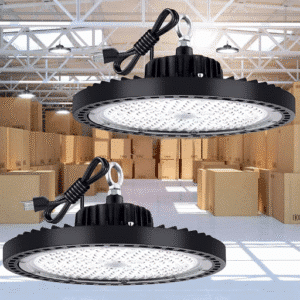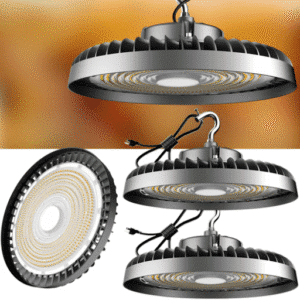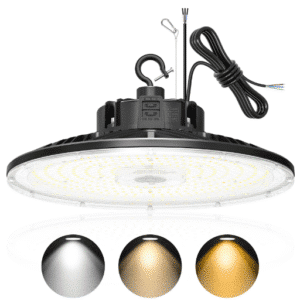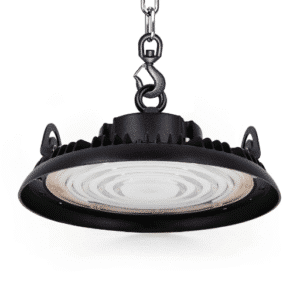

Gymnasiums require different levels of illumination which range from 30 to 75 foot-candles based on the competition level and ceiling height. The correct design for gym high bay lighting begins with IES requirements for gym lighting and then proceeds to your particular sport needs and finally concludes with fixtures that can withstand direct volleyball impacts.
Athletic Director Mike Chen selected 200W UFO high bays for his gymnasium retrofit project at Riverside High because he wanted to duplicate the lighting system that his contractor had installed in the district warehouse. A stray volleyball hit one fixture and broke its lens six months after the installation. PE teachers reported facing glare problems while playing pickleball. The light meter recorded 28 foot-candles on the court which measured 22 foot-candles below the state requirement for varsity competition. He used a gymnasium space to store equipment as if it were a warehouse space. The two locations have different functions.
Lighting systems in schools and community centers and commercial gyms determine player safety and influence energy expenses. This guide provides you with all necessary information about gymnasium lighting requirements which include foot-candle targets and calculation procedures and fixture specifications to design a system which meets code requirements and withstands impacts and maintains budget limits.
Key Takeaways
- IES Class IV recreational gyms need 30 fc; Class I professional venues need 100+ fc on the playing surface.
- The standard high school gym which measures 84 feet by 50 feet and has 24-foot ceilings requires between 16 and 20 UFO high bays that each produce 20,000 to 30,000 lumens of light.
- Ball sports require impact-rated fixtures which meet the minimum IK08 standard because standard warehouse high bays will not meet this requirement.
- The ASHRAE 90.1 standard permits gymnasiums to operate at 0.94 watts per square foot while the 150-plus lm/W LED efficacy allows you to maintain compliance with the standard because you have extra capacity.
- Gyms that serve multiple purposes require scene dimming which operates at 30 foot-candles for physical education classes 50 foot-candles for practice sessions and 75 foot-candles for competitive events.
What Is Gym High Bay Lighting and When Do You Need High Bay Lights for Gym Ceilings?

Gym high bay lighting describes LED lights which installation takes place on ceilings exceeding 20 feet height to achieve complete and intense light distribution across extensive athletic areas. The LED gym lighting fixtures present to facility managers differ from conventional commercial lights because they produce different lumen levels and use different beam patterns and their durability standards differ.
High Bay vs Low Bay Gym Lighting: Which Does Your Facility Need?
The 20-foot rule separates high bay from low bay lighting. Low bay fixtures with wide beam angles (110 to 120 degrees) provide sufficient coverage without creating excessive glare in spaces which stay below 20 feet. High bay fixtures require you to use higher lumen output and tighter beam control to direct light down to the floor from heights exceeding 20 feet. Most school gymnasiums fall into the 20 to 30 foot range which makes high bay lighting the standard choice.
Why Standard Office Lighting Fails in Gymnasiums
Office troffers and panel lights are designed for 8 to 12 foot ceilings and horizontal desk surfaces. Gymnasium lighting needs to extend its reach to vertical surfaces which include player faces and backboards and ball trajectories and the floor area which athletes will use. Standard commercial fixtures lack the lumen output, beam optics, and impact resistance to perform in athletic environments. Gym usage of this equipment results in the development of dark areas, the formation of hazardous shadows, and the quick breakdown of lighting fixtures.
Gymnasium Lighting Requirements: IES Foot-Candle Standards by Sport and Competition Level
The Illuminating Engineering Society (IES) divides indoor sports facilities into four distinct competition levels which they use to assess their requirements. The first step toward achieving gym high bay lighting design requires understanding these classes.
IES Class I–IV System Explained
| IES Class | Facility Type | Spectator Capacity | Horizontal fc Target |
|---|---|---|---|
| Class I | College / Professional | 5,000+ | 100 fc |
| Class II | High School / College | Up to 5,000 | 75 fc |
| Class III | High School / Recreation | Some spectators | 50 fc |
| Class IV | Elementary / Recreational | None | 30 fc |
These values represent maintained illuminance, not initial output. Your design must account for light loss over time so the gym still hits target levels in year five, not just on day one.
Foot-Candle Table by Sport
Different sports within the same facility may need different levels. A multipurpose gym that hosts basketball, volleyball, and wrestling must be designed for the highest-use activity or controlled with dimming.
| Activity | Competition Level | Target Horizontal fc |
|---|---|---|
| Basketball (varsity) | Class II–III | 50–75 fc |
| Basketball (recreation) | Class IV | 30 fc |
| Volleyball (competition) | Class II–III | 50–75 fc |
| Volleyball (recreation) | Class IV | 30 fc |
| Wrestling (tournament) | Class II–III | 50–75 fc |
| General PE / Fitness | Class IV | 30 fc |
| Weight room | General | 30–50 fc |
Sources: IES Recommended Practice for Sports Lighting (RP-6) and the IES Lighting Handbook.
Vertical vs Horizontal Illuminance
Here is where most gym lighting guides fail. They focus entirely on horizontal foot-candles, the light hitting the floor. In sports, vertical illuminance matters just as much. Referees need to see player expressions. Cameras need to capture faces for broadcasts. Players track balls moving through space at eye level.
The IES guidelines specify that vertical illuminance should be set between 50 percent and 70 percent of your horizontal target which should be measured at a height of 5 feet above the finished floor. A Class III gym should match its design requirements to provide 25 to 35 fc of vertical light for a 50 fc horizontal light level. The majority of online calculators exclude this particular aspect from their calculations. Your gymdesign based on floor brightness will create an appearance of brightness from bleachers but it will not support proper gameplay.
The design team at Lincoln Community Center achieved their goal when their new LED gym lighting system produced 52 fc on the floor. Two weeks after opening, basketball referees complained they could not read player numbers during fast breaks. The vertical light meter revealed the actual conditions which showed only 18 fc illumination at face height that fell below the IES standard. The solution needed both extra fixtures and another lift rental. The measurement of horizontal fc cannot function as a standalone system.
How Many Lumens for Gym Lighting? Fixture Output by Ceiling Height
Once you know your foot-candle target, you translate that into fixture count. If you have not calculated total lumens yet, start with our guide on how many lumens you need for high bay lighting before returning to gym-specific spacing and impact requirements. The lumen output of each fixture depends on mounting height. If you are asking how many lumens for gym lighting you need, the answer depends on ceiling height: higher ceilings need more lumens per fixture to overcome distance.
Your foot-candle goal determines your required number of fixtures. You need to begin with our high bay lighting lumen requirements guide before proceeding to gym-specific spacing and impact requirements because you have not yet calculated your total lumens. The lumen output of each fixture depends on mounting height. The required gym lighting lumens will depend on your chosen ceiling height because higher ceilings require additional lumens for each fixture to achieve proper illumination.
Fixture Output Ranges for Gymnasiums
| Mounting Height | Lumen Range per Fixture | Typical Wattage | Beam Angle |
|---|---|---|---|
| 15–20 ft | 10,000–18,000 lm | 80–120W | 110°–120° |
| 20–25 ft | 18,000–24,000 lm | 130–180W | 90°–110° |
| 25–30 ft | 24,000–30,000 lm | 180–220W | 60°–90° |
| 30–40 ft | 30,000–45,000 lm | 220W–300W | 60° |
For most school gymnasiums in the 20 to 25 foot ceiling range, 150W to 200W UFO high bays delivering 20,000 to 30,000 lumens are the standard starting point. The 150W UFO high bay light is ideal for 20-foot ceilings and smaller courts where 24,000 lumens provides full coverage without exceeding ASHRAE 90.1 limits.
Efficacy Matters
The measurement of efficacy through lumens per watt shows how much light you receive from each watt of electrical power. The commercial baseline for 2026 establishes a value of 150 lm/W. Premium fixtures reach 170+ lm/W. Higher efficacy matters for gymnasiums because ASHRAE 90.1 caps your power density. A fixture at 170 lm/W delivers the same light as a 150 lm/W fixture while using 12 percent less energy. The margin between passing and failing code inspection depends on this which determines your outcome.
The Complete Calculation: Sizing High Bays for a Basketball Court

This is the section most facility managers bookmark. Here is the five-step process for sizing gym high bay lighting for a standard court.
Step 1: Determine Target Foot-Candles
Identify your IES class and sport. For this example, we will use a Class III high school basketball gym targeting 50 fc horizontally and 30 fc vertically.
Step 2: Calculate Total Raw Lumens Needed
Use the basic formula:
Total Raw Lumens = Target fc × Floor Area (sq ft)
For an 84 ft × 50 ft high school court:
- Floor area = 4,200 sq ft
- Target = 50 fc
- Total Raw Lumens = 50 × 4,200 = 210,000 lumens
This is the theoretical minimum before any real-world losses.
Step 3: Apply Coefficient of Utilization (CU)
The Coefficient of Utilization accounts for light that never reaches the playing surface. It is absorbed by walls, ceilings, and bleachers. For a typical gymnasium with light-colored walls (50 to 70 percent reflectance) and a high ceiling, CU usually falls between 0.55 and 0.70.
Using a conservative CU of 0.60:
Adjusted Lumens = 210,000 / 0.60 = 350,000 lumens
Step 4: Apply Light Loss Factor (LLF)
The Light Loss Factor accounts for dirt accumulation and lumen depreciation over time. LED fixtures depreciate slower than metal halide, which is why most metal halide replacement projects see immediate lumen gains. Gymnasiums are dusty environments, so a standard LLF for LED in a school gym is 0.80.
Maintained Lumens = 350,000 / 0.80 = 437,500 lumens
This is the total output your fixture array must deliver on day one to still hit 50 fc after years of use.
Step 5: Divide by Fixture Output and Add Spacing
Using 24,000-lumen fixtures:
Fixture Count = 437,500 / 24,000 ≈ 18.2 fixtures
Round up to 18 to 20 fixtures for layout symmetry. Space them in a grid pattern with spacing-to-mounting-height ratio of 1.0 to 1.2. At 24 feet, that means 24 to 29 feet between fixture centers.
Worked Example: Riverside High School Gymnasium
Facility: 84 ft × 50 ft basketball court, 24 ft ceiling, Class III competition
- Target: 50 fc horizontal, 30 fc vertical
- Floor area: 4,200 sq ft
- CU: 0.60
- LLF: 0.80
- Fixture: 24,000-lumen UFO high bay
Calculation:
- Raw lumens: 50 × 4,200 = 210,000
- With CU: 210,000 / 0.60 = 350,000
- With LLF: 350,000 / 0.80 = 437,500
- Fixture count: 437,500 / 24,000 = 18.2 → 18 fixtures
- Spacing: 24 ft × 1.1 = 26.4 ft on center
The 200W UFO high bay delivers 30,000 lumens at 150 lm/W, letting you hit the same target with fewer units and lower installation cost.
Beam Angle, Spacing, and Uniformity for Courts
Getting the lumen count right is only half the battle. Layout determines whether players see consistent light or a patchwork of bright spots and shadows.
Spacing-to-Mounting Height Ratio for Gyms
The correct spacing-to-mounting-height ratio for gymnasium use should remain between 1.0 and 1.2. The system becomes inefficient when its measurement drops below 1.0 because it produces extra light that overlaps with existing output. The system produces dark spots between light sources when its measurement exceeds 1.2 because there will be no light to illuminate those areas.
At 24 feet, space fixtures 24 to 29 feet apart. At 30 feet, space them 30 to 36 feet apart. The installation of three or four fixture rows running along the court length will occur in most cases with rectangular courts.
Beam Angle Selection by Court Size
| Beam Angle | Best For | Typical Use Case |
|---|---|---|
| 60° | High ceilings (30+ ft), focused court coverage | College arenas, field houses |
| 90° | Medium ceilings (20–30 ft), balanced throw and spread | Standard school gyms |
| 110°–120° | Lower ceilings (15–20 ft), wide coverage | Recreation centers, weight rooms |
For the standard 84 ft × 50 ft high school gym at 24 feet, 90° beams are the most common choice. They provide enough overlap for uniformity without excessive spill light into the bleachers.
Uniformity Ratio
The max-to-min uniformity ratio measures the brightest spot divided by the darkest spot on the playing surface. The ratio for competitive play should not exceed 2:1. The ratio for recreational use should be 3:1. The players experience eye fatigue and their reaction times become slower because of poor uniformity.
The only way to verify uniformity before installation is a photometric plan using .IES files from your fixture manufacturer. Many suppliers provide this as a free service when you submit your floor plan. Once your layout is approved, our high bay lighting installation guide walks through mounting methods, electrical requirements, and safety protocols for gymnasium ceilings.
Impact Ratings and Durability: Why Gyms Are Different

This is where gym high bay lighting diverges from warehouse lighting. In a warehouse, the biggest threat to a fixture is dust and vibration. In a gymnasium, a 12-ounce volleyball is traveling at 60 miles per hour.
Looking to design your warehouse lighting layout? Check out our (warehouse lighting layout guide).
IK Rating System Explained
The IK rating measures impact resistance in joules. It runs from IK00 (no protection) to IK10 (20 joules, equivalent to a 5 kg mass dropped from 400 mm).
| IK Rating | Impact Energy | Gym Suitability |
|---|---|---|
| IK06 | 1 joule | Insufficient for ball sports |
| IK08 | 5 joules | Minimum for gymnasiums |
| IK10 | 20 joules | Ideal for competitive courts |
Why IK08 Is the Minimum for Gymnasiums
A standard polycarbonate lens rated at IK08 can withstand a direct hit from a basketball or volleyball without cracking. Lenses below IK08 standards will break apart which exposes their electrical parts while making them dangerous to fall. The system provides you extra protection when you shoot from the edge of the rim and when your equipment makes contact with the boundary.
The maintenance director at Westfield Recreation Center learned this the hard way. He installed generic warehouse UFO fixtures to save 40 percent per unit in the community gym after which he discovered the products lacked IK rating. Eight months later, a volleyball served destroyed a lens. The shattered fixture dangled from its cord until the next scheduled maintenance cycle. The total cost for replacement reached 40 dollars per unit because of lift expenses and equipment rental and workforce costs. Eight months later, a volleyball served destroyed a lens. The shattered fixture dangled from its cord until the next scheduled maintenance cycle. The replacement cost including lift and rent and labor costs reached 1200 dollars. The $400 “savings” on 10 fixtures cost him thousands in callbacks and liability risk.
IP Ratings for Humid Environments
Gymnasiums require IP65-rated fixtures which must be installed in gymnasiums that exist near locker rooms and pool areas and places with humid weather conditions. This rating ensures protection against dust and low-pressure water jets. The better choice for athletic facilities should use IP65 as their standard because of their mopping activities and humidity levels and possibility of sprinkler accidents which require protection from water damage.
The IK08-rated D11 UFO high bay light provides both impact protection and environmental defense because it combines IK08 protection with IP65 certification. The system protects areas which face two different types of threats.
UFO vs Linear High Bays for Gymnasiums
Both fixture types work in gyms, but they produce different results on a rectangular court.
Light Distribution on a Rectangular Court
UFO high bays distribute light in a circular pattern. Linear high bays distribute light in an elongated oval. On a basketball court, this difference matters.
When UFO Delivers More Floor Coverage
UFO fixtures excel in open court applications where uniform floor brightness is the priority. Their symmetrical beam spreads light evenly in all directions, which works well for:
- Standard basketball and volleyball courts
- Circular or octagonal floor plans
- Facilities where fixtures mount directly above the center of the court
When Linear Wins on Sideline and Baseline Uniformity
Linear fixtures excel when you need to push light to the sidelines and baselines without creating hot spots in the center. Their elongated beam pattern aligns with the long axis of the court, providing:
- Better uniformity along the full length of the court
- Reduced glare in the center where players look up most often
- Easier alignment with court markings and bleacher rows
For most school gymnasiums, UFO high bays are the standard choice due to easier installation and lower cost per lumen. Our guide to the best UFO high bay lights ranks the top fixtures for 2026 by efficacy, durability, and warranty. Linear fixtures become the better option when ceiling mounting locations are restricted to the long sides of the building or when glare control is the top priority.
Scene Dimming and Controls for Multi-Use Gymnasiums
Most gymnasiums serve multiple functions. The same court hosts morning PE classes, afternoon volleyball practice, evening basketball games, and weekend community events. Each function needs a different light level.
PE Class vs Practice vs Competition vs Assembly
| Activity | Target fc | Dimming Level | Use Case |
|---|---|---|---|
| General PE / Fitness | 30 fc | 60% | Daily physical education |
| Practice / Intramurals | 50 fc | 80% | Team practice, club sports |
| Competition | 75 fc | 100% | Varsity games, tournaments |
| Assembly / Events | 20 fc | 40% | Graduation, concerts, cleaning |
The design requires all fixtures to operate at their maximum capacity throughout all activities which results in energy waste during PE. Your design violates ASHRAE 90.1 LPD limits because it operates at full power for your entire design.
0-10V Dimming and Occupancy Sensors
0-10V dimming serves as the standard protocol which controls LED high bay fixtures. The system provides continuous dimming control which operates between 100 percent and 10 percent brightness without producing flickering. The gym automatically decreases to 20 percent output when no one occupies the space because of its occupancy sensor system. The system saves energy during periods when the space remains empty while it extends the lifespan of the lighting fixtures.
Scene preset controls enable school and community center staff to operate PE, practice, and competition modes through one-button operation. The system operates without requiring staff to adjust dimming levels manually. The system provides staff with reliable light levels which fulfill all regulations for different types of events.
Code Compliance and Energy Limits

Designing for the right lumens is not enough. After you calculate how much gym high bay lighting your facility requires, your design must also comply with energy codes that limit total wattage per square foot.
ASHRAE 90.1 Gymnasium LPD
ASHRAE 90.1 limits lighting power density (LPD) using two methods. For gymnasiums, the Space-by-Space method is almost always used because it gives a higher power budget to the activity area itself.
| Method | Gymnasium LPD Limit |
|---|---|
| Space-by-Space (activity floor) | 0.94 W/sq ft |
| Space-by-Space (audience seating) | 0.43–0.65 W/sq ft |
| Building Area Method (whole building) | 0.72 W/sq ft |
For our 84 ft × 50 ft example gym (4,200 sq ft), the space-by-space limit is:
4,200 sq ft × 0.94 W/sq ft = 3,948 watts maximum
With 18 fixtures at 150W each, you would hit 2,700 watts, well under the limit. But if you chose lower-efficacy fixtures or oversized the wattage, you could exceed code. Always check LPD before finalizing fixture count.
Meeting IES Targets Without Exceeding Code
The easiest way to stay compliant is to specify high-efficacy fixtures. Your system generates more light output at 170 lumens per watt which allows you to achieve your foot-candle requirement using fewer watts. The current system provides enough capacity to support extra fixtures which you can use to achieve better lighting distribution and vertical light levels.
Occupancy Sensor Requirements
ASHRAE 90.1 requires building systems to have installation of control systems. Gymnasiums must have occupancy-based auto-shutoff or dimming. Lights must reduce to 50 percent or lower within 20 minutes of vacancy. Daylight harvesting is required if your gym has windows which provide substantial natural light.
Frequently Asked Questions
How Many Lumens for Gym Lighting Do I Need for a High School Gym?
The high school gym requires between 350000 and 450000 maintained lumens to achieve 50 foot-candles of lighting which depends on the gym’s ceiling height and its ceiling reflectance. The requirement translates to 16 to 20 fixtures which each provide 20000 to 30000 lumens. The five-step calculation method in this guide enables you to assess high bay lights that suit your gym needs which extend to uses beyond basketball.
Is 5000K too harsh for a gymnasium?
The industry standard for competitive sports requires 5000K light because it replicates daylight which enhances visual performance. The 4000K lighting option creates a less clinical atmosphere for multipurpose gyms that accommodate yoga and assembly events. The Probapro fixtures with selectable CCT let you choose 4000K for recreation and 5000K for competition in the same unit.
Are impact-rated fixtures necessary for volleyball courts?
Volleyballs and basketballs will hit fixtures mounted over courts. Gymnasium fixtures need a minimum impact rating of IK08. Competitive play requires fixtures with IK10 impact rating. Gymnasiums require fixtures which have IK ratings because standard warehouse fixtures will break when a ball strikes them.
How does dimming affect total lumen requirements?
Dimming does not change your maximum lumen requirement. Dimming complete output capacity needs to be installed because your system needs to function at competition level performance. Dimming enables you to decrease energy costs while increasing the operational life of your fixtures through reduced light output. You should operate at peak demand levels while designing based on actual activity requirements.
Conclusion
The gym high bay lighting system for gymnasium use operates as a distinct lighting system which requires specific design criteria. The design process requires sports lighting experts who must deliver specific foot-candle requirements while creating vertical lighting designs and using impact-resistant lighting fixtures and setting controls for multiple usage scenarios. Researching LED gym lighting for new construction projects and assessing high bay lights for gym retrofits both require application of identical principles.
The facilities that get it right follow the same process: pick your IES class, calculate maintained lumens with CU and LLF, select impact-rated fixtures with the right beam angle, verify uniformity with a photometric plan, and confirm ASHRAE 90.1 compliance before installation.
The facilities that get it wrong treat the gym like a storage facility with bleachers. They end up with shattered lenses, referee complaints, and energy code violations that cost more to fix than doing it right the first time.
Need help sizing gym high bay lighting for your specific facility? Start with our UFO high bay light guide, or review our high bay lighting installation guide once you know your fixture count.