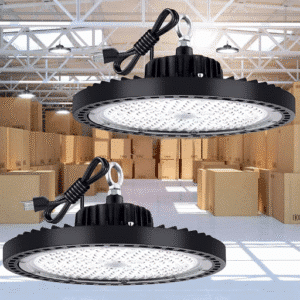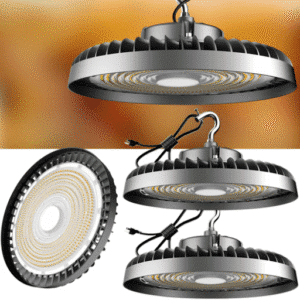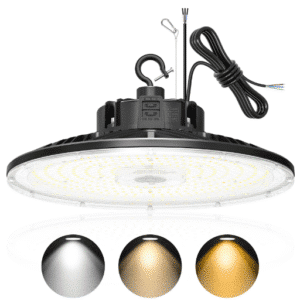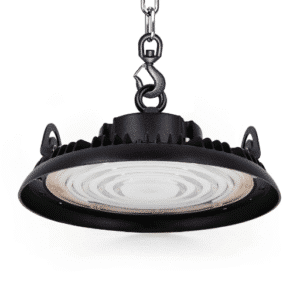

The best UFO high bay lights in 2026 deliver 150+ lumens per watt, carry DLC Premium and UL certifications, and match the right wattage to your ceiling height. For most warehouses with 20–30 foot ceilings, a 150W UFO high bay at 5000K with a 90° beam angle is the optimal specification.
Most of the so-called “best of” lists in some ways entice you with well-marketed products without enough explanation so that you may fully understand them. This is a big issue when a small warehouse retrofit has 50 to 200 fixtures, and the investment potential reaches six figures. If such an order is done haphazardly, energy will be squandered, dark spots will appear here and there, and too soon will you get to the point of making a second purchase.
You can discover the five features separating industrial-grade lighting for consumer version substitutes. A standard from which you can work out the choice of wattage and beam angle for your logistics facility will also be given. In effect, a working example will be adapted to illuminate your design. And by the end, you will be well versed in your ability to select the best UFO high bay lights out there, with confidence.
Key Takeaways
- The most energy-saving UFO high bay lights are capable of an efficacy of 150lm/W thanks to both DLC Premium and UL listings.
- 150-watt is apt for spacing of 20 to 30 feet-high ceilings; installations of 200 watts are required in taller rooms or for HID replacement of 600W or more.
- Concerning the allowable beam angle: 90 degrees are optimal for mid-walled height applications, with 60 degrees best for ceilings over 35 feet.
- Adding intelligent features such as motion sensors and 0-10V dimming means an additional energy-saving of 30–40%.
- DLC Premium certification opens up additional rebates that are not available with DLC Standard.
What Makes the Best UFO High Bay Lights Stand Out?

Not every round LED fixture qualifies as industrial-grade. The best UFO high bay lights share five non-negotiable specifications that separate true industrial high bay lighting from consumer-grade substitutes. These are the same standards that define the best high bay LED lights for any facility.
The best UFO high bay lights share five non-negotiable specifications:
- Efficacy: 150+ lumens per watt
- Certifications: DLC Premium and UL/ETL listed
- Ingress Protection: IP65 minimum
- Driver Quality: 0-10V dimming and surge protection
- Warranty: Five-year minimum with LM-80 data
1. Efficacy: 150+ Lumens Per Watt
Efficiency relates to the amount of light a fixture produces for every watt it consumes. In 2026, 150 lumens per watt will be the benchmark performance level for commercial-grade UFO high bays, while high-tier products will likely go up to 160–175 lm/W. The leading commercial UFO lights maximize the use of industrial-grade LED chips, cobbled with good thermal management, to prevent the light output from declining over time. For issuance or assembly sections, 80 CRI or higher should be prioritized as this enhances the correct viewing of colors.
The monetary impact is immediate. A 150W lamp at 150 lm/W works out as 22,500 lumens. A competing 130 lm/W light needs 173W to produce the same- to operate. Over eighty fixtures and six thousand operational hours per year, incurring an additional 23W cost $1,794 due to added consumption at a rate of $0.13 per kilowatt-hour. According to the U. S. Department of Energy, LED industrial retrofits typically reduce energy usage by 60%–75% against legacy metal halide systems.
2. Certifications: DLC Premium + UL/ETL Listed
Certifications are not just paperwork exercises. They literally dictate whether your fixtures would or would not qualify for utility rebates, electrical inspection passes, and property insurance coverage.
- DLC Premium: Top tier on the DesignLights Consortium’s Qualified Products List. Fixtures need to meet higher standards for efficacy, lumen maintenance, and color quality. Utilities usually offer greater rebates—usually 20-40 percent more—for DLC Premium than for DLC Standard.
- UL/ETL/cUL: Proof that a respected laboratory had tested the fixture for its electrical and fire safety properties. These would need to be visible to inspectors and insurers.
When Marcus Chen retrofitted has 80,000 sq. ft. distribution center in Ohio and initially began to source from an Amazon vendor without certification, which helped him save a total of 12 per unit. His fixturization was quickly caught by the electrical inspector, thereby rendering his rebate application unapproved by utility and forcing him to repurchase the entire lot. The “savings” ended up costing him 8,400 per unit or six weeks of delay.
3. Ingress Protection: IP65 Minimum
The requirement of being IP65 dust–tight and resistant to any water spray from low-pressure-type water jets all around the fixture is considered a must for warehouses, food preparation areas, and settings where the fixture endures dust, condensation, washdown, as well as the elements.
If the facility involves high-pressure cleaning, exposure to chemicals, or outside loading docks, consider IP66 for additional water-jet protection.
4. Driver Quality and Dimming Compatibility
The LED driver is the electrical power converter which converts the AC current from electrical power to the DC voltage the LED needs to function. The worse thing is that cheap drivers fail even before the LED chips do. A Mean Well driver is the real industry standard, for its most reliable drivers for both commercial LED fixtures.
Look for:
- 0-10V dimming compatibility: Allows you to add motion sensors or daylight harvesting later without replacing hardware.
- Surge protection: 4kV or higher protects against voltage spikes common in industrial electrical systems.
- Wide operating temperature range: -40°C to 50°C ensures reliable performance in unconditioned spaces.
5. Warranty and Lumen Maintenance
5-Year warranty is an official industry minimum by 2026; anything lower is unfair to the manufacturer. He must ask for LM-80 test data and TM-21 projections. This information will show exactly how many lumens are still being retained within the LED at 50,000 hours. A good quality fixture will sustain at least 70% of its initial lumen output, or in other words, L70.
How to Choose the Right Wattage for Your Ceiling Height
By now, many buyers will be asking themselves about wattage as the main point of confusion when looking for the best UFO high bay lights. When you go wrong, it may result in patch-like coverage or unnecessary power costs.
100W – Small Shops and Retail (10-15ft Ceilings)
Here, a 100W UFO high bay with 14,000 to 15,000 lumens draws nearly enough illumination for smaller workshops or auto repair bays. The light is also suitable for generally low- to medium-height retail spaces. Units with the coverage of 120° and up should provide ample lighting without overpowering the facility where the ceiling is less than 15 feet.
150 W – Standard Warehouses and Athletic Gyms (15-25ft Ceilings)
This is the UFO number one specification throughout the international lighting market. Standing around, 150+ lm/W would more than 22,500. A hundred and fifty watts completely substitutes the old 400W metal halide player while taking off around sixty-five percent of energy use.
For the 400W Metal Halide replacement contractors who are at the traditional ceiling height of 20 feet, 150W UFO High Bay has become the standard requirement. It balances the lumens, its thermal coefficient, and the cost; hence suitable for applications very broadly.
Need help sizing gym high bay lighting for your specific facility? Start with our (gym high bay lighting guide).
200W – Heavier Loads and High Spaces (25 – 35 ft ceilings)
Cannot produce less than 30,000+ lumens. This is the best utility as far as taller or high ceiling warehouses, manufacturing plants with high equipment racks, or gymnasiums are concerned where light has to travel further before coming in contact with the actual work area.
Volume gaps are covered with longer wattage by the UFO high bay using a 200W measurement for taller facilities or larger systems in larger hallways or larger 600W HID replacers.
240W and up- Maximum Heights and Extreme lumen Requirements (35+ ft ceilings)
There seems to be a significant difference in the habitat upon crossing the 240W threshold; the fixtures are best for aircraft hangars, atriums, and bulk storage facilities with ceilings more than 35 feet high. Also, they are pretty handy in areas where efficiency in floor lighting is required in the highest light intensities, like precision assembly or quality-inspection zones.
Wattage-to-Ceiling-Height Decision Matrix
| Ceiling Height | Recommended Wattage | Beam Angle | Typical Application |
|---|---|---|---|
| 10–15 ft | 100W | 120° | Workshops, retail, garages |
| 15–25 ft | 150W | 90° | Warehouses, gyms, factories |
| 25–35 ft | 200W | 90° | Large warehouses, manufacturing |
| 35+ ft | 240W+ | 60° | Hangars, bulk storage, atriums |
If you are unsure which wattage and lumen package fits your ceiling height and task requirements, read our guide on (how to choose UFO high bay lights) before finalizing your specification.
UFO vs Linear High Bay: When to Choose Which

When evaluating LED high bay lighting options, UFO and linear fixtures both serve high-ceiling environments, but their distribution patterns suit different layouts. The best UFO high bay lights excel in open floor plans.
UFO high bays cast symmetrical, downward-focused light from a compact circular housing. They install quickly with a single hook or pendant mount. Choose UFO fixtures when:
- You have open floor areas without narrow aisles.
- You need focused intensity at the work plane.
- Ceiling access is limited and you want simple mounting.
Linear high bays are rectangular fixtures that spread light across a wider, more elongated pattern. They work better when:
- Your facility has long aisles or shelving rows.
- You need continuous, uniform coverage along a path.
- You are replacing existing fluorescent strip fixtures and want to reuse mounting locations.
For most general warehouses and manufacturing floors, UFO fixtures are the better default. Their higher efficacy per watt and simpler installation usually outweigh the linear fixture’s spread advantage unless your layout is heavily aisle-driven.
Beam Angle Guide: 60°, 90°, or 120°?
Light beam angle specifies the spreading of light from the fixture on the floor. A wrong angle creates hot spots directly beneath the fixture and dark zones between rows. Right angle provides even and usable light across the whole space.
60°—Focused Throw for High Ceilings
The 60° light beam focuses its light into a tight circle where, at 40 feet, it covers only a 42-foot diameter. Using this angle would be appropriate for a very high ceiling where electrical energy must transmit over long distances without losing intensity and where the fixate is above individual work stations or inspection areas where the light is to be focused and not spread.
90°—Balanced Coverage For Mid-Height Facilities
The 90° beam is for warehousing workhorse. It gives the proper spread to allow reasonable spacing between fixtures while maintaining adequate fc levels at 20–30 ft mounting heights. On a regular 25-foot ceiling, a 90° beam will cover about a 50-foot diameter on the floor.
120° — Wide Spread for Lower Ceilings and Open Plans
At 120°, light is spread out wide, best for ceilings less than 20 feet tall or open retail and showroom spaces. There is a lot more gentle light absorption with the light. Care should actually be taken not to exceed 25 feet in height with 120°. The light is just dispersed so widely, the floor-level intensity falls below its productive power.
Wow, what an oversight on the part of the team at Apex Logistics when they elected 120° for the lighting of their 32-foot tall distribution center; they had assumed that more was better. When the lights were metered, the shop readings showed 18 foot candles, far below the 30 fc target for a warehouse. The engineers then replaced the lenses with 90°, and changed the average of 35 fc for illuminance. Furthermore, in response to the hotter-beam count; they boosted it 12 percent since the tight beam was overlapping much better.
General rule for spacing: Space fixtures at 1-1.5x the mounting height. A good starting point for a 90° beam at 25 feet is 25-35 foot spacing, and adjust based on the light meter.
Smart Features That Actually Pay Off
The best UFO high bay lights are excellent for having smart controls, as the conventional on/off operation would be a total wastage of energy at locations that do not run 24/7. These controls make the lighting a variable cost, so the lighting operation cost is directly proportional to occupancy and daylight.
Motion Sensors
Occupancy sensors detect movement and raise light levels when staff or equipment are present. This can save 40-60% of runtime in areas where traffic is low, such as storage aisles or shipping docks. Fixtures should be selected that are configured with 0-10V dimming drivers so that sensors can be added, and no change of hardware will be required.
0-10V Dimming
The purpose of a 0-10V dimming circuit is that you may dim the lights by hand or by using automated devices. If the dimming level is 50%, energy consumption is cut by roughly half. It also prolongs the life of LEDs. The system should be coupled with daylight harvesting sensors wherein it reduces artificial lighting by itself whenever the daylight coming from skylights or windows is quite sufficient.
Smart Controls and Automation
Advanced systems use Bluetooth Mesh, DALI, or wireless protocols to create zone-based control. You can schedule different light levels by shift, area, or task. For more on smart lighting systems and sensor integration, see our guide on (smart warehouse lighting) strategies.
Certifications Decoded: DLC, UL, and IP Ratings

When selecting the best UFO high bay lights, certifications seem like alphabet soup until you know what each one protects. Here are what actually matters to your project.
DLC Premium vs DLC Standard
The DesignLights Consortium maintains the most largely-recognized certification list for commercial LED fixtures in North America. There are two tiers:
- -DLC Standard: minimum efficacy and performance thresholds. Qualifies for basic utility rebate.
- -DLC Premium: higher efficacy requirements (hence-the better pricing), stricter lumen maintenance, and tougher-to-meet color-quality standards. Qualifies for maximum rebates.
The rebate difference is HUGE! A utility may give 20 for DLC Standard and 20 per fixture. In the case of basic utility rebates provided, it is possible that one might offer 20 per fixture for DLC Standard, or perhaps offer 35 per fixture for DLC Premium. On a 200-fixture job, that adds up to a $3,000 gap. DLC Premium is always recommended in price-conscience cases.
UL, ETL, and cUL
Certified marks from a lab imply that the lab has tested the fixture for electrical and risk of fire safety:
- UL (Underwriters Laboratories): The most well-recognized safety certification in North America.
- ETL (Intertek): Testing equal to the UL, hence inspection by certified personnel.
- cUL: UL certification specifically for Canadian electric codes.
If your establishment sees insurance audits or safety inspections, one of these marks should also be there to catch the eyes of any inspector.
IP Ratings Explained
IP stands for Ingress Protection. The first digit will denote dust protection, while the second provides water resistance.
- IP65: Dust-proof and water spray-resistant. This is the standard rating for industrial warehouses.
- IP66: Dust-proof and protected against high-pressure water jets. Ideal for food processing, car washes, or outdoor canopies.
- IP67: Dust-proof and resistant to temporary immersion. Rarely needed for standard high bay applications.
Mostly IP65 suffices in warehouses and factories. Only consider upgrading to IP66 in case you are definite about heavy washdowns or chemical exposure.
Worked Example: Specifying Lights for a 20,000 sq ft Warehouse
Let us walk through a real warehouse LED lighting solutions specification so you can see how the pieces fit together. This example shows why the best UFO high bay lights deliver payback in under three months.
Facility Details
- Floor area: 20,000 sq ft (200 ft × 100 ft)
- Ceiling height: 25 feet
- Current lighting: 100 × 458W metal halide (includes ballast draw)
- Operating hours: 6,000 hours per year (two shifts)
- Electricity rate: $0.13 per kWh
Step 1: Determine Fixture Count
At 25 feet with 90° beam angles, we use 1.2× mounting height for spacing:
- 25 ft × 1.2 = 30-foot spacing
- 200 ft ÷ 30 ft = 6.7 → 7 rows
- 100 ft ÷ 30 ft = 3.3 → 3 fixtures per row
- Total: 21 fixtures
Wait—that is a significant reduction from the existing 100 fixtures. The original metal halide layout used more fixtures because older systems had lower efficacy and poorer light distribution. Modern LED UFO fixtures with 90° optics and 150+ lm/W deliver more usable light per unit, so fewer fixtures achieve equal or better uniformity.
Step 2: Select Wattage
For 25-foot ceilings replacing 400W MH, we specify 150W UFO high bays at 150 lm/W (22,500 lumens each).
Step 3: Calculate Energy Savings
- Old draw: 100 fixtures × 458W = 45,800W = 45.8 kW
- New draw: 21 fixtures × 150W = 3,150W = 3.15 kW
- Demand reduction: 42.65 kW
- Annual energy savings: 42.65 kW × 6,000 hours × 0.13=0.13=33,267 per year
Step 4: Factor in Maintenance and Rebates
- Metal halide bulb replacement: ~15perbulb×100bulbsevery2years=15perbulb×100bulbsevery2years=750/year
- LED maintenance: Near zero for first 5 years
- DLC Premium rebate estimate: 21 fixtures × 35=35=735
- Annual maintenance savings: ~$750
Total first-year savings: 33,267+33,267+750 + 735=735=34,752
Step 5: Payback
If 150W DLC Premium UFO fixtures cost $85 each installed:
- Total project cost: 21 × 85=85=1,785
- Payback period: 1,785÷1,785÷34,752 = 0.05 years ≈ 2.4 weeks
This is an extreme case because we are consolidating from 100 legacy fixtures to 21 modern ones. Even if you keep a one-for-one replacement count, the energy savings alone typically deliver payback in 5–18 months. For a complete comparison of LED and metal halide performance, read our guide to (LED vs metal halide savings).
Best UFO High Bay Lights by Category for 2026

To help overly tense our best UFO high bay lights that we will install in our facility on Thursday, we will rank lighting fixtures by those very issues that they aim to solve, then list particular models that meet the five fundamental requirements. This way the prospective user can match the category to their preference and focus on comparing competing lights with genuinely superior perspectives.
Best for Energy Efficiency: 170+ lm/W Fixtures
Your ultimate desire, in pursuit of minimizing the cost of operation, would require the identification of those fixtures that give you 170 lm/W or better. At 170 lm/W, a 150 W lighting unit yields the minimum 25,500 lumens for high bays. It is understood that the extra cost will book itself more than a few times over the 10-year period.
Best for Harsh Environments: IP65 + Die-Cast Aluminum
Places with dust, dampness, vibration or temperature fluctuations do better with something more than just raw lumens. The fixture should feature die-cast aluminum housings, IK08 impact resistance, and gasket-sealed lenses. Such units ought to endure the very factors that destroy budget-grade systems within two to three years. To serve up a more hardcore version of the above, check our IP65-rated, die-cast aluminum UFO high bay light D11.
Best for Smart Upgrades: Sensor-Ready with 0-10V Dimming
If not today, you can always add sensors later. Consequently, pick 0-10V dimming drivers with a sensor port port, and your future-proof investment should be safe and sound to go, allowing you to include either motion or daylight control with an eye to the next budget cycle, without the need for a complete hardware rehaul.
Best Budget Option: 130–140 lm/W with Core Certifications
In case capital is prohibitive, welcome fixtures that are 130–140 lm/W and appropriately allowed by DLC/UL, while the operating cost might be slightly higher; your advantages will be the extended operating life of these LED lamps and reduced maintenance. Do not go for the generic, none-warranty support sort of fixtures.
Installation and Spacing Quick Reference
Even the best UFO high bay lights underperform if installed incorrectly. Proper installation affects both safety and performance. Here are the essentials.
Mounting Methods
- Hook mount: The most common method. The fixture hangs from a ceiling hook using the built-in eye bolt. Fast and tool-friendly.
- Pendant mount: A rigid pipe or cable suspends the fixture at a specific drop length. Use this when you need to lower fixtures below ductwork or obstructions.
- Chain mount: Flexible chain allows adjustable height. Useful in temporary or reconfigurable spaces.
- Surface mount: Bracket attaches directly to a junction box on the ceiling. Best for low-ceiling applications under 20 feet.
Spacing Guidelines
| Mounting Height | 60° Beam Spacing | 90° Beam Spacing | 120° Beam Spacing |
|---|---|---|---|
| 15 ft | 18–22 ft | 20–25 ft | 22–28 ft |
| 20 ft | 22–28 ft | 25–32 ft | 28–35 ft |
| 25 ft | 28–35 ft | 30–40 ft | 35–45 ft |
| 30 ft | 35–42 ft | 35–48 ft | 40–55 ft |
Always verify with a light meter after installation. Software like DIALux or AGi32 can model your exact layout before purchase, but a physical measurement confirms real-world performance.
Want to know about (cold storage lighting requirements)? Click to view our related guidelines.
Frequently Asked Questions
What is the best wattage for UFO high bay lights?
The best wattage for most industrial applications is the 100W version, which should be chosen for ceilings between 15 and 25 feet when selecting the best UFO high bay lights. It replaces a 400W metal halide system and saves energy by approximately 65 percent. For ceilings above 30 feet, step up to 200W or 240W to have enough foot-candles.
How many lumens do I need for a warehouse?
General warehouse operations require 20-30 foot-candles on the work plane. Assembly and inspection space need 50-75 foot-candles. It is guided by the Illuminating Engineering Society (IES) recommended practice for the Industrial Lighting Design. 150W UFO at 150 lm/W would produce 22,500 lumens in the least, which should get about 25-35 foot-candles at the 20-25 foot mounting heights with the right spacing.
Are LED UFO high bay lights even better than linear lights?
Circular-formation beams are well-suited for larger spaces and localized focused illumination. Whereas linear fixtures are better energies expended when lighting up longer aisles comprising extended spanning segments. For maximum warehouses and production facilities, UFO high bays may be easier because they generate light in a more efficient manner and are less costly to install.
Can UFO high bays replace metal halides one-to-one?
On the whole, yes. For example, a 150W LED UFO replacement can replace a 400W metal halide; a 200W UFO replacement can replace a 600-1000 watt metal halide. As the LED optics are more directional and efficient, you might even be able to install fewer solutions than previously, and even inputs into would improve the equability of illumination.
Could UFO high bay lights be dimmable?
Many premium models support 0-10V dimming. Some advanced models could be provided with motion sensors, photocells, and smart control integration through Bluetooth Mesh or DALI, too. If dimming is essential for your project, you can quickly check the driver spec sheet before ordering the product.
Conclusion
Choosing the best UFO high bay lights is not about finding the cheapest price or the longest feature list. It is about matching five core specifications—efficacy, certifications, protection rating, driver quality, and warranty—to the real conditions in your facility.
To determine the wattage, first consider the height of your ceiling and then the beam angle according to your design. Verify DLC Premium and UL listings, for both rebate eligibility and approval. Hence, you should get sensor-ready dimming drivers to keep your options open for smart control later on when you’re done saving.
Finally, you must consider your local rebate programs, and make sure that the best UFO high bay lights available are certified by DLC Premium to maximize ROI and install LEDs now for long-term savings.
Want a comprehensive understanding of UFO high bay light? Check out our (UFO high bay light guide).