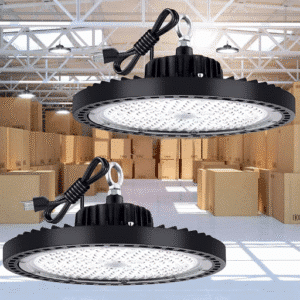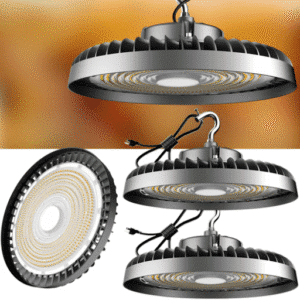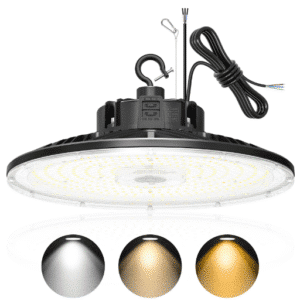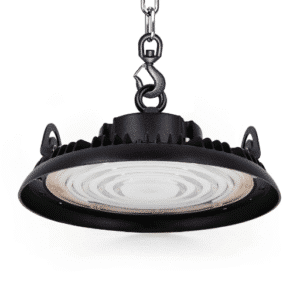

Mike was proud of his meticulousness as a facilities manager in Michigan. He took measurements across the ceiling of his warehouse and came up with 20 feet height, calculated the square footage, and ordered 40 of the brightest UFO high bay lights available to his specifications: 240 W fixtures with 28,000 fluxes per unit. By six months, his pickers were already complaining about the glare, the floor showed hot spots beneath every light, and Mike was called for the procurement of another set of lights at half the wattage.
This is a mistake many shoppers commit, as they go UFO high bay light shopping with only the wattage and the price in mind as inidcative parameters and not really the three things that really count and regulate the efficacy of the fixture: ceiling height, beam angle, and intended task. Hence, any customer needs a selection framework that matches the light with the space.
The guide explains how to choose the best UFO high bay lights for warehouses, factories, and industrial installations. The wattage requirements are clearly spelled out based on ceiling height and the beam angle rules are used to avoid over-lighting while describing a working list that you can work with whenever needed in the future.
The high bay UFO light is usually chosen against the ceiling height and considering the required task. You can begin by measuring for the ceiling height and may proceed to select the given wattage not only depending on the height-wattage chart, then pick the beam angle that meets the requirements of your floor plan without the issue of over-lighting, and ensure its efficacy and certifications, before you are ready to order space by considering the required spacing for the intended application.
Why Ceiling Height Determines Everything

Ceiling height is the starting point for every UFO high bay decision. It dictates how much light reaches the work plane, how concentrated that light needs to be, and what UFO high bay wattage range makes sense.
UFO High Bay Wattage: The Height-Wattage Relationship
Here is the practical breakdown used by industrial lighting designers in 2026:
- 10–15 ft ceilings → 100–150W
- 15–20 ft ceilings → 100–150W
- 20–30 ft ceilings → 150–200W
- 30–40 ft ceilings → 200–300W
- 40+ ft ceilings → 300W+
The aforementioned ranges address basic warehouse functions like picking, packing, and forklift operation. If your operation involves detail assembly or even QA evaluation, increase one wattage range above so as to reach the higher foot candle thresholds.
A Real Mistake Story
Mike’s 20-foot warehouse fell squarely in the 150–200W range. By jumping to 240W, he pushed too many lumens onto a relatively low work plane. The result was blinding glare for pickers on scissor lifts and wasted energy from light spilling onto walls instead of aisles. After replacing the 240W fixtures with 150W UFOs and 90° beam angles, his average illuminance dropped to a comfortable, productive level and his energy bill fell 35%.
UFO High Bay Wattage: What Actually Matters
In 2026, high bay UFOS wattage shall serve, at best, as a rough reference. During purchase, the number to direct discussion would be the luminous efficacy: how many lumens they get in exchange for each watt of electricity.
Focus on Efficacy, Not Just Watts
UFO high bay lighting is now available at over 150 lm/W at the minimum and several between 180–200 lm/W high with special refinement. Thus, by achieving 170 lm/W, a lamp of 150W would produce 25,500 lumens, whereas a 200W cheap fixture at 110 lm/W would produce only 22,000 lumens while consuming 33.5% more power.
This matters for two reasons:
1. Energy costs-Efficacy means lower operating cost at the same light output.
2. Rebate entitlements- These high-efficacy ratings are brought by highly regarded DLC Premium, which has higher utility rebates amounting to 20% to 50% larger than Standard.
Typical Lumen Output by Wattage
| Wattage | Lumen Range (150+ lm/W) | Metal Halide Equivalent |
|---|---|---|
| 100W | 15,000–17,500 lm | 250W–300W |
| 150W | 22,500–26,000 lm | 400W |
| 200W | 30,000–35,000 lm | 600W–750W |
| 240W | 36,000–42,000 lm | 750W–1000W |
When comparing fixtures, always check the published lumen output and the DLC qualification level. A lower-wattage, high-efficacy fixture often outperforms a higher-wattage, low-efficiency competitor.
For a deeper dive on matching wattage to ceiling height, see our (high bay light wattage guide).
UFO High Bay Beam Angle Selection
The beam angle on a UFO high bay is all about how light spreads from the fixture to the floor. A wrong beam angle might waste lumens, create hot spots, or even cause glare.
60° for High Ceilings
On a 30–50+ foot spread, the light has longer to cover and needs to be focused accordingly. A 60° beam performs this function well because it can concentrate the lumens into a sharp cone, which maintains luminous intensity where it is desired. Broader beam spread essentially scatters the light and leaves the work plane cold.
90° for General Warehouse Use
The 90° beam would be the most versatile option for heights between 20 feet and 30 feet. It spreads far enough to reduce the requirement of fixtures while keeping light levels uniform across these open floors as well as the corridors in the aisles.
120° for Low Ceilings and Open Floors
A good use of the 120° beam would be within the 10-20 foot height spread as the light gets to the surface all around. Perfect for open staging areas, gyms, and low-bay manufacturing floors where fewer fixtures and softer boundary lines between light pools are desired.
Field-Selectable Optics
Selectable UFO high bay beam angles at installation are being offered by some of the most advanced UFO fixtures. This is handy if you are uncertain about the mounting height you are aiming for or if you want to standardize on one SKU across multiple buildings with varying ceiling heights.
UFO vs Linear High Bay: Which Is Right for Your Space?

A round UFO type fixture is not required for every high-ceiling space. The UFO vs. linear high bay conundrum is one faced by buyers on every project, and never make a selection only to compromise layout design later.
Choose UFO for Open Spaces and Harsh Environments
UFO high bays are more suited for:
- Open warehouse floors
- Manufacturing facilities that are subject to dust and moisture
- Gymnasiums and recreation centers
- Any spaced with a ceiling height, of, say, 25-30 feet and minimal racking
Chances are if you are installing a high bay in an industrial space, it’s going to run into some dust and moisture. Therefore, it’s imperative that the sealed housing, nearly always with an IP65 rating, could keep water jets and dust out. The round shape diffuses the light evenly in all directions, which is what an open layout needs.
Choose Linear for Aisles and Rack-Heavy Layouts
Linear high bays are a better fit for:
- Thin aisles between very tall racking
- Distribution centers with longer pick paths
- Places that need light directed in a pattern with rectangular properties.
Yet UFOs are less wasteful; the cleanest lines produce less wasted light and the round bays of UFOs are typically the highest quality points.
The Hybrid Approach Most Warehouses Use
Most large places use both. While UFOs are blazing on top of receiving and staging, the linear fixtures allow good visibility between the aisles. If, in a warehouse, there is almost entire open floor with some racking, UFOs almost certainly represent a more straightforward and less complicated entry point in relation to covering the racking aisles.
Color Temperature, CRI, and Light Quality
Much of the attention is directed toward wattage and beam angle, while color temperature and color rendering index (CRI) directly affect the comfort, safety and precision of work.
4000K vs. 5000K
- When choosing 4000K (neutral white, the slightly warmer of the two), they’re practically gentle on the eyes through the longest of shifts. Very popular in assembly areas and packaging zones
- Daylight White, or 5000K: This is crisp and quite abrupt in its look. Used by most in industrial areas and distribution facilities-places where quality inspection is carried out.
The general trend is to use 5000K for warehouses and 4000K for manufacturing. Some Probapro models are fitted with Switchable CCT, which allows you to select light temperatures during installation.
For more on smart warehouse lighting systems and sensor integration, see our (guide on smart warehouse lighting strategies).
Why CRI 80+ Matters for Labels and Safety
A CRI is the indicator of how well colors appear when laundry is exposed to the light. An 80 CR, and thereabouts, would be just enough to deal with situations needing accurate coloring, especially those that involve reading labels or finding traffic signs, when CRI matters. Meanwhile, if you want your product inspection or paint matching to yield repeatable, whatever peak CRI consists of 85 and 90 or more would be suitable.
Durability and Environmental Ratings
Industrial lighting lights up the harshness of reality. Dust, accidental blows, vibration, moisture, among other things can all be experienced daily. With the right ratings, fixtures itself do not resolve many issues and remain good media for managing maintenance-related costs.
IP65 for Dust and Moisture
The IP65 rating factually translates to the fact that the fixture is dust-tight and able to withstand water projected from any position. It’s a bottom line if you are involved in storage facilities or factories. Any possibility of exposure to high-pressure washdowns, or simply outdoor lighting, should lead to the consideration of an IP66 or higher rating.
IK08+ for Impact Resistance
The IK08 denotes them as suitable for withstanding a 5-joule impact similar to a 1.7 kg mass dropped from 300 mm. In atmospheres that are marred by forklift trucks, cranes, or flying objects, IK08+ ratings will keep the housing and lens intact.
Die-Cast Aluminum and Thermal Management
The LED means increased lifespan. LED fixtures with die-cast aluminum housings would cool the LEDs better than stamped steel or plastic solutions. More efficient thermal management, the LEDs stay cooler and throughout the life of the 50,000+ driven hours, maintain light output and emission thoroughly.
Certifications and Rebates

When one says certifications, one is actually disregarding the paperwork because they may imply rebate eligibility, insurance compliance, and whether the fixture will perform as advertised.
DLC Premium and Utility Rebates
Fixtures that are part of the DesignLights Consortium (DLC) are rated based on their efficacy, light quality, and reliability. DLC Premium is the next level up. Even though integrated fixtures cost more upfront, they usually earn the buyer a 20–50% larger utility rebate than DLC Standard products. In states with aggressive rebate programs, the payback difference could be less than one year.
UL / ETL Listing
Having a UL or ETL listing ensures these fixtures adhere to established U. S. safety standards concerning electrical and fire safety, a necessary aspect when dealing with many building inspectors and insurance underwriters. Always verify the listing on the official UL or Intertek database before purchasing it.
Smart Features to Consider
Modern UFO high bays are no longer just consoles of light. They lead to more energy-saving control, and building automation.
Selectable Wattage and CCT
Whether it is to select the wattage that one requires and to fix the lumen output of the light at installation, whether it is to lower the down lumen production later on rather than having to run back to the warehouses to replace the light fixture. Being able to select your color temperature helps reduce risk and simplify inventory, finding a much swifter buy-in.
Our (high bay lighting installation guide) walks through mounting methods, electrical requirements, and safety protocols
0-10V Dimming and Sensor Compatibility
Luminaires designed to dim down to 0% with 0-10V dimming drivers can seamlessly integrate motion sensing, daylight-harvesting sensors, and building management systems. The energy savings can then be further increased, in the range of 30–50% of the baseline LED savings, by this combined system, in a warehouse environment.
Spacing and Layout Basics
Even the right fixture fails if it is spaced poorly. Too far apart and you get dark spots. Too close and you waste money on overlapping light pools.
The Spacing-to-Height Rule
A standard rule of thumb is to space fixtures at 1.0 to 1.5 times the mounting height. For example:
- 20 ft ceiling → 20–30 ft spacing
- 30 ft ceiling → 30–45 ft spacing
- 40 ft ceiling → 40–60 ft spacing
This assumes open floor plans. Narrow aisles, tall racking, and task-specific areas may need tighter spacing or different optics.
For example, a warehouse space measuring 100ft × 100ft with a clear height of 25 ft and an open floor plan. It is then roughly 30 feet, using the 1.2 times factory factor, that the fixings are spaced apart from each other. A 4×4 grid comes into existence — 16 fixtures in all — gives pretty even coverage. If the same area had tall racking aisles, one might want to tighten spacing to 20 feet along the aisles and use fewer fixtures in the open staging areas.
When to Get a Photometric Plan
For projects that are larger than 50,000 square feet or require specific light levels, a reliable photometric study can go a long way. An LD [lighting designer] uses computer software to model the exact racking layout, ceiling height, and reflectance values and to specify the correct number of fixtures, the right wattage for uniform coverage, and the specific spacing.
Common Mistakes When Buying UFO High Bays
Go off these mistakes and you will be able to save bucks, time, and sweat.
- Shopping by price instead of efficacy
The least costly fixture available in Amazon is by far the most expensive over its lifetime. Low efficacy results in high electricity bills. No certificaiton, no rebates. Low-quality thermal management causes a fixture to fail early and requires replacement labor. - Using too wide a beam on high ceilings
A 120° beam at 35 feet spreads light on the floor too thinly no matter how many lumens the luminaire boasts. Matching tight beams with high ceilings for good glare-free illumination. - Over-lighting low ceilings
More lumens need not always be better. A 240W fixture on a 20-foot ceiling results in terrible glare, shadows, and wasted light. Stick to the height-wattage table and dismiss the impulse to upsize. - Skipping the layout calculation
Buying fixtures before working out spacing is like buying the lumber before measuring the room. Do the math, or engage a lighting designer to do it for you. - Buying non-DLC fixtures and missing rebates
A non-DLC fixture may cost 50 less upfront, but cost you 50 less upfront but cost you 500 in missed rebates and higher energy bills over five years. Always check the DLC Qualified Products List.
Need help sourcing quality UFO high bay lights for your warehouse? Review our complete (best UFO high bay lights guide).
Best UFO High Bay Lights by Application

The best UFO high bay lights depend on your ceiling height and the tasks performed below them. Here are the top configurations for common spaces:
- Warehouses (20–30 ft): 150W, 90° beam, 5000K, CRI 80+
- Gymnasiums (15–25 ft): 100–150W, 120° beam, 4000K, CRI 80+
- Manufacturing (15–20 ft): 100–150W, 90°–120° beam, 4000K–5000K, CRI 85+
- Aviation hangars (40+ ft): 240W+, 60° beam, 5000K, CRI 80+
- Distribution centers (20–30 ft): 150–200W, 90° beam, 5000K, CRI 80+, motion sensors recommended
Use this as a starting point, then adjust for local energy codes and rebate requirements.
Quick Reference: Ceiling Height Selection Table
| Ceiling Height | Recommended Wattage | Typical Lumens | Best Beam Angle | Common Applications |
|---|---|---|---|---|
| 10–15 ft | 100–150W | 15,000–20,000 lm | 120° | Workshops, retail, low-bay storage |
| 15–20 ft | 100–150W | 15,000–20,000 lm | 90°–120° | Small warehouses, gyms, manufacturing |
| 20–30 ft | 150–200W | 22,500–30,000 lm | 90° | General warehouses, distribution centers |
| 30–40 ft | 200–240W | 30,000–38,000 lm | 60°–90° | Large warehouses, big-box retail |
| 40+ ft | 240W+ | 36,000+ lm | 60° | Aviation hangars, atriums, sports arenas |
Use this table as your starting point, then adjust for task requirements, racking density, and local energy codes.
Printable Buyer Checklist
Before you place your order, confirm each item below:
- Ceiling height measured accurately
- Work plane tasks identified (picking, assembly, inspection)
- Wattage selected based on height and task
- Beam angle matched to ceiling height and layout
- Lumen output and efficacy (lm/W) verified
- Color temperature chosen (4000K or 5000K)
- CRI confirmed (80+ minimum, 85+ for inspection)
- IP and IK ratings suitable for the environment
- DLC Premium or Standard qualification checked
- UL / ETL listing verified
- Spacing calculated or photometric plan obtained
- Smart features evaluated (dimming, sensors, selectable wattage)
- Utility rebate requirements confirmed
Conclusion
The way to go with selecting the right UFO high bay light is to let the scope of the fixture match the area that requires lighting. To select the UFO high bay lights that work well and keep lifetime cost at minimal, begin with ceiling height to find the right wattage of UFO high bay, lean on the UFO high bay beam angle for placing light where it is needed, and apply the UFO vs linear high bay comparison to select the perfect form factor. One must always run a layout calculation in order to make an informed decision prior to purchasing.
Mike learned it the hard way. You don’t have to. Follow the framework contained within this guide so you can mount the best UFO high bay lights the very first time.
For so-called normal warehouses, in the range of 20 to 30 feet high: 150W UFO high bay light is what they always use—be it yours. For taller ones, high bay lights between 31 and 40 feet high is where you come in with the 200W UFO high bay: And that provides the lumen output and throw distance you need.
Want a comprehensive understanding of UFO high bay light? Check out our (UFO high bay light guide).