
OSHA requires a minimum of 5 foot-candles in indoor warehouse and storage areas under 29 CFR 1926.56. 3 foot-candles are needed at loading platforms and active storage areas. The cost of one serious lighting violation will reach 16550 dollars in 2025.
The facility manager at a Midwest distribution center found 8 foot-candles of light in the center aisle when he inspected warehouse lighting. His assumption of compliance proved false when the OSHA inspector measured light levels through a narrow storage aisle between tall racks. The result cost the organization 14000 dollars which led to the creation of a necessary abatement plan and an emergency lighting system upgrade that cost three times more than the originally budgeted retrofitting work.
You already know that warehouse lighting affects safety and productivity. The guide provides complete OSHA standards and a compliance audit process together with fixture specifications which allow users to meet and exceed standards. The presentation will explain 2025 penalty amounts together with foot-candle requirements for different zones and accurate methods for measuring light levels and typical compliance errors and safe accident prevention through LED high bay selection.
Key Takeaways
- OSHA mandates 5 foot-candles minimum for indoor warehouses and 3 foot-candles for active storage or loading platforms.
- IES recommends 15–30 foot-candles for safe warehouse operations, well above the OSHA floor.
- A single serious violation in 2025 can result in a fine up to 16,550;willfulorrepeatedviolationsreach16,550;willfulorrepeatedviolationsreach165,514.
- Measure at the task plane (30 inches above the floor) with a calibrated light meter, not just at the center of the room.
- LED UFO high bays at 150+ lumens per watt make it cost-effective to exceed OSHA minimums while cutting energy use by 50–75%.
What Are the OSHA Warehouse Lighting Standards?

The foundation of OSHA warehouse lighting requirements sits in 29 CFR 1926.56, which establishes minimum illumination levels for construction and general industry work areas. Although this standard applies to construction sites, OSHA inspectors use it to assess warehouse operations through the General Duty Clause. The clause requires every employer to provide a workplace free from recognized hazards which includes dangerous conditions caused by insufficient lighting.
The Regulatory Foundation (29 CFR 1926.56)
OSHA Standard 1926.56, Table D-3, establishes minimum foot-candle requirements which various areas must meet. These numbers establish the legal minimum requirement. Organizations face immediate legal risks between 70 and 100 percent of their operations. For a deeper comparison of high-bay and low-bay lights, please refer to our complete (guide to high-bay vs low-bay lights).
Minimum Foot-Candles by Warehouse Area
The table below shows the OSHA minimum alongside the IES recommended practice. Smart facilities design to the IES column, not the OSHA column.
| Area of Operation | OSHA Minimum | IES Recommendation |
|---|---|---|
| Indoor warehouse / general storage | 5 foot-candles | 15–30 foot-candles |
| Active storage / loading platforms | 3 foot-candles | 15–30 foot-candles |
| Aisles and passageways | 5 foot-candles | 10–20 foot-candles |
| Offices / first aid stations | 30 foot-candles | 30–50 foot-candles |
| General construction / plant areas | 10 foot-candles | 20–30 foot-candles |
For areas not listed in the table, OSHA directs employers to ANSI/IES RP-7-21 for guidance. That standard provides the engineering detail needed to design safe, productive lighting layouts.
Powered Industrial Truck Requirements (29 CFR 1910.178)
The regulation which people tend to forget establishes 29 CFR 1910.178(h)(2) as its official rule. The regulation requires powered industrial trucks and forklifts to install directional lights which activate when their regular lighting decreases to 2 lumens per square foot. The requirement states that all areas with light meter readings below 2 foot-candles must operate forklifts with their headlights activated. The requirement remains unnoticed by most operators and safety managers because its threshold falls below the standard 5 foot-candle warehouse minimum.
OSHA Minimums vs. IES Best Practices
Understanding the gap between OSHA and IES standards is critical. OSHA sets the legal minimum to prevent citations. IES sets the operational target to prevent accidents.
Why 5 Foot-Candles Is a Floor, Not a Target
The minimum illuminance level of 5 foot-candles exists for final assessment work instead of serving as an optimal illumination benchmark. The minimum requirement permits safe navigation through space yet fails to support basic tasks which include reading and forklift operation and quality control operations. The Illuminating Engineering Society (IES) publishes RP-7-21 which establishes active warehouse work requirements for15-30 foot-candle illumination based on different work complexity levels. The installation of 5 foot-candles will maintain your legal obligations according to documentation standards but creates actual business risks which remain unprotected.
The Light Loss Factor Problem
All lighting systems experience a decrease in brightness throughout their operational lifetime. Dust particles build up on the surface of lenses. LED chips decrease their light output as they age. The combined light output reduction effect establishes the Light Loss Factor (LLF) phenomenon. The industry standard requires engineers to design systems which exceed the desired outcomes by 10 to 15 percent. Your design process needs to create initial fixtures which will produce 6 to 7 foot-candles because you need to maintain 5 foot-candles after the fixture reaches its maximum operational duration. The IES standard of 20 foot-candles requires you to set up your system for 23 to 24 foot-candles during its initial deployment.
Uniformity Matters More Than Average
A common error occurs when people measure lights across an entire area and average their results to determine whether they meet standards. The layout shows an average light output of 10 foot-candles while its narrow aisles and rack-shadowed corners produce areas that drop to 3 foot-candles. The IES standard requires a uniformity ratio of 3:1 which states that the maximum brightness level must remain under three times the minimum brightness level. Forklift operators experience tunnel vision from dark aisles which leads to more frequent collision incidents.
How to Measure Warehouse Light Levels for Compliance

The standard requirements must be understood first before you can start measuring. The presence of a measurement fault can falsely create a non-compliant condition which actually maintains compliance, or it can conceal an actual code violation.
What You Need
A calibrated illuminance meter also known as a light meter and lux meter must be used. The smartphone app does not meet OSHA requirements for documentation purposes. A meter should display measurements in foot-candles and lux with a minimum resolution of 0.1 foot-candle. The calibration certificate needs annual verification.
Where to Measure
OSHA compliance testing occurs at the task plane which operators maintain at 30 inches above their finished floor surface. Workers use that height to perform hand and eye activities. Multiple points need to be measured throughout each zone, instead of measuring one point only. The warehouse space requires grid pattern readings, which should occur every 20 to 30 feet. The assessment should focus on aisles and corners while examining spaces that operate under obstructions.
Converting Units
One foot-candle equals one lumen per square foot, or approximately 10.76 lux. If your meter reads in lux, divide by 10.76 to convert to foot-candles. For example, a reading of 215 lux equals about 20 foot-candles.
The Cost of Non-Compliance: OSHA Fines and Safety Risks
Understanding the financial and human cost of inadequate lighting creates the urgency needed to act.
2025 OSHA Penalty Structure
Effective January 15, 2025, OSHA increased civil penalties by 2.6% for inflation. The current maximum fines are:
| Violation Type | 2025 Maximum Fine |
|---|---|
| Serious / Other-Than-Serious | $16,550 per violation |
| Failure to Abate | $16,550 per day beyond deadline |
| Willful or Repeated | $165,514 per violation |
The first lighting citation will lead to an entire facility examination. OSHA inspectors begin their work after they discover one violation by extending their investigation. The 16,550 figure represents the maximum penalty for a serious violation although light-related violations usually settle at 16,550. The average settlements for lighting-related citations, which depend on case severity and the employer’s compliance history, historically reach 14,500.
Beyond Fines: Accident and Productivity Costs
Poor lighting causes accidents and forklift crashes which make it dangerous for people working in the area. The National Safety Council reports that workplace injuries cost U. S. employers over $167 billion annually in direct and indirect costs. Workers face increased eye strain with decreased picking accuracy because of insufficient lighting which also delays their productivity. The cost of a single workers’ compensation claim from a lighting-related fall often exceeds the cost of a full LED retrofit.
Step-by-Step OSHA Lighting Compliance Audit

The systematic audit process safeguards both your facility and your personnel. The six-step method enables you to check compliance requirements which you need to fulfill today.
Step 1: Identify All Work Zones
Your facility requires mapping into separate areas which include general storage spaces and active picking zones and loading dock areas and aisle pathways and office spaces and emergency exit routes. The foot-candle standards for each zone must be calculated according to their specific requirements.
Step 2: Measure Current Light Levels
The task plane requires light meter readings which an operator must perform using a calibrated light meter across different zones. The operator must record three specific measurements which include the lowest and highest and average value for each space. The operator needs to concentrate on evaluating the darkest areas because those locations hold greater importance than average values.
Step 3: Compare Against OSHA Minimums
Your minimum readings need verification against the OSHA table. Any zone which registers below the required minimum needs to undergo immediate correction procedures. The minimum requirement for warehouses stands at 5 foot-candles while active storage and loading areas need 3 foot-candles for their minimum requirement.
Step 4: Check Emergency and Exit Lighting
The exit routes need to maintain at least 1 foot-candle light at floor level during power outages. According to NFPA 101 emergency lights must provide illumination for at least 90 minutes.
Step 5: Inspect Fixtures for Physical Safety
The floor needs to be walked through to find any exposed wires or broken lenses or missing guards or fixtures that need to be checked for secure mounting. OSHA mandates that all industrial fixtures must have either protective covers or shatterproof shields installed.
Step 6: Document Everything
Your measurement results need to be recorded in a written log that shows the exact date and time and meter calibration date and identification of the person who conducted the readings. The meter needs to be photographed at every dark area. The documentation you have created will serve as your strongest protection against OSHA inquiries about your compliance with regulations.
The maintenance supervisor presented six months of light meter readings when OSHA arrived at a Georgia manufacturing plant to investigate an unrelated noise complaint. The inspector verified two readings against his own meter and moved on in under 20 minutes. The documentation process transforms a possible citation into a discussion that lasts five minutes.
Choosing LED Fixtures That Meet OSHA Requirements
Once you know what you need, the next step is selecting fixtures that deliver it. This is where many guides stop. We will connect the numbers to actual products.
Matching Foot-Candle Targets to Fixture Output
Use the lumen method to estimate how many fixtures you need. The formula is:
Total Lumens Required = (Square Feet × Target Foot-Candles) ÷ (Coefficient of Utilization × Light Loss Factor)
For most warehouse environments with light-colored ceilings and medium-colored floors, the Coefficient of Utilization (CU) ranges from 0.5 to 0.7. Use a conservative LLF of 0.8 to account for dirt and depreciation.
The table below connects common warehouse scenarios to recommended LED UFO high bay fixtures.
| Mounting Height | Area | Target Foot-Candles | Recommended Fixture | Lumen Output |
|---|---|---|---|---|
| 20–25 ft | General storage (5,000 sq ft) | 15–20 fc | 150W UFO high bay | 22,500 lumens |
| 25–30 ft | Active picking (10,000 sq ft) | 20–30 fc | 200W UFO high bay | 30,000 lumens |
| 30–35 ft | High-rack aisles | 25–30 fc | 200W UFO high bay | 30,000 lumens |
| 15–20 ft | Loading dock / staging | 20–30 fc | 150W UFO high bay | 22,500 lumens |
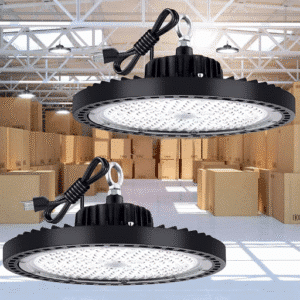
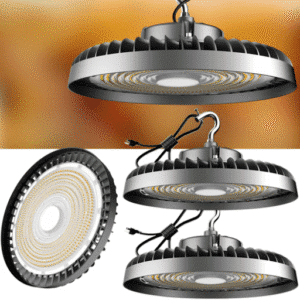
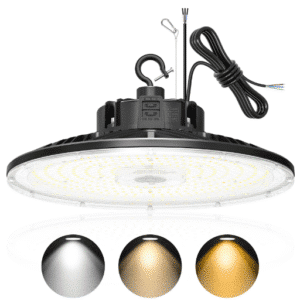
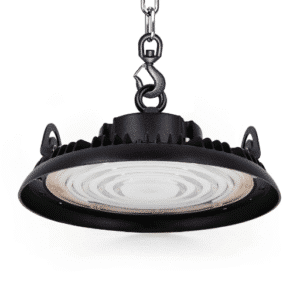
These outputs represent the warehouse lighting minimum lumens required to achieve the target foot-candle levels at each mounting height. For a detailed walkthrough on calculating lumens for your specific space, see our guide on how many lumens you need for high bay lighting.
Certifications to Require
Every fixture in your facility should carry a UL or ETL listing. These NRTL (Nationally Recognized Testing Laboratory) marks provide electrical safety proof which OSHA accepts as valid documentation. Additionally, look for DLC qualification if you plan to apply for utility rebates. For dusty or damp warehouse environments, specify an IP65 rating minimum to protect against dust ingress and moisture.
Beam Angle and Spacing for Even Coverage
The beam angle determines how light from the fixture will spread across different areas. A 60° beam angle directs light downwards to illuminate high-ceiling aisles which contain tall racking. A 90° to 120° angle spreads light across a wider area for open storage floors. The proper fixture spacing requires installations at a distance which equals 1.0 to 1.5 times the mounting height. At a 25-foot mounting height fixtures should be spaced between 25 and 37 feet apart.
Emergency Lighting Specifications
High-ceiling warehouses present a unique challenge for emergency lighting. A standard emergency fixture mounted at 30 feet may not deliver 1 foot-candle at the floor. Your system needs to use high-output LED emergency fixtures or battery backup modules which operate together with your main high bay lights. A monthly functional test needs to verify the 90-minute runtime capability.
Common Warehouse Lighting Compliance Mistakes

Even well-intentioned facilities make these errors. Avoiding them saves money and keeps workers safe.
- Designing to exactly 5 foot-candles. Without a light loss buffer, your facility will fall below compliance within months as fixtures age and collect dust.
- Measuring only at the center of the room. The center is almost always the brightest spot. The inspector will walk to the darkest aisle.
- Ignoring forklift auxiliary lighting requirements. Any zone below 2 foot-candles requires powered industrial trucks to use directional lighting.
- Using non-UL-listed or temporary fixtures permanently. Temporary string lights and unlisted fixtures do not satisfy OSHA’s fixture safety standards.
- Skipping emergency lighting verification. A power outage during a shift change is when emergency lighting matters most. Test it monthly.
- Failing to document measurements. If you cannot prove compliance with dated records, an inspector will rely on their own readings.
Upgrading to LED: A Compliance and Cost Strategy
Upgrading from metal halide or fluorescent to LED is one of the fastest ways to solve compliance and cost problems simultaneously.
A distribution center in Indiana replaced 400-watt metal halide fixtures with 150W UFO LED high bays. The facility now maintains a consistent light level of 22 foot-candles after previous light levels between 6 and 12 foot-candles. The company achieved a 68% reduction in energy expenses. The safety team reported fewer near-misses in the first quarter because workers could actually see labels and floor markings. The project paid for itself in 14 months through energy savings alone.
LED fixtures maintain consistent lumen output far longer than metal halide lamps, which can lose 30% of their brightness within the first year. With efficacy ratings of 150 lumens per watt or higher, LED high bays make it cost-effective to design for IES recommendations instead of scraping by at the OSHA minimum. Motion sensors and zoning controls cut runtime hours in low-traffic aisles without sacrificing compliance in occupied zones.
For a detailed cost breakdown, read our comparison of LED versus metal halide savings.
Explore our best UFO high bay lights for warehouse compliance
Conclusion
The legal minimum for general storage areas requires 5 foot-candles of light while active loading zones need 3 foot-candles. The minimum requirements help you avoid violations but they do not provide worker protection. The IES recommends 15 to 30 foot-candles for active warehouse tasks and designing to that standard protects both your people and your budget.
Begin with a compliance audit. Task plane measurements require operators to conduct their work. All readings need to be recorded. An LED retrofit will achieve compliance together with improved lighting consistency and energy efficiency when your existing system does not meet requirements. The cost of a planned upgrade is always lower than the cost of a citation, an accident, or a rushed emergency replacement.
Need a photometric plan to prove compliance? Contact our team for a layout analysis tailored to your facility’s ceiling height, square footage, and operational needs. We will show you exactly which fixtures deliver the foot-candles you need, where to place them, and how much you will save.