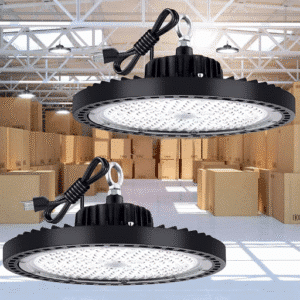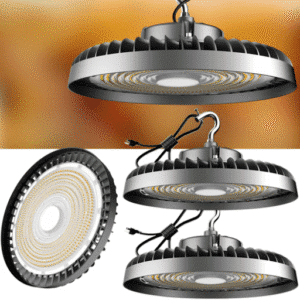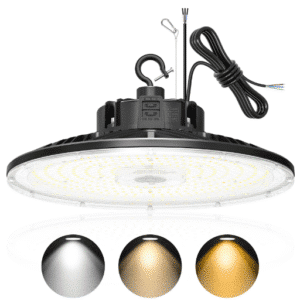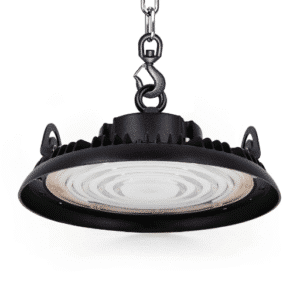

The beam angle is optimal for high bays and is also dependent on installing a building: higher than 25 feet, use 60 degrees; 20 to 25 feet, use 90 degrees; 15 to 20 feet, use 100 degrees; and less than 15 feet, use 120 degree. Narrow beams can throw a bright, concentrated light in the aisles of tall warehouse buildings with rack systems; on the contrary, the wider the beams, better the lighting spread evenly across lower spaces.
The space-footcandle ratio easily triples with the slightest miscalculation in the nomininal angle that may get the wrong lighting onto the ceiling deck, living dark voids amid fixtures, or give a hammer on the floor’s hotspots.
Last spring, Maria, the distribution-center plant operator at a 60,000-sq-ft facility in Ohio, put in 200W UFO fixtures outlined to 30,000 lumens. Grid specs looked great; six weeks afterwards, she found out her order pickers still thought the aisles were dark and the energy bill barely budged. The fixtures came through with 120° lenses and 30-ft mounting. Reflecting on this, they bundled 60° optics on, and voila, average floor illuminance improved from 14 to 36 fc at the same power.
That is why a beam angle comes into the picture. This article dissects how to make the choice based upon mounting height, task, and space, with examples and a selection table to be applied today.
Key Takeaways
- Beam angle is the cone of light measured at 50% of peak intensity, expressed in degrees (typically 60°, 90°, 100°, or 120° for high bay fixtures).
- Higher ceilings need narrower beams. Use 60° above 25 ft, 90°–100° for 15–25 ft, and 120° below 15 ft.
- The same 30,000-lumen fixture at 25 ft can deliver about 38 fc at 60°, 22 fc at 90°, or 14 fc at 120°.
- Always pair beam angle with spacing-to-height ratio: 0.8–1.0× for narrow beams, 1.3–1.5× for wide beams.
- Skip the catalog page and read the photometric (IES) file. Center beam candlepower (CBCP) reveals what total lumens hide.
What Is Beam Angle in High Bay Lighting?

In simpler terms, the beam angle is the given cone of light from any high bay fixture and is measured in degrees at the points where light intensity drops to 50% of its peak. High bay fixtures typically come with a range of 60°, 90°, 100°, and 120° for beam angles. It is with the narrow angles that an area is lit up for a higher ceiling or that wide angles are spread to illuminate a larger area for a lower ceiling. For a deeper comparison of high-bay and low-bay lights, please refer to our complete (guide to high-bay vs low-bay lights).
The half-power angle, explained
Engineers call this measurement the full-width-half-maximum, or FWHM. Imagine the light leaving the fixture as a cone. The center of that cone is the brightest point. As you move outward, intensity drops. The beam angle is the width of the cone at the point where intensity has fallen to half of that peak.
Anything outside that cone is still light, but lighting designers call it spill or field light. Field angle measures the wider cone where intensity drops to 10% of peak.
Why beam angle matters more than total lumens
Two fixtures can produce the same 30,000 lumens and deliver completely different results on the floor. A 60° beam pushes more candelas straight down. A 120° beam spreads the same lumens over a wider area, lowering the foot-candles at any given point.
If you select fixtures by lumens alone, you might pay for output that never reaches your workers. Beam angle is the geometry that connects fixture spec to floor performance.
Standard Beam Angles for High Bay Lights
Most LED high bay manufacturers offer beam angles in four common widths. Each has a clear role.
60° narrow beam
Narrow optics are built for ceilings 25 ft and higher, narrow aisle racking, and any space where you need to push intensity deep. They deliver high center beam candlepower (CBCP) and minimize wasted light on walls and ceiling structure. Distribution centers with selective-rack or very-narrow-aisle (VNA) layouts almost always specify 60° fixtures.
90° medium-narrow beam
90° is the workhorse for 20–25 ft ceilings. It balances intensity with reasonable spread. Most general warehousing, manufacturing bays, and large workshops do well with 90° optics because they offer good uniformity without leaving dark gaps.
100° medium-wide beam
For mid-height industrial spaces between 15 and 20 ft, 100° optics deliver smoother coverage with slightly less peak intensity. Light packing, assembly lines, and mixed-use warehouses fit this profile.
120° wide beam
The horizontal optics are suitable for spaces with lower ceilings: workshops, retail store floors, gymnasiums, and production floors rising at less than 15 ft. These optics give a wide, balanced distribution that minimizes any hotspots, and also brings a reduction in the overall number of fixtures used, elevating application up to 30 ft is underutilization.
If you are still deciding between fixture form factors and beam options, our UFO high bay lighting guide walks through the standard options Probapro engineers for industrial sites.
How Ceiling Height Determines Beam Angle
The single most important variable in this decision is mounting height. Not ceiling height, mounting height: the actual distance from the floor to the fixture. If you need to dig deeper into how ceiling structure affects fixture placement, our guide on (ceiling height for high bay lighting) covers the full framework.
The inverse-square rule and beam spread
Physics is cold here. When rules are made in physics, there is a dark path. It is punishable by a factor of four that doubles the distance of the light source. Therefore, you actually need approximately four times the candelas at the centermost setting to produce the foot-candles on the floor in order to maintain it for a 30-ft-high fixture instead of a 15-foot-high one.
Narrower beams concentrate those candelas. That is why high ceilings demand tight optics. A 120° lens at 35 ft wastes most of its output on racking sides and the upper structure, never reaching the floor at usable intensity.
Beam angle by ceiling height: reference table

| Mounting Height | Recommended Beam Angle | Spacing (× Mounting Height) | Typical Use Case |
|---|---|---|---|
| 10–15 ft | 120° | 1.3–1.5× | Workshops, gyms, retail stockrooms |
| 15–20 ft | 100°–120° | 1.2–1.4× | Light warehousing, packing, assembly |
| 20–25 ft | 90°–100° | 1.0–1.3× | General warehouses, manufacturing |
| 25–30 ft | 60°–90° | 1.0–1.2× | High-rack warehousing, production |
| 30–40+ ft | 60° | 0.8–1.0× | Distribution centers, narrow aisles |
This table reflects the foot-candle targets recommended by the Illuminating Engineering Society for industrial spaces. Cross-check it against your actual task requirements before specifying.
Narrow vs Wide Beam: The Trade-offs
Choosing between narrow and wide is rarely about which is “better.” It is about which trade-offs fit your facility.
Narrow beam (60°) advantages and drawbacks
They provide incomparable down lighting directly beneath the fixtures, penetrating deep into the ground in high-ceiling situations. They successfully pass through racking, focusing light on the applicable areas where workers need pouring light.
The compromise, however, is this: when set up too far apart, a 60-degree would cause too strong explosive points and inadequate uniformity. For instance, a 60-degree beam fitted at a height of 30 ft only lit up a small circle of light very strongly; when you space these units 1.5 times by mounting height, you get brilliant spots under each unit and almost darkness between them.
Wide beam (120°) advantages and drawbacks
They radiate all of the illuminated light with minimum hot spotting. These are very forgiving with the barriers of spacing and create fewer fixtures in a tight-ceiling environment.
The compromise: The light washes the sides of walls and ceiling with light in high-ceiled environments. A 120° beam on a 30-ft high ceiling will give you less than half the floor illumination produced by a 60° beam of equal luminaire output.
How to Choose the Right Beam Angle: A 4-Step Method

Skip the catalog browsing. Use this sequence instead.
Step 1: Measure mounting height (not ceiling height)
Fixtures rarely hang at the ceiling deck. Pendant rods, suspension cables, and hook mounts often lower fixtures 2–5 ft below the structure. That delta matters. Measure from the floor to where the fixture will actually sit.
Step 2: Define the task and foot-candle target
Different tasks need different brightness. IES recommended foot-candle ranges:
- General storage: 10–20 fc
- Picking and packing: 20–30 fc
- Manufacturing and assembly: 30–50 fc
- Inspection and quality control: 50–100+ fc
Match the target to the lowest-intensity activity in the space. If your workers inspect parts in one zone and store pallets in another, plan separately or use the higher target.
Step 3: Decide between aisle coverage and open-floor coverage
Racked warehouses with tall, narrow aisles need narrow optics that reach down between the racks. Open production floors need wider optics for uniform spread.
Last fall, Jake, a contractor in a retail-distribution hybrid space, installed 60° fixtures across an open packing floor with 18-ft ceilings. The result: harsh pools of light surrounded by dark borders. Swapping to 100° fixed the uniformity in a single afternoon.
Step 4: Confirm with spacing-to-height ratio
Once you have a beam angle, verify the layout math. Spacing-to-mounting-height ratios:
- Narrow beam (60°): 0.8–1.0× mounting height
- Medium beam (90°–100°): 1.0–1.3× mounting height
- Wide beam (120°): 1.3–1.5× mounting height
If your existing fixture layout forces a wider spacing than the beam supports, plan to add fixtures or widen the optic.
Beam Angle and Foot-Candle Delivery: A Worked Example
Theory is fine. Numbers are better.
Setup: 30,000-lumen fixture at 25 ft mounting height
Take a single 200W UFO fixture rated at 30,000 lumens, hung at 25 ft. With nothing else changing, here is how floor illuminance directly below the fixture shifts by beam angle:
- 60° beam: approximately 38 fc
- 90° beam: approximately 22 fc
- 120° beam: approximately 14 fc
The fixture is identical. The lumens are identical. Beam angle alone produces a 2.7x swing in foot-candles on the floor.
This is also why two fixtures with the same lumen rating can perform differently. A 30,000-lumen 60° fixture might list a CBCP of 25,000 candelas; the same lumens at 120° drops CBCP to under 8,000 candelas. The total light output stays the same. The intensity at any given point does not.
Why center beam candlepower matters
Always check the photometric file (an IES file) before specifying a fixture. The IES file plots intensity in every direction. It will tell you the peak candela, the beam angle, the field angle, and how light distributes through the floor plane.
Carlos, a facility engineer at a Texas distribution center with 35-ft ceilings, was running 200W fixtures at 90° and measuring only 18 fc in the aisles. He pulled the IES files and confirmed the fixtures were below target for the height. He swapped to a 60° version of the same fixture line. Aisle illuminance jumped to 41 fc, and the team finally met OSHA workplace lighting recommendations for picking accuracy without adding fixture count.
Reflectors, Lenses, and Effective Beam Angle

The optic system inside the fixture shapes the beam.
Polycarbonate clear lens
A clear PC lens preserves the stated beam angle and produces sharper cutoffs. It also exposes more glare from the LED array, which can be a problem in high-traffic visual zones.
Frosted or diffused lens
Frosted lenses widen the perceived beam by roughly 5–10° and lower peak candela by 10–15%. They reduce direct glare and create a softer overall feel. Useful in gyms, retail spaces, and any environment where worker line of sight crosses the fixture. Our guide to (UFO vs linear high bay) lighting breaks down the exact spacing and photometric differences.
Reflector design
Faceted aluminum reflectors deliver clean beam edges and tighter cutoff. Smooth or hammered reflectors blend the transition between bright center and outer edge, which can improve perceived uniformity at the cost of slightly less center intensity.
When you compare fixtures, do not assume two 90° beams are equivalent. Check the photometric file. Manufacturers sometimes round beam angles up or down in marketing copy.
Common Beam Angle Mistakes to Avoid
Five errors come up over and over in industrial retrofits.
- Using 120° in a 30-ft warehouse. Foot-candles drop, energy use stays the same, and the floor still looks dim. This is the most expensive mistake.
- Using 60° in a 15-ft retail space. Creates hot spots directly under fixtures and dim valleys between them. Uniformity ratios spike to 4:1 or worse.
- Ignoring rack height. Fixtures must clear the top of racking. If a 60° beam is partially blocked by a rack top, you lose the very intensity you specified.
- Selecting beam angle before confirming spacing. Beam angle and spacing are paired decisions. Treating them separately leads to dark gaps or wasted lumens.
- Skipping the photometric file. Catalog beam-angle numbers are summaries. The IES file is the real data.
Most of these mistakes also tie back to wattage selection. For a deeper look at how wattage interacts with beam angle, see our high bay light wattage guide, and review warehouse lighting layout for spacing math.
Conclusion: Beam Angle Is the Missing Variable
For most industrial lighting projects, the beam angle for high bay lights is the difference between a successful retrofit and a costly second round of rework. Lumens get the headlines. Beam angle decides what actually lands on your floor.
Five things to remember:
- Match beam angle to mounting height: 60° for ceilings above 25 ft, 90° for 20–25 ft, 100° for 15–20 ft, 120° below 15 ft.
- Beam angle measured at 50% of peak intensity. Anything beyond that is spill light.
- The same lumen rating at different beam angles produces 2–3x swings in floor foot-candles.
- Pair beam angle with the right spacing-to-height ratio every time.
- Always read the photometric (IES) file before you specify.
Probapro engineers selectable beam-angle UFO high bay fixtures for warehouses, distribution centers, factories, and gymnasiums in our full high bay LED lights catalog. Each model ships with the photometric file, full DLC qualification data, and our IP65 / IK08 industrial build.
Get the right beam angle the first time. Request a free photometric layout from Probapro and we will model your facility, recommend the optic and wattage combination, and help you avoid the rework that catches most operators on retrofit day.