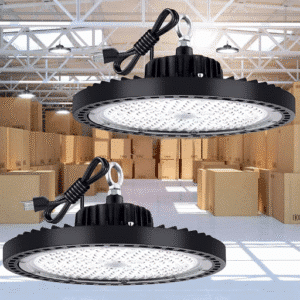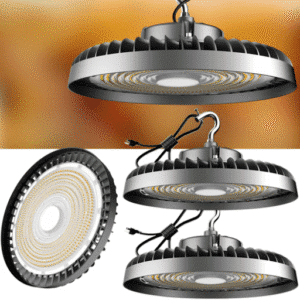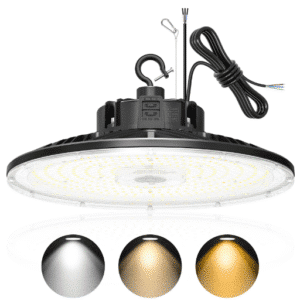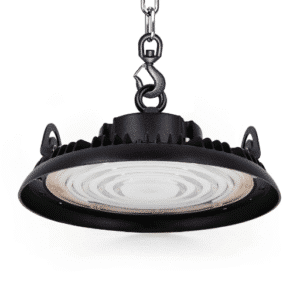

For high bay lighting, the minimum ceiling height required is 20 ft. Anything below this level is better serviced with low bay light fixtures which offer more even coverage and less glare. However, anything above 20 ft necessitates the use of high bays with appropriate beam angle and lumens output for safe and efficient working conditions.
Mike Chen, the facilities manager at a Midwest distribution center, had a bitter taste of this perennial struggle. It so happened that his warehouse’s ceiling was 18 feet high. He was advised by a supplier to use the regular UFO high bays meant for 25-foot ceiling mounts.
After half a year of running the system, employees reported complaints of glare in packaging zones. Accuracy in picking was reduced by 12 percent.
In the end, Mike had to relay 40 units gonna $18, 000. Where did he go wrong? He purchased for the height of the ceiling instead of the mounting. He purchased high bays when the required optical layout was a wide-beam low bay.
This manual provides an unequivocal decision-making strategy when it comes to a UFO High Bay Lighting installation. You will be told which heights exactly to respect, how to measure a genuine mount height, how many renderings are to be employed at which height and in which angle of illumination and the common errors that cause huge losses for the facility manager in refurbishing will be touched upon. For a deeper comparison of high-bay and low-bay lights, please refer to our complete (guide to high-bay vs low-bay lights).
Key Takeaways
- High bay lighting starts actually at 20 feet mounting height per IES RP-7 standards. Below 20 feet, use low bay fixtures or wide-beam high bays.
- Use floor-to-fixture (true mounting height), not floor-to-ceiling. Anything like ductwork or trusses can reduce effective height by 2-4 feet.
- At 20-25 feet, specify 18,000-25,000 lumens with 90° beam angles. At 25-35 feet, move to 25,000-40,000 lumens with 60° to 90° beams.
- The gray area of 15-20 feet requires a rundown of racking presence, aisle width, glare tolerance, and requirements for the tasks to decide the desired high bay fixture for any specific application.
- An incorrect fixture-height match costs 15-30% more energy and drives re-installation costs two to three times more than right on the first go.
The 20-Foot Rule: Where High Bay Lighting Actually Starts

The 20-foot threshold is not arbitrary. High bay spaces, according to the Illuminating Engineering Society (IES), are spaces where the fixture mounts 20 feet or higher. Installers in the field are quick to agree and practice itself confirms it. Below this contour, standard high bay optics do not apply since the physics of light distribution do not permit them.
The light from high bay fixtures shines down a long distance. This light is condensed and poured down by beam angles of 60 to 90 degrees. When the bubble starts just 15 feet above the ground, extremely close light levels end up creating hotspot down the columns. The huge gaps between the columns will now be in near darkness.
Workers are stunned by the glare. Light is plentiful and glaring off reflective surfaces, with reflective materials encompassing floors, walls, and clad racking, and amplifying the problem even further.
On the contrary, the vast distribution of greater beam angles with low bays ranging from 90 to 120 degrees or wider ensures suffused, comfortable light all throughout, without that bombardment of brightness typical for high bays when mounted at such lower distances. Want to know (what is high bay lighting?) Please see our related guide.
Why 20 Feet Is the Industry Standard (IES RP-7)
IES RP-21 and RP-7 form the background to technical standards governing industrial lighting design practice. These standards also delineate fixture categories depending on mounting height, spelt out by the inverse square-law relationship between height, lumens dropping with it, beam angle, and illuminance. Doubling the mounting height mandates a fourfold increase in lumens to hold lamp levels upon the work plane. Therefore, fixtures designated for a 30-foot mounting height cannot help but be excessive to some extent at 18 feet.
OSHA lays down that 5 foot-candles should be maintained as the minimum level of illumination in any warehouse, taking for granted that 30-50 foot-candles may reasonably be required for active picking and packing operations, depending on the constant engagement of the worker. Furnishing those levels of light from just over 20 feet tall means the fixture must be very potent–that much centralised light would move those to working past beyond the 100 foot-candles at mere 15 feet in some spots.
Mounting Height vs. Ceiling Height: Measure the Right Number
This is where most specification errors begin. Facility managers measure the structural ceiling and assume that is the mounting height. It’s not.
True mounting height is the distance from the floor to the bottom of the fixture. In most industrial buildings, that number is 2 to 4 feet lower than the ceiling deck. Consider what hangs below the roof structure:
- HVAC ductwork and diffusers
- Fire suppression sprinkler systems
- Electrical conduit and cable trays
- Crane rails and monorail systems
- Structural trusses and joists
A 25-foot ceiling with 3 feet of ductwork and a 1-foot pendant drop leaves a true mounting height of 21 feet. That changes everything. Specifically, the beam angle, spacing, and lumen output all shift when the effective height drops by 4 feet.
Rule: Always send someone up with a tape measure before specifying fixtures. The number on the architectural drawing is rarely the number that matters.
How Ceiling Height Affects Lumen Output and Fixture Selection

Once you know the true mounting height, the next step is matching lumen output, wattage, and beam angle to that number. Getting this match wrong is the second most common specification error after incorrect height measurement.
Lumens by Ceiling Height
This table gives you the starting point for fixture selection, including LED high bay lighting for 20 ft ceiling heights and beyond. These values assume general warehouse operations targeting 30-50 foot-candles with a standard light loss factor of 0.8.
| Mounting Height | Recommended Lumens | Typical LED Wattage | Beam Angle | Best Fixture Type |
|---|---|---|---|---|
| 15-20 ft | 15,000-22,000 | 100-150W | 90-120 degrees | Wide-beam UFO or low bay |
| 20-25 ft | 18,000-25,000 | 100-150W | 90 degrees | UFO high bay |
| 25-35 ft | 25,000-40,000 | 150-200W | 60-90 degrees | UFO or linear high bay |
| 35-50 ft | 35,000-60,000 | 200-300W | 60 degrees or narrower | Linear or modular high bay |
| 50+ ft | 50,000-75,000 | 300W+ | Narrow/custom | Super high bay modular |
The 15-20 foot range sits in the gray zone. Some applications work with wide-beam UFO high bays. Others need purpose-built low bay fixtures.
The next section covers how to decide. For most buyers, understanding the minimum height for high bay lights is the first step to avoiding a costly mismatch.
Wattage vs. Lumens: What Actually Matters
The term wattage says the power grabbed by a unit. Lumens yell out the light that the fixtures send. The real metric to focus on is, and always ought to remain, the quantity of lumens per watt, generally referred to as efficacy.
A rather up-to-date LED UFO high bay fixture manages 150-175+ lumens/watt (lm/W) while the 150W counterpart boasts the output of 24,000 lumens at 160 lm/W. Arranging it according to the same characteristics, the 200W fixture would provide 32,000 lumens.
That is a difference of 50 watts with 8,000 lumens in addition.
In the case of model numbers, feature lumens first; make sure they are consistent with your mounting height and the types of activities performed. Then check to see if the wattage is efficient enough to minimize operating costs. A configuration with the same lumens at a lower wattage comes down in lifetime energy savings.
Look out for DLC, UL, or ETL certification of luminaries on terms of rebate and quality assurance. It proves that the lumen output and efficacy stated in specifications are in tune with independent testing verification.
Beam Angle for High Bay Lights: Selection by Height
Beam angle is the most misunderstood variable in high bay specification. Think of it like a spray nozzle. A narrow angle concentrates the stream. A wide angle fans it out.
At 20 to 25 feet, a 90° beam spreads light too widely for it to avoid any zebra striping from noticeable degree of intensity at the floor between the luminaires. At 35 feet, a 90° beam has too much light spread to render the floor nearly dark. An important point is that a 60° beam is needed to direct more light energetically downward with a strong component to carry the luminaire foot-candles long enough for one to use.
The opposite mistake is just as costly. A 60-degree beam at 20 feet creates blinding pin spots. Workers tilt away from the light.
Forklift operators lose depth perception. The space feels aggressive rather than functional.
Match the optic to the height. Start with your true mounting height. Then select the beam angle that maintains uniform coverage at that distance. Your manufacturer should provide photometric data showing lux distribution at various mounting heights.
Check out our (beam angle for high bay lights guide) to find out what wattage of high bay lights you should buy.
The 15-20 Ft Gray Zone: Low Bay or High Bay?
15 to 20 foot ceilings make for more thinking. When they are below the official high bay IES threshold, in comes the high bay fixture, large lobe, different caveats, and their own designers, which is why we say the error margin at hand here is awfully small.
Now consider the size of Acme Parts, a small factory in the state of Ohio; production floor ceilings were at 17 feet with very few obstacles. The owner fixed typical 90-degree UFO high bays specified for 20,000 lumens.
At this height, the floor adequately establishes lumens. Instead, the light almost saturated the machinists sitting at the benches from the beginning. He took the panels back out and replaced them with low bay panels with diffuser lenses in response to four months of employee grumbling.
Illumination on the floor decreased from 55 foot-candles to a comfortable 40. Worker morale improved immediately. In view, the nature of the fixture will mean more at 17 feet than mere raw output.
Use this checklist when your mounting height falls in the 15-20 foot range:
- Is there tall racking or shelving? If racking reaches 14-15 feet, a high bay mounted at 17 feet has only 2-3 feet of clearance. Light hits the top of pallets instead of the aisles. Use low bays or linear aisle lighting.
- Are aisles narrow? Narrow aisles amplify glare because workers look directly across the space at fixtures on the opposite side. Low bays with diffused optics reduce this problem.
- What tasks happen in the space? Detailed assembly or inspection needs high, uniform light. General storage or shipping can tolerate more variation. High bays in the gray zone work better for storage than for precision tasks.
- Is glare tolerance low? If the space has polished floors, white walls, or reflective machinery, wide-beam high bays at 15-18 feet create excessive reflection. Low bays with lower lumen output and diffused lenses are the safer choice.
- Will the space change? If you plan to add mezzanines or taller racking within five years, low bays give you more flexibility. High bays lock you into a specific mounting height range.
When in doubt, choose low bay for the gray zone. You can always supplement with task lighting at workstations. Reversing a high bay installation is expensive. Interested in low bay lighting? Check out our “What is Low Bay Lighting?” guide.
High Bay Lighting Spacing Guidelines by Ceiling Height

What serves as the litmus test is whether illumination all around is uniform, or whether a checkerboard of bright spots and shadows will be the result. Proper warehouse lighting layout, though, would require matching these spacing manners to the true mounting height, beam angle, and the coefficient of utilization–an expression for how much of the room’s light is reflected from the surfaces.
The Spacing-to-Height Ratio
The general rule of thumb is to space about 1.0 to 1.5 mounting-height units apart from the roof. In practice, for a 25-foot mounting height, it would scale from 25 to 37.5.
By design, the 1.5x end of this range works very well: fluorescent light-colored ceilings and walls, open space plans, late floors, and wide beamwidth angles. Applying 1.2 times the mounting height, the majority of industrial spaces usually allow for the maximum practical spacing. Dark floors, high-stack, narrow racks yet want fixtures to function at a closer spacing side.
This table shows recommended spacing by mounting height for general warehouse conditions:
| Mounting Height | Recommended Spacing | Spacing Range |
|---|---|---|
| 15-20 ft | 12-18 ft | 0.8-1.0x mounting height |
| 20-25 ft | 18-25 ft | 0.9-1.1x mounting height |
| 25-30 ft | 20-28 ft | 0.9-1.1x mounting height |
| 30-35 ft | 24-32 ft | 0.8-1.0x mounting height |
| 35-40 ft | 28-36 ft | 0.8-1.0x mounting height |
Remember that tall ceilings usually require narrow beam angles. That is because narrow beam angles focus on a small spread of the horizontal area. So, a 60-degree beam that is placed 35 feet high creates a very small pool of light on the floor as compared to a 90-degree beam placed 25 feet high.
For big projects, always go for a photometric layout utilizing the manufacturer’s IES file in programs like DIALux or AGi32. These simulations will point out to you where any dark spots or overly illuminated zones are long before you actually lay down an order for one-off fixtures. If you’re considering fixtures for 20-25 foot heights, our 150W UFO high bay might be your solution for the lumens and beam angles you need. For 25-35 foot mounting heights, go with a 200W UFO High Bay-it offers a focused light beam over long throws.
Wall Offset Rules
The most obvious thing is that the first setting of fixtures should be halfway from the wall when viewed from the interior line. For an interior with 20-foot fixture spacing squares, the wall row is 10 feet away from the room’s walls. It is necessary to prevent the dark perimeter that occurs when fixtures are too close to walls or too long from walls.
Racked Aisle Considerations
One major flaw in going with rack serving is that at pallet-top height, the light is all wasted. Additionally, any light meant for reaching the floor must travel over many obstructions due to the obstacles in-between racks.
When considering rack aisles, given contrary beam patterns of 20+ foot, narrow-rack light distribution has been seen to work in a grid system. Normally, linear high bays are found rather safe long-term than round UFO fixtures to light up aisles specifically. A rectangular distribution born from the 360-degree optics sends light downward, up and down at extravert, libraries, or storage label reading, and may deal at least with shadow buffs.
There is indeed an 8-foot headroom for the light sources below the first row on their fixture mounts. That convenient 30-foot effective throw distance? It is in truth the 8-foot distance to the top of the racking plus the racking height. Light selection requires a nod in the headache.
Common Ceiling Height Mistakes for High Bay Lighting (and How to Avoid Them)
Field installers and lighting designers see the same errors repeatedly. Most are preventable with a 30-minute site survey and a basic lighting calculation.
Measuring Ceiling Height Instead of True Mounting Height
This is the number one mistake. A facilities director at a Tennessee automotive plant ordered 200 fixtures based on a 32-foot ceiling height shown on the building plans.
What the plans did not show was a network of compressed air lines and electrical busway suspended 4 feet below the roof deck. The fixtures had to hang below the busway on 2-foot drops. True mounting height: 26 feet. The 200W fixtures specified for 32-foot heights over-delivered at 26 feet, creating glare complaints and excessive energy consumption.
A simple field measurement would have caught the error before the purchase order.
Using One Fixture Type Across the Entire Building
Warehouses are not flat boxes. A typical facility contains open floor areas, narrow racking aisles, packing stations, loading docks, and offices. Each zone has different ceiling heights, task requirements, and obstruction profiles.
Using identical UFO high bays everywhere is convenient and usually wrong. The packing station near the shipping door may have a 16-foot ceiling. The bulk storage area behind it may clear 28 feet. The aisle between them has 24-foot racking.
One fixture type cannot serve all three zones optimally. Choosing between UFO and linear fixtures by zone improves uniformity, lowers energy bills, and reduces complaints.
Ignoring Glare Angles at Different Heights
Glare isn’t merely a problem of intensity; it’s also of the angles. Light fittings located directly above and 20 m above a workstation can throw light directly downwards into a worker’s eyes hurting them because they are at an uncomfortable angle. The same fitting, at 30 ft., provides a more attenuated, steeper angle that mostly reduces the incident glare.
Lift truck operators will be the most vulnerable. When the chip mast hoists to deposit the pallets, it looks for a rather high-level, and the fixture is quite a bad aim, so as to reflect right into the driver’s eyes. This momentary blindness highlights a massive safety violation at this level. Think about fixture shielding, re-aiming the fixtures, or repositioning them in places where workers are constantly looking up.
Over-Lighting “Just to Be Safe”
Some specifiers add 20-30% more fixtures or specify maximum wattage as a buffer. This creates excessive contrast, eye fatigue, and reflective glare off polished floors. It also drives up energy costs permanently.
Instead, the right approach is a photometric calculation based on actual task requirements. General storage needs 10-20 foot-candles. Active picking needs 30-50. Detailed inspection may need 75-100.
Specify for the task, not the maximum. You can always add supplemental task lighting at specific workstations if needed.
Failing to Plan for Maintenance Access
At 35+ feet, changing a fixture requires a scissor lift or boom lift. Rental costs, aisle blockage, and downtime all increase with height. If a driver fails in a fixture mounted over a production line, the maintenance burden is significant enough that it often gets deferred.
Plan fixture locations with access in mind. Leave clearance for lift maneuvering. Consider fixtures with field-replaceable drivers that can be serviced without removing the entire unit. In very high bays, the labor cost of access can exceed the fixture cost over the system’s lifetime.
Looking to retrofit your high bay lights? Check out our (high bay lighting retrofit guide) before you start.
Connecting Height to ROI: Why Getting This Right Saves Money

Ceiling height decisions directly impact three cost categories: energy, maintenance, and re-installation.
Energy Waste from Wrong Fixture-Height Matching
If a considerably narrow beam high bay light is installed below the optimal mounting height, it sends most light beyond the useful area. The light falls on the tops of racks, walls, or machinery, but not the task area. The facility is throwing money at lumens that do not contribute to visibility or safety.
Conversely, a high-mounted wide beam fixture dissipates light before it even reaches the floor. Even though high energy consumption is maintained, the space appears to be dim. The facility manager usually will resolve this by adding more fixtures or moving to higher power fixtures, further doubling up energy wastage.
In summary, a proper fixture is an ideal representation of minimizing waste since it gets the right amount of light to the appropriate place. Therefore, in a 50,000 SF warehouse, it comes to within 15-30% of the annual energy worth of the design or improper fixture area.
Want to see what optimized lighting could save your facility? Explore our UFO high bay lighting solutions designed for precise height matching and maximum efficiency.
Maintenance Access Costs at Different Heights
The cost to service a fixture increases with mounting height. At 20 feet, a technician on a step ladder can reach most fixtures. At 30 feet, you need a scissor lift.
At 40 feet, a boom lift with an operator. Each step up adds rental fees, aisle closure time, and labor hours.
A facility with 100 fixtures at 35-foot mounting height should budget 150−300 per fixture for a routine maintenance cycle that includes lift rental and labor. At 20 feet, the same cycle costs 150−300 per fixture for a routine maintenance cycle that includes lift rental and labor. At 20feet, the same cycle costs 30-50 per fixture. Over a 10-year lifespan, that difference adds up to $12,000-25,000 in maintenance cost variance.
Fixtures with longer rated lifespans and field-replaceable components reduce this burden. For example, our high bay LED lighting range includes options rated for 50,000+ hours. At 12 hours per day, that means over 11 years before the first replacement cycle.
A metal halide fixture at the same location needs replacement every 2-3 years. Consequently, the labor savings alone often justify the LED upgrade.
The Cost of Re-Installation
Fixing a specification error after installation is the most expensive outcome. The facility must remove the wrong fixtures, patch or modify mounting hardware, order replacements, and reinstall. During the swap, operations are disrupted or sections of the facility go dark.
According to the industry, the reinstallation cost might be almost the same or even twice the original installment price. Now let’s assume that in a warehouse with 100 fixtures, the original install would cost 8,000-12,000. The specifications are wrong; so reboot would be 8,000-12,000. If the specs are wrong, now you are looking at a range of 20,000-35,000; it depends on how much of everything: removal, disposal, and labor and, of course, the new fixtures.
The prevention is simple: measure true mounting height. Confirm task requirements. Run a basic lumen calculation. Verify beam angles against the space layout.
These four steps take less than an hour and can prevent a $20,000 mistake.
Conclusion
Ceiling height for high bay lighting is not a suggestion. It’s a specification parameter that drives lumen output, beam angle, spacing, and energy efficiency. Start at 20 feet. Measure true mounting height, not ceiling deck height.
Match the fixture to the height, the task, and the space layout.
The 15-20-foot grey area should operate based on a full checklist. Think of racking, aisle widths, glare tolerances, and what might be possible for future changes before fixing on a fixture. At heights above 20 feet, you would have to narrow your beam angles and lumen output with increasing height. An added possibility is that obstructions such as overhead piping, ventilation, or fire suppression could decrease your effective mounting height.
Improper specifications are more expensive in every respect than wasting more energy. They create hazards, restrict productivity, and increase re-installation expenses, which can top the original budget for fixtures. Eliminate all this with 30 minutes of a site survey and a lighting calculation.
Start with the numbers in planning for a lighting upgrade or a new installation before selecting the fixtures. Fixtures that could provide illumination exactly where needed are those you should be specifying. Good lighting increases development, and good ceiling height matching is where it all starts.
Need help selecting fixtures for your ceiling height? Get a custom lighting assessment and receive a photometric layout recommendation tailored to your facility’s exact dimensions.