
Neither UFO nor linear high bay lights are universally better. The right choice depends on your facility layout: choose UFO fixtures for open warehouse floors and linear fixtures for narrow aisles with racked shelving. Many large facilities use both in a hybrid design.
The distribution center manager installed 200 UFO high bays throughout the 200000 square foot facility because he believed that uniformity would make it easier to handle maintenance tasks. Within three months, pickers complained they could not read labels on lower rack shelves. The photometric audit showed that 35% of UFO light output reached rack tops while 65% remained in the aisle areas. The installation of linear aisle-optic fixtures into pick aisles reduced fixture requirements by 18% while increasing vertical illuminance by 40%.
You know that choosing the wrong fixture shape wastes money, creates dark spots, and reduces worker productivity. This guide provides you with technical criteria and actual cost information and a detailed process for selecting the proper fixture on your initial attempt. The presentation will examine differences in light distribution and track installation expenses and assessment of durability and glare control and recommendations for various applications and hybrid design approach and smart controls system compatibility and a decision checklist which you can implement immediately. For a deeper comparison of high-bay and low-bay lights, please refer to our complete (guide to high-bay vs low-bay lights).
Key Takeaways
- UFO high bays excel in open floors, high ceilings, and harsh environments with circular beam patterns that flood wide areas
- Linear high bays outperform in narrow aisles, racked storage, and task-precise areas with rectangular light distribution
- Many facilities achieve the best results with a hybrid design that matches each zone to the right fixture type
- Installation cost, spacing calculations, and smart controls should drive the decision alongside fixture price
What Is a UFO High Bay Light?

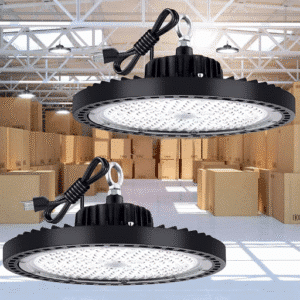
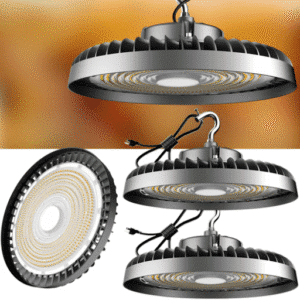
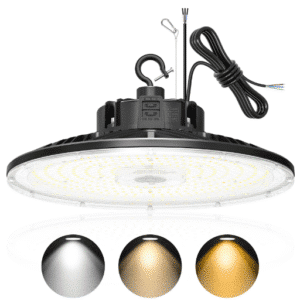
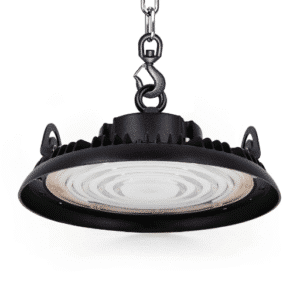
The UFO high bay light fixture exists as a circular LED light that serves spaces with ceiling heights ranging from 15 to 50 feet. Its circular form factor concentrates the LED chips in a small area and projects light downward through a single optical lens. This design produces a circular beam pattern that distributes light throughout open space. Want to know (what is high bay lighting?) Please see our related guide.
Typical Specifications
UFO fixtures operate between 100W and 240W which produces light output between 15000 lumens and 36000 lumens. Efficacy for quality models runs between 135 and 180 lm/W. Standard beam angles include 60deg, 90deg, and 120deg, with 90deg to 120deg being the most common for general warehouse use. The values are obtained through testing according to IES LM-79-19 standards.
Why the Compact Shape Matters
The UFO’s single-point design offers two practical advantages. The entire fixture functions as a radial heat sink according to its first practical benefit. The finned aluminum housing dissipates heat efficiently from the concentrated LED array, which helps maintain lumen output over time. The compact size enables users to install equipment through single-point mounting. A standard hook or pendant mount installs in 3 to 5 minutes per fixture. The process achieves two objectives by lowering workforce expenses and making retrofit installations easier.
The circular beam pattern works best in unobstructed spaces. In an open warehouse floor with no racking, a 120deg UFO at 25 feet can cover approximately 30 feet on center. For a deeper look at how lumens translate to real coverage, see our (guide on how many lumens you need for high bay lighting).
What Is a Linear High Bay Light?
The linear high bay light functions as an elongated rectangular LED fixture which operates in the same ceiling height range as UFO fixtures. The system uses multiple LED chips which run across its entire length to create a distribution pattern that uses asymmetric optics for producing a rectangular beam pattern. The distribution pattern of the system matches the layout of long narrow areas which include aisles and production lines and conveyor corridors.
Typical Specifications
The linear fixtures operate at power levels between 100W and 200W which enables them to generate a light output range of 15000 to 32000 lumens. The efficacy of the system operates between 130 lm/W and 170 lm/W. The fundamental distinction exists in optical design whereas all other aspects remain constant. The linear fixtures implement aisle-optic lenses which direct their light output along the fixture’s length while minimizing sideward light leakage. The system delivers illumination down the aisle corridor while avoiding waste of light to rack tops.
Why the Elongated Shape Matters
The linear form factor provides superior vertical illuminance. In a racked warehouse, pickers need to see labels on vertical shelf faces. A linear fixture with aisle optics directs light at those surfaces, improving barcode scan accuracy and reducing picking errors. The light source is also spread across a longer area, which typically produces lower glare.
Installation requires two-point suspension. Chain, cable, or rod mounts keep the fixture level and oriented correctly. This adds 8 to 12 minutes per fixture compared to a UFO hook mount. Alignment matters. If the fixture rotates even slightly off-axis, the asymmetric beam misses the aisle and defeats the purpose.
UFO vs Linear High Bay: Side-by-Side Comparison
The difference between UFO and linear high bay lights comes down to how the shape controls light. One is not superior to the other. Each solves a specific distribution problem.
| Feature | UFO High Bay | Linear High Bay |
|---|---|---|
| Shape | Round, compact | Rectangular, elongated |
| Light Pattern | Circular, symmetrical | Rectangular, asymmetric |
| Best Layout | Open floors, bulk storage | Narrow aisles, rack rows |
| Beam Angle | 60deg to 120deg | Aisle optics, 90deg x 120deg |
| Mounting | Single-point hook/pendant | Two-point chain or cable |
| Install Time | 3-5 minutes per fixture | 8-12 minutes per fixture |
| Typical Efficacy | 135-180 lm/W | 130-170 lm/W |
| Glare (UGR) | 22-28 | 19-25 |
| IP Rating | Often IP65 | Varies, typically IP54-IP65 |
| Best Ceiling Height | 20-50+ ft | 15-35 ft |
Check out our (beam angle for high bay lights guide) to find out what wattage of high bay lights you should buy.
The Deciding Factor: Open Floor vs. Structured Aisles
Your facility layout is the single most important variable. In an open warehouse with bulk storage on the floor and minimal racking, UFO fixtures provide the simplest, most cost-effective coverage. Their circular beams overlap naturally in a grid pattern, creating uniform horizontal illuminance across the entire space.
The standard UFO fixtures used in the warehouse waste light because the building design features narrow aisles and tall racking. The circular beam hits the top of racks, illuminates the wall between aisles, and leaves the lower shelf faces in shadow. The linear aisle-optic fixtures provide a solution because they direct their light output to the areas where pickers and forklift operators work.
Light Distribution and Beam Patterns
UFO fixtures project a cone of light from a central point. A 120deg lens at 25 feet produces a circular pool of light roughly 43 feet in diameter on the floor. This is efficient for open areas but problematic in aisles. The light that falls outside the aisle width is effectively lost.
Linear fixtures with aisle optics shape the beam into a rectangle aligned with the aisle. A typical aisle optic might spread light 90deg across the aisle width while pushing 120deg along the aisle length. This keeps lumens where they count and improves the vertical illuminance on rack faces by 30 to 40% compared to UFO fixtures in the same aisle.
Performance and Efficiency
Both fixture types use advanced LED technology and deliver similar energy savings versus legacy systems. The efficiency difference is not in the LED itself but in how effectively each fixture places light where it is needed.
Lumen Output Comparison
At equivalent wattages, both fixture types produce broadly similar lumen packages:
| Wattage | Typical Lumen Output |
|---|---|
| 100W | 15,000-18,000 lm |
| 150W | 22,000-26,000 lm |
| 200W | 28,000-32,000 lm |
| 240W+ | 32,000-40,000+ lm |
A 150W UFO and a 150W linear fixture will both deliver approximately 22,000 to 26,000 lumens. The difference is not total output but usable output. In a narrow aisle, a linear fixture may deliver 30 to 40% more useful light to the task plane because its optics avoid rack-top spill.
Energy Savings vs. Traditional Lighting
The UFO and linear LED high bays systems achieve energy savings between 60 to 75% when compared to metal halide and fluorescent systems. The 150W LED fixture replaces the 400W metal halide lamp and ballast which leads to a 250W reduction in fixture demand. A warehouse with 80 fixtures which operates 12 hours each day experiences an energy reduction of approximately 87600 kWh per year. The annual energy savings which exceed 12000 at 0.14 per kWh exceed the annual energy savings which exceed 0.14 per kWh.These efficiency targets align with ANSI/ASHRAE/IES 90.1-2022 energy standards.
Installation and Cost Analysis

Fixture price is only one component of total project cost. Installation labor, lift rental, and alignment time can shift the economics significantly between the two types.
Mounting Methods and Labor Time
UFO fixtures mount with a single hook, bracket, or pendant. An electrician needs about 3 to 5 minutes to install and connect a UFO after the lift reaches its target height. Linear fixtures need two suspension points because precise horizontal alignment and vertical orientation need to be maintained along the aisle. This extends installation time to 8 to 12 minutes per fixture. The difference increases labor time by 8 to 14 hours for a project that contains 100 fixtures.
Fixture and Installation Costs
| Cost Factor | UFO High Bay | Linear High Bay |
|---|---|---|
| Fixture Price (150W) | 85−85−150 | 95−95−180 |
| Mounting Hardware | Hook or pendant | Two chains/cables + brackets |
| Labor per Fixture | 25−25−40 | 45−45−70 |
| Total Installed Cost | 110−110−190 | 140−140−250 |
| Lift Rental (100 fixtures) | 1 day | 2-3 days |
The complete installation costs for 100 fixtures show a price range between 3000 and 6000. The aisle-oriented design of the space requires 15 to 20% fewer linear fixtures for achieving desired lighting levels. The increased expense of each fixture can be balanced out through this cost reduction.
Total Cost of Ownership
Energy costs represent the primary expense during the entire 10-year duration. The annual electricity consumption of a 150W fixture which operates 4380 hours per year at a rate of 0.14 per kWh totals 919 in electricity expenses. The 40 to 40 to 60 per-fixture installation difference becomes insignificant compared to $9,000+ in energy costs over the same period. Select the lighting fixture which provides optimal light distribution according to your particular layout requirements instead of choosing the cheapest option available.
Durability and Environment
Industrial lighting must survive dust, moisture, vibration, and temperature extremes. The fixture form factor affects how well it handles these conditions.
IP Ratings and Harsh Environments
UFO fixtures commonly achieve IP65 ratings. The compact, sealed design with a single glass or polycarbonate lens creates fewer points of entry for dust and moisture. This makes them the preferred choice for machine shops, food processing plants, water treatment facilities, and any environment with washdown requirements.
The sealing performance of linear fixtures exhibits greater differences than standard fixtures. Standard models may carry IP54 ratings which protect against dust and splashing water but not high-pressure jets. Linear fixtures that meet IP65 standards exist in the market but their prices are usually higher than standard fixtures. The IP rating needs verification before you can specify linear fixtures for environments that experience extreme conditions.
Heat Dissipation and Thermal Management
UFO housings use radial finned aluminum which provides heat dissipation from the concentrated LED array. The compact design can run hotter at the center but cools effectively in open-air ceiling mounts. The heating process of linear fixtures occurs through their extended aluminum extrusion which enables them to maintain lower peak chip temperatures. In ceilings that exceed a temperature of 40degC (104degF) this heat distribution system provides a small benefit for equipment durability.
The two fixture types need effective thermal design to achieve optimal performance. The preferred material for housing systems should use die-cast aluminum instead of stamped steel. LEDs require proper thermal management systems to achieve 90% of their initial lumen output after running for 50,000 hours.
Visual Comfort and Glare Control
Glare is not just an annoyance. Excessive glare causes eye fatigue, reduces productivity, and creates safety hazards in forklift operations. The fixture shape directly impacts glare levels.
Glare Metrics for Each Type
The Unified Glare Rating (UGR) measures discomfort glare on a scale where lower numbers mean less glare. Typical ranges are:
- UFO fixtures: UGR 22-28. The concentrated light source in a small area produces higher glare, especially at lower mounting heights or with narrow beam angles.
- Linear fixtures: UGR 19-25. The elongated light source spreads brightness across a larger area, which naturally reduces glare and improves visual comfort.
In assembly areas, quality control stations, or any space where workers perform detailed visual tasks, linear fixtures often provide a more comfortable working environment. In open bulk storage where workers move quickly and do not stare into fixtures, the higher UGR of UFO fixtures is rarely a problem.
Best Applications by Facility Type

The right fixture depends on what happens below it. Here is how to match fixture type to common industrial environments.
Warehouses and Distribution Centers
Open floor bulk storage zones favor UFO fixtures. Their circular beams create even horizontal illuminance across pallet stacks and staging areas. Pick aisles with racking above 15 feet favor linear aisle-optic fixtures. The rectangular beam keeps light in the aisle, improving label readability and scan rates.
Many modern distribution centers use a hybrid approach. UFOs illuminate receiving docks, staging areas, and shipping zones. Linears cover pick modules and rack aisles. This zoning strategy optimizes both performance and cost.
Manufacturing and Assembly Plants
Production floors with machinery layouts often behave like open spaces with obstacles. UFO fixtures work well over open production areas. Linear fixtures excel over assembly lines, conveyor systems, and inspection stations where workers need consistent light along a narrow path. In inspection areas, the lower UGR of linear fixtures reduces eye strain during detailed work.
Gymnasiums and Sports Facilities
Gyms need uniform light across a wide, open court. UFO fixtures with 120deg lenses are the standard choice. Their circular distribution minimizes the number of fixtures needed to achieve uniform illuminance.
Cold Storage Facilities
Freezers and refrigerated warehouses present unique challenges. The facility requires all elements to be sealed because of three specific needs which include condensation and temperature changes and cleaning with harsh methods. UFO fixtures with IP65 ratings and wide temperature ranges (-40degC to +50degC) handle these conditions reliably.
Retail and Supermarket Aisles
The long narrow design of retail environments makes them perfect for using linear fixtures. The rectangular beam follows the aisle geometry, providing even light on product faces without creating hot spots on the floor. Color rendering also matters in retail. Both fixture types are available with CRI 80+ options that make products look accurate under the light.
Workshop and Maintenance Bays
Automotive workshops and maintenance bays often combine open floor areas with lift bays and tool stations. A mixed layout works well. UFO fixtures cover the open floor, while linear fixtures run directly above lift bays to put light where mechanics work on vehicles.
The Hybrid Approach: Using Both Fixture Types
The most efficient facility designs no longer choose one fixture type. They zone the space and match each zone to the right technology.
When a cold storage facility in Wisconsin needed lighting for both open staging areas and narrow rack aisles, the engineer zoned the facility instead of specifying one fixture type. UFO IP65 fixtures covered the open floor for durability and ease of cleaning. Linear fixtures with aisle optics covered the rack aisles for barcode scanning accuracy. The hybrid design reduced total energy draw by 22% compared to using UFOs everywhere because the linear zones required fewer fixtures to hit target foot-candle levels.
When Mixed Designs Make Sense
A hybrid design makes sense when your facility has distinct zones with different lighting needs. Common hybrid scenarios include:
- Warehouses with open staging plus rack aisles
- Manufacturing plants with open production plus conveyor lines
- Logistics centers with bulk storage plus pick modules
- Workshops with open floor plus dedicated task bays
Zone Mapping Methodology
Start by dividing your facility into zones based on activity and layout. For each zone, answer three questions:
- Is the space open or aisle-based?
- What is the primary task (bulk storage, picking, assembly, inspection)?
- What are the environmental conditions (dust, moisture, temperature)?
Open zones with no racking get UFO fixtures. Aisle zones with racking above 12 feet get linear fixtures with aisle optics. Harsh environments get IP65-rated fixtures regardless of type.
Spacing Guidelines for Mixed Layouts
The Spacing-to-Mounting-Height (S/MH) ratio determines how far apart you can place fixtures while maintaining uniformity:
- UFO with 120deg optics: S/MH = 1.2 to 1.3
- UFO with 90deg optics: S/MH = 0.9 to 1.1
- Linear aisle-optic fixtures: S/MH = 1.0 to 1.5 along the aisle
For example, a UFO with a 120deg lens mounted at 25 feet can be spaced up to 30 to 33 feet on center in open areas. A linear fixture in a 25-foot aisle can be spaced up to 25 to 38 feet along the aisle row, depending on the optic.
For more detail on calculating spacing and creating a full lighting plan, see our warehouse lighting layout guide.
Smart Controls and Sensor Integration
Modern high bay installations increasingly include automated controls that cut energy waste beyond the baseline LED savings. Both UFO and linear fixtures support these systems, but implementation differs.
Motion Sensor Compatibility
Both fixture types work with occupancy sensors. For high-ceiling UFO installations, microwave sensors are often preferred over infrared because they detect motion more reliably at heights above 20 feet. Linear fixtures in aisles can use either technology. The key is zoning. Sensors should control only the aisle or zone in use rather than entire rows.
Dimming and Daylight Harvesting
Most quality LED high bays support 0-10V dimming. The system enables fixtures to reduce brightness when they do not require full illumination. Daylight harvesting sensors measure existing light levels from skylights to adjust fixture brightness. Dimming operations at facilities which receive abundant daylight can achieve energy savings between 20 and 30 percent during daytime periods.
Bluetooth Mesh and Building Management Systems
Bluetooth Mesh enables facility managers to operate wireless control systems which allow them to create schedules and establish dimming settings while tracking energy consumption through a unified control interface. Both UFO and linear fixtures can integrate with these systems when specified with compatible drivers. The installation process becomes simpler with wireless control because it removes the requirement for control wiring.
How to Choose: Decision Framework

Use this checklist to select the right fixture type for your project.
Step-by-Step Selection Checklist
- Measure your ceiling height. Fixtures under 20 feet may need low bay alternatives rather than high bays.
- Map your facility layout. Identify open zones and aisle zones separately.
- Determine target light levels. Active warehouses need 20 to 30 foot-candles. Detailed inspection areas need 50 to 100 foot-candles. Refer to ANSI/IES RP-7-21 for industry-specific illuminance recommendations.
- Select fixture type by zone. Open zones get UFO fixtures. Aisle zones get linear fixtures.
- Choose beam angle or optic. Open areas use 90deg to 120deg UFO lenses. Aisles use aisle-optic linear fixtures.
- Calculate spacing. Use the S/MH ratios above to estimate fixture count.
- Add controls. Specify motion sensors, dimming, and daylight harvesting where applicable.
- Verify DLC listing. Choose DLC Premium products to maximize utility rebate eligibility.
- Request a photometric layout. For projects over 50 fixtures, an IES-based layout in DIALux or AGi32 confirms spacing and uniformity before purchase.
When to Request a Photometric Layout
Any project involving narrow aisles, mixed zones, or high-density racking should include a professional photometric study. The study uses your IES files and facility dimensions to model light levels, uniformity ratios, and glare metrics before you buy a single fixture. Most suppliers offer this service at no charge with a purchase commitment.
Need help planning your layout? Request a free photometric assessment and get an IES-based lighting plan tailored to your facility dimensions.
Frequently Asked Questions
What is the distinction between UFO lights and linear high bay lights?
UFO high bay lights are round, compact fixtures that produce a circular light beam which works best in open space environments. Linear high bay lights are elongated, rectangular fixtures that produce a directional light beam which follows the paths of aisles and storage systems. The main distinction between the two systems lies in their light distribution patterns which determine their optimal usage areas.
Can I use UFO lights as replacement products for fluorescent tube lights?
The preferred method for replacing long fluorescent T5 or T8 fixtures involves using linear high bays despite their compatibility with UFO lights. The original mounting points of the space design maintain its long, uniform distribution through linear fixtures. UFO fixtures in a fluorescent retrofit often create uneven light pools and require new mounting hardware.
Which installation process requires less effort for completion?
UFO fixtures offer faster installation times than other options. Their single-point hook or pendant mount takes 3 to 5 minutes per fixture. Linear fixtures require two-point suspension and careful alignment, which takes 8 to 12 minutes per fixture. The process incurs extra labor costs particularly during extensive work assignments.
Which lighting solution functions better in rooms with extremely high ceilings?
UFO fixtures excel at very high ceilings (30 to 50+ feet). The fixture produces light which descends downward because of its compact design and focused optical system. Linear fixtures perform effectively between the heights of 15 and 35 feet but their performance decreases at extremely high elevations unless designers choose their high-output models.
Can linear lights be used in open spaces?
Yes but UFOs deliver better performance in wide-open areas than linear fixtures do. Linear fixtures can provide lighting for open spaces however they need more fixtures with exact beam angles to create the same light distribution that UFO fixtures provide.
Which material shows greater resistance to wear and damage?
UFO fixtures demonstrate better performance than other lighting options in severe environmental conditions. The design achieves IP65 rating through its compact sealed construction which protects against dust and moisture and impacts. The Linear fixtures offer durable performance yet their specific models need to be selected in order to achieve identical IP and IK rating standards.
Conclusion
The ufo vs linear high bay decision is not about which fixture is better. It is about which fixture solves your specific lighting problem. Open warehouse floors need the circular, wide beam of UFO fixtures. Narrow aisles with tall racking need the directional, rectangular beam of linear fixtures. Most large facilities benefit from a hybrid design that deploys each type where it delivers the most usable light per lumen.
When a manufacturing plant engineer needed to justify a lighting upgrade to his CFO, he ran the numbers carefully. UFO fixtures cost $45 per unit installed. Linear fixtures cost 45 per unit installed. Linear fixtures cost $72 per unit installed. By mapping the facility into open zones and aisle zones, he specified UFOs for the open production floor and linears for the rack aisles. The mixed approach saved $11,000 in upfront costs compared to using linears everywhere while delivering better light where operators needed it. The 14-month energy payback sealed the approval.
Use the checklist in this guide to map your facility, calculate spacing, and choose the right fixture for each zone. If you need a detailed photometric layout or help selecting wattage and beam angles for your ceiling height, our team can provide an IES-based plan at no charge.
Ready to upgrade your facility lighting? View Probapro’s industrial-grade UFO high bay lights rated IP65 and IK08, with efficacy up to 175 lm/W and smart control compatibility built in.