
The average repayment period of a common LED high bay retrofit with two-shift warehouses would be between 1.5 and 3 years while such a payback would be less than 12 months in 24/7 operations. Except most buyers never see these numbers, because they only rely on the most dumbed-down energy-savings calculators that overlook half of the savings.
Pennsylvania facilities director James dealt with the unintended consequences of purchasing 80 fixtures. He pursued only basic energy savings calculator advice, minimizing the consultation by foregoing rebates and maintenance and other gains. These were never set forth in the calculator. His wrong move earned James 28,000 in annual savings on the energy alone on a non-DLC fixture, while rebates and Section 179 Deductions gathered dust. His mistake, for a non-DLC fixture, hailed a scarce 50-per-unit savings. James ultimately forfeited utility rebates worth about 40 per unit, missed out on tax deductions totaling 12,000, spent an extra 8,000 on relamping costs, and, in the first 3 years, only saved them 50 each. In 3 years’ time, the rest of the DLC fixtures would return not, not even 8,000 in relamping costs. He missed out on 24,000 dollars.
Working out the ROI for LED high bays correctly requires a formula that encompasses every variable, such as true wattage draw (not just bulb rating), maintenance avoidance, rebates, tax incentives, and demand charges. This particular guide provides this formula, a complete example of a worked warehouse, as well as the landscape for incentives im 2026 so that you do not leave money lying on the floor.
Key Takeaways
- 400 watt metal halide draws 455-465 watts when you include ballast loss. Hence the energy savings is 12-15% more than a theoretical figure predicts.
- Utilities will save you much more with nearly equal payback. Energy savings do not become as much a factor for payback on building-ceiling high facilities during a five years period.
- Paybacks typically range from 18 months to 36 months for two-shift warehouses and less than 12 months in 24/7 facilities.
- Utility rebate cover the 20-40% of the total cost DLC-listed fixtures, and Section 179D federal tax deduction applies through projects commenced before June 30, 2026.
- Occupancy sensors and daylight harvesting contribute 20-60% in additional savings, reducing the payback time by half.
Why Most LED High Bay ROI Estimates Are Wrong

Most online calculators ask for three inputs: current wattage, LED wattage, and electricity rate. Then they multiply. The problem is that three-input model misses most of what determines your actual return.
The Hidden Cost of Ballast Draw
Metal halide bulbs can decrease by 20% in the first six months, then by increase up to 50%. Even so, the fixture keeps consuming full power all the way. The cost of your electricity never drops as the bulb dims. If an LED luminaire (50,000+ hours with L70 rating) is installed, the lumen output will be maintained at a considerably longer duration, yielding constant light output at the same or lower watts.
Most calculators use the bulb rating, not the system draw. That error alone understates your energy savings by 12–15%. If you’re replacing 100 fixtures, that’s not a rounding error. That’s thousands of dollars per year in uncounted savings. For a deeper breakdown of how these hidden draws affect your total project savings, see our complete guide to (LED vs metal halide savings).
Lumen Depreciation Nobody Counts
By the time the bulb reaches half of its life, as much as 50% of its light output disappears. Metal halide lamps lose more than 20% of their light output in the first 6 months. The fixtures still eat 100% of their power for the whole time. That’s inefficient. You don’t save on your electric bill when the lamp dims. LED fixtures keep their lumen output at higher levels for longer times, with most of them boasting a rating of L70 for 50,000+ hours. This is a way to obtain consistent light for equal or less wattage.
A calculator that compares nominal wattage at installation ignores the fact that your MH system was already underperforming on day one hundred and eighty. The real comparison is degraded MH output versus stable LED output.
What a Real LED High Bay ROI Calculator Includes
An LED high bay ROI calculator is a tool or formula that measures the financial return of replacing metal halide or fluorescent high bay fixtures with LED units. It factors in energy savings, maintenance avoidance, rebates, tax deductions, and demand charges to compute payback period and total return on investment.
A complete calculation captures five categories of savings and cost:
- Energy savings — baseline kWh minus LED kWh, multiplied by your rate
- Maintenance avoidance — relamping labor, lift rental, ballast replacement
- Demand charge reduction — lower peak wattage reduces demand-based utility fees
- Rebates and incentives — utility rebates, DLC Premium bonuses, tax deductions
- Controls multiplier — occupancy sensors, daylight harvesting, dimming integration
Most online tools stop at item one. This guide walks you through all five.
The LED High Bay ROI Formula: Step-by-Step
Think of this section as your LED high bay ROI calculator in written form. You don’t need a spreadsheet. You need five inputs and one systematic approach.
Step 1: Measure Your Current System
Gather these numbers for your existing installation:
- Number of fixtures
- Actual system wattage per fixture (bulb wattage + ballast draw)
- Annual operating hours
- Electricity rate ($/kWh, from your utility bill)
- Demand charge rate ($/kW, if applicable on your industrial rate schedule)
For a typical warehouse: 100 fixtures, 400W MH (458W actual), 6,000 hours per year, $0.13/kWh.
Step 2: Calculate Annual Energy Savings
Use this formula:
Baseline Annual kWh = (System Wattage × Fixture Count × Annual Hours) ÷ 1,000
LED Annual kWh = (LED Wattage × Fixture Count × Annual Hours) ÷ 1,000
Annual Energy Savings = (Baseline kWh – LED kWh) × Electricity Rate
If you are wondering how much energy do LED high bay lights save versus metal halide, the answer is typically 60–75% less wattage for equal or better light. Example: Replacing 100 × 458W MH with 100 × 150W LED at 6,000 hours and $0.13/kWh:
- Baseline: (458 × 100 × 6,000) ÷ 1,000 = 274,800 kWh
- LED: (150 × 100 × 6,000) ÷ 1,000 = 90,000 kWh
- kWh saved: 184,800
- Annual energy savings: $24,024
That’s using the actual system draw. A basic calculator using 400W would report only 19,200.The difference is 19,200.The difference is 4,824 per year. If you’re unsure which wattage and lumen package fits your ceiling height and task requirements, read our guide on (how to choose UFO high bay lights) before finalizing your specification.
Step 3: Add Maintenance Savings
Metal halide lamps last 10,000–20,000 hours. In a 6,000-hour-per-year facility, you relamp every 2–3 years. At high mounting heights, relamping requires a lift rental and two workers.
Annual maintenance cost per MH fixture:
- Lamp replacement: 25–25–40
- Ballast replacement (every 3–5 years): 30–30–100 amortized
- Lift rental and labor: 50–50–200 per relamping event
For a 100-fixture facility at 25-foot mounting height, annual maintenance savings typically range from 5,000 to 5,000 to 15,000.
Step 4: Factor Rebates and Tax Deductions
Your net project cost is not the sticker price.
Utility rebates: Most utilities, generally, reimburse around 20–20–60 per fixture for DLC-listed LED high bays replacing HID. DLC Premium fixtures typically get 20-50% more than DLC Standard. This could account for 2,000–2,000–6,000 discount on your project for 100 fixtures.
Section 179D federal tax deduction: Applicable until a certified energy-saving commercial building plan begins development no later than June 30, 2026. The stringent, straightforward 179D rules provide a tax deduction for 0.60 to 0.60 to 5.00 per square foot, founded on the project’s overall efficiency. To maximize that, qualifying for maximum efficiency, a 50,000 sq ft warehouse gets 75,000–75,000–150,000 in tax benefits. Please check the eligible standards and best strategies by involving your tax advisor.
Step 5: Compute Payback and 10-Year ROI
Simple Payback (Years) = Net Project Cost ÷ Annual Savings
Where:
- Net Project Cost = (Fixture Cost + Installation + Disposal) – Rebates – Tax Deductions
- Annual Savings = Energy Savings + Maintenance Savings + Demand Charge Reduction
10-Year ROI % = ((Annual Savings × 10) – Net Project Cost) ÷ Net Project Cost × 100
Round payback up to the nearest quarter-year. Conservative estimates protect your business case.
Worked Example: 100-Fixture Warehouse Retrofit

Let’s walk through a real scenario.
The Scenario
A facility manager runs a 100 × 100 ft warehouse with 25-foot ceilings. The space currently uses 100 × 400W metal halide fixtures. Operating hours are 6,000 per year (two shifts, 260 days). The local electricity rate is 0.13/kWh.The facility qualifies for a 0.13/kWh.The facility qualifies for a 40-per-fixture utility rebate for DLC Premium replacements.
The Math
Step 1: Upfront Costs
- 100 × 150W LED high bays at 120/fixture:120/fixture:12,000
- Installation labor at 80/fixture:80/fixture:8,000
- MH disposal: $500
- Gross project cost: $20,500
- Utility rebate (100 × 40):–40):–4,000
- Net project cost: $16,500
Step 2: Annual Energy Savings
- Baseline: 274,800 kWh
- LED: 90,000 kWh
- kWh saved: 184,800
- Energy savings: $24,024/year
Step 3: Annual Maintenance Savings
- Eliminate relamping (lift + labor + lamps): $7,500/year
- Eliminate ballast replacements: $2,000/year
- Total maintenance savings: $9,500/year
Combined with the energy savings above, total warehouse lighting cost savings for this facility reach $33,524 per year.
Step 4: Demand Charge Reduction
- Peak demand reduction: 30.8 kW
- Demand charge at 12/kW:∗∗12/kW:∗∗4,608/year**
Step 5: Total Annual Savings
- 24,024+24,024+9,500 + 4,608=∗∗4,608=∗∗38,132/year**
Step 6: Payback and ROI
- Simple payback: 16,500÷16,500÷38,132 = 0.43 years ≈ 5.2 months
- 10-year ROI: ((38,132×10)–38,132×10)–16,500) ÷ $16,500 × 100 = 2,210%
- 10-year total savings: 381,320–381,320–16,500 = $364,820
What the Numbers Reveal
Without rebates, payback would be 8.2 months. With rebates, it drops to 5.2 months. That’s the difference between a good investment and an exceptional one. And this example does not even include the Section 179D tax deduction, which could reduce net cost further.
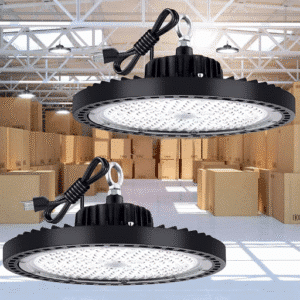
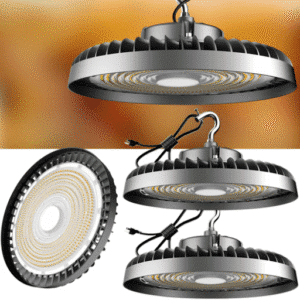
For facilities with 20-foot ceilings replacing 400W MH systems, our 150W UFO high bay light is the standard specification. For taller facilities or 600W+ replacements, the 200W UFO high bay delivers the lumen output and throw distance for larger wattage gaps.
High Bay Lighting Payback Period by Facility Type
Operating hours are the single biggest variable in your payback calculation. More hours mean more kWh saved per year, which compresses the payback timeline.
| Operating Schedule | Hours/Year | Typical Payback (Gross) | Payback (With Rebates) |
|---|---|---|---|
| 24/7 distribution | 8,760 | 1.2–1.7 years | 0.8–1.3 years |
| Two-shift (16/5) | ~4,160 | 2.5–3.5 years | 1.8–2.7 years |
| Two-shift (12/7) | ~6,000 | 1.5–2.5 years | 1.0–1.8 years |
| Single shift | ~2,600 | 4.0–6.0 years | 3.0–4.5 years |
| Limited use (<20 hrs/wk) | ~1,040 | 8–12 years | 6–9 years |
These ranges assume 100–200 fixtures, 0.11–0.11–0.15/kWh, and standard installation costs. Single shift facilities still are attractive due to strong payback when maintenance savings are high (tall ceilings with frequent re-lamping) or electricity rates locally exceed $0.15/kWh.
Maria is operating a cold storage facility in Texas, which works 24/7. Initially, she had 312 × 400W metal halide fixtures in her 250,000 square feet building, and she switched to 180W LED high bays. Given the operating hours maxed out at 8,760 per year and electricity rates at 0.14/kWh, the high bay fixture lighting payback was 7.8 months before rebates. After utility incentives were factored in, the payback period dropped to 5.1 months∗∗. Currently, with annual savings of 0.14/kWh, her high bay lighting payback was 7.8 months when rebates were not included. With utility incentives, it now drops to 5.1 months. She currently saves over 106,000 annually.
How Fixture Efficacy Changes Your ROI
The same warehouse needs the same light. The wattage required to deliver it changes based on fixture quality, and that changes your savings math.
Budget Fixtures (130 lm/W)
Therefore, higher-wattage LED fixtures are required to achieve lumen targets. For instance, a 400W MH 150W LED light replacement might just work but another 30W might be required to maintain proper illumination. The additional power of 30-50W per fixture pulls back your annual energy savings and adds 3-6 months to the payoff period.
Standard Fixtures (150 lm/W)
There is the 2026 standard. A 150W fixture running at 150 lumens/W is supposed to be generating 22,500 lumens, which is very much a match to the illuminance of 400-Watt MH. Strikes a good balance between initial cost and energy savings.
Premium Fixtures (170+ lm/W)
This model promises at least 170 lumens/W, providing 22,500 lumens with only 132W Used: Instead of being needed for every 100 units with a 6,000-hour runtime and the cost of electricity at 0.13/kWh, the extra 18 W per unit saved per fixture produces an overalltodal saving of $1,404 as against the 150 lm/W alternative each year. Over 10 years, $14,040 would definitely make the difference to justify the higher basic per lumens cost.
Controls and Sensors: The ROI Multiplier

Basic ROI calculators ignore the largest untapped savings category. Controls can increase your total savings by 20–60% without adding fixtures.
Occupancy Sensors (+18–32% Savings)
In warehouses with intermittent traffic, lights stay on in empty aisles for hours. Occupancy sensors with 0-10V dimming integration cut power to 10–20% when no motion is detected. For a facility with 30% unoccupied time, that’s an additional 18–32% on top of baseline LED savings.
Daylight Harvesting (+12–25% Savings)
Buildings with skylights or window walls receive free ambient light for 4–8 hours per day. Daylight sensors dim LED fixtures proportionally as natural light increases. Facilities with significant daylight exposure see 12–25% additional savings.
The Combined Effect
A distribution center in Ohio installed 200 LED high bays with motion sensors and daylight harvesting. Baseline LED savings were 52,000peryear.Controlsaddedanother52,000peryear.Controlsaddedanother18,200. The sensor package cost $8,000. Payback on the controls alone was 5.3 months. The entire project, including controls, paid back in 11 months.
For more on smart lighting systems and sensor integration, see our guide on (smart warehouse lighting) strategies. If you’re specifying fixtures today, choose units with 0-10V dimming drivers so you can add sensors later without replacing hardware.
2026 Rebates and Tax Incentives
Your LED high bay ROI calculator is not complete without the incentive layer. In 2026, three programs dominate the landscape.
DLC Premium Utility Rebates
The DesignLights Consortium qualifies fixtures based on efficacy, light quality, and reliability. DLC Premium is the higher tier. Premium fixtures cost more upfront but unlock rebates 20–50% larger than DLC Standard models. Many utilities require DLC listing as a prerequisite for any rebate.
Always check the DSIRE database for your state’s current rebate schedule. Programs change quarterly.
Section 179D Federal Tax Deduction
Available for qualifying energy-efficient commercial building projects with construction starting before June 30, 2026. Deductions range from 0.60to0.60to5.00 per square foot depending on efficiency performance relative to ASHRAE 90.1 baselines. A lighting retrofit that reduces power density by 25–40% typically lands in the 1.00–1.00–2.50/sq ft range.
Important: The deduction requires modeling by a qualified engineer and certification. It’s not automatic. But for a 100,000 sq ft warehouse, even a 1.50/sqftdeductionequals1.50/sqftdeductionequals150,000 in tax benefits.
State and Local Bans
Several states have enacted fluorescent tube bans post-2025. Replacement tube scarcity is already driving up maintenance costs for legacy T5 and T8 systems. This hidden cost accelerates the effective ROI of staying with fluorescent or MH systems.
Common Lighting Upgrade ROI Calculation Mistakes

Avoid these errors and your business case will be bulletproof.
- Ignoring ballast draw
Using bulb wattage instead of system wattage understates savings by 12–15%. Always use actual draw. For more on why this matters, see LED Lighting Supply’s technical comparison of LED vs metal halide. - Forgetting maintenance and relamping
At 25-foot mounting heights, a single relamping event costs 150–150–300 in labor and lift rental. Over 10 years, that’s 500–500–1,000 per fixture in avoided costs. - Using sticker price instead of net cost
A 120fixturewitha120fixturewitha40 rebate costs 80.A80.A90 fixture with no rebate costs $90. The “more expensive” fixture is actually cheaper. - Ignoring demand charges
Industrial rate schedules often include demand charges that make up 40–60% of the total bill. Reducing wattage lowers peak demand and cuts these fees. - Skipping the controls multiplier
Sensors and daylight harvesting can boost savings by 20–60%. Most calculators don’t ask about them. For a deeper breakdown of fixture costs and what drives ROI, ELEDlights’ cost analysis is a solid cross-reference.
LED High Bay ROI Calculator: Quick Reference
Use this summary card to run your numbers without reading the full guide again.
Formula Card:
| Variable | How to Calculate |
|---|---|
| Baseline kWh | (Actual system watts × fixtures × hours) ÷ 1,000 |
| LED kWh | (LED watts × fixtures × hours) ÷ 1,000 |
| Energy savings | (Baseline kWh – LED kWh) × $/kWh |
| Maintenance savings | Relamping cost + ballast cost + lift/labor, annualized |
| Demand savings | kW reduction × demand charge rate |
| Net project cost | (Fixtures + install + disposal) – rebates – tax deductions |
| Simple payback | Net project cost ÷ total annual savings |
| 10-year ROI | ((Annual savings × 10) – net cost) ÷ net cost × 100 |
Typical Maintenance Savings per Fixture (Annualized):
- 15–20 ft ceilings: 40–40–80/year
- 20–30 ft ceilings: 80–80–150/year
- 30–40+ ft ceilings: 150–150–250/year
Higher ceilings mean more lift time, more labor, and bigger savings when you eliminate relamping.
Conclusion
Calculating LED high bay ROI is not about finding an online calculator and typing in three numbers. It’s about building a complete picture of your current costs, your future savings, and every incentive available to reduce your net investment.
The five-step LED high bay ROI calculator formula in this guide gives you that picture. Measure actual system wattage. Count maintenance avoidance. Factor rebates and tax deductions. Add controls if your facility has intermittent occupancy or daylight exposure. Then run the payback math.
James in Pennsylvania got it wrong the first time. He bought on sticker price, ignored rebates, and missed maintenance savings entirely. His second retrofit—done with the full lighting upgrade ROI formula—paid back in 8 months and saved his company $340,000 over 10 years.
You can do the same. Use this LED high bay ROI calculator framework to run the numbers for your facility, verify your local rebate programs, and always demand UFO high bay lights with DLC Premium certification that maximize your incentive capture and long-term savings.
Want a comprehensive understanding of UFO high bay light? Check out our (UFO high bay light guide).
Frequently Asked Questions
What is the payback duration for LED high bay lights?
This ranges from 1.5 to 3 years for two-shift warehouses (4,000 to 6,000 hours/year). Payback is less than 12 months for 24/7 operations. Single-shift facilities have paybacks of 3 to 5 years; even so, it is a competitive payback period recording the LED life of over 50,000 hours.
What amount of energy is saved using LED high bay lights versus metal halide?
LED high bays use 60–75% less energy compared to the same capacity metal halide fixtures. For example, a 150W LED can replace a 400W MH lamp (455W with SCR’s) with better or equal light levels. The reduction of 305W per fixture would bring significant energy savings when applied on a large scale.
May an LED high bay ROI calculator be used for T5 fluorescent retrofits?
Yes. The formula is the same. A 6-lamp T5HO high bay draws about 234W and can be replaced with a 140-160W LED unit. The wattage gap is way too small compared to those of MH because of low leverage as returns would be typically longer, 2.5-4 years’ period. However, T5 lamp bannings in certain states presently make replacement tubes expensive and rare, pointing to the fold of an effective ROI to change now.
Are LED high bay lights eligible for tax deductions?
Yes, through Section 179D of the federal tax code, for qualifying energy-efficient commercial building projects. Start your construction process before June 30, 2026. Deduction rates are in the range between 0.60 and5.00 per square foot. Consult a qualified tax professional to verify eligibility and the required certification.