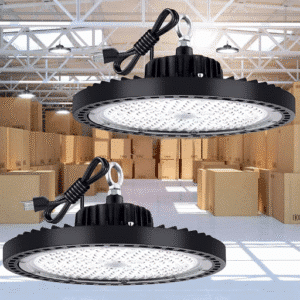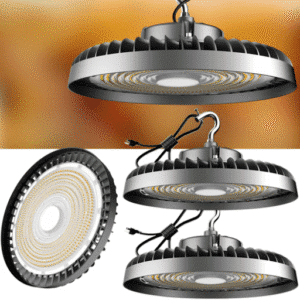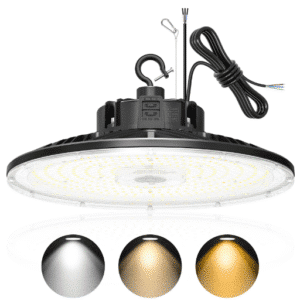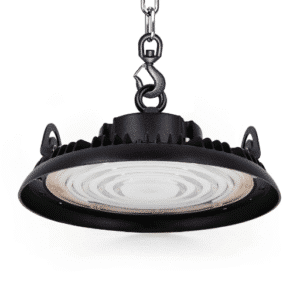

Solar high bay lights are off-grid lighting systems that combine photovoltaic panels, battery storage, charge controllers, and LED high bay fixtures to deliver industrial-grade illumination without drawing power from the utility grid. They are designed for warehouses, factories, and remote facilities where eliminating electricity costs, achieving energy independence, or avoiding expensive grid extension makes financial sense.
The global solar lighting market is surging. According to The Business Research Company, it is projected to grow from 9.26 billion in 025 to 9.26 billion in 2025 to 10.58 billion in 2026, a 14.3% CAGR. Yet most guides on the topic treat solar lighting as an outdoor-only solution — street lights, parking lots, and pathway fixtures. The indoor industrial application, the solar high bay light mounted inside a warehouse or factory ceiling, is barely covered.
That’s the gap this guide fills. You’ll learn exactly how solar high bay systems work, how to size the solar array and battery bank for your facility, what battery chemistry to specify, when solar beats grid-powered LED and when it doesn’t, and how to calculate the real payback period. For the broader strategic framework on industrial lighting, see our guide to factory lighting solutions.
Key Takeaways
- Solar high bay lights combine photovoltaic panels, charge controllers, LiFePO4 batteries, and LED fixtures into an off-grid DC system that eliminates lighting electricity bills.
- System sizing depends on peak sun hours in your region: Southwest US sites need 30-40% smaller arrays than Pacific Northwest sites for the same load.
- LiFePO4 batteries are the industrial standard for solar high bays, delivering 4,000-6,000 cycles and 10-15 year lifespans versus 500-1,000 cycles for lead-acid.
- Payback ranges from 2-5 years in high-sunlight regions to 3-7 years in moderate regions; remote facilities often save $50,000+ by avoiding trenching.
- Pure solar works for remote and high-sunlight facilities; hybrid grid+solar systems are better for 24/7 cold storage and low-winter-sun regions.
What Are Solar High Bay Lights?

Definition and System Architecture
A solar high bay light is an integrated lighting system that generates, stores, and delivers its own power. The architecture is straightforward but different from a standard grid-tied high bay.
Sunlight hits the photovoltaic panel and generates DC electricity. A charge controller regulates that power and routes it to a battery bank. The battery stores energy for nighttime and cloudy-day operation. The LED high bay fixture draws DC power from the battery and converts it to light.
This is a closed DC loop. There is no inverter to AC unless you are running a hybrid system. Most industrial solar high bays use native DC LEDs to avoid inverter losses, which can steal 5-10% of your stored energy.
There are three configuration types. Off-grid systems are completely independent and rely solely on solar generation and battery storage. Grid-tied systems use solar to supplement grid power but have no battery backup. Hybrid systems combine solar, battery storage, and grid connection, using the grid as a backup when solar generation is insufficient.
Core System Components
Solar panels are typically monocrystalline silicon with efficiencies of 18-22%, compared to 13-17% for polycrystalline. Monocrystalline costs more per watt but produces more energy per square foot, which matters when roof space is limited.
Charge controllers manage the voltage and current between the panel, battery, and load. MPPT (Maximum Power Point Tracking) controllers are up to 30% more efficient than basic PWM controllers because they continuously adjust the electrical operating point of the panel to extract maximum power. On a 10 kW solar array, that 30% difference can mean the ability to run an extra two or three high bay fixtures.
Battery banks store energy for periods without sunlight. For industrial solar high bays, LiFePO4 (lithium iron phosphate) has become the standard due to cycle life, safety, and temperature tolerance.
LED high bay fixtures in solar systems are either DC-native, operating directly from the battery voltage, or AC fixtures paired with a small inverter. DC-native is preferred for off-grid systems because it eliminates inverter cost, complexity, and conversion losses.
Smart controls including motion sensors, dimming drivers, and remote monitoring modules can reduce energy consumption by 30-50%, which directly translates to smaller solar arrays and battery banks.
Need help evaluating whether solar makes sense for your facility? Probapro engineers can assess your location, load, and budget to determine if an off-grid or hybrid system is the right choice. Request a solar lighting assessment.
Solar High Bay Lights vs Grid-Powered LED: When Solar Wins
The decision between solar and grid-powered LED isn’t ideological. It’s financial and logistical. In some scenarios, solar is the clear winner. In others, a grid-powered LED retrofit is the smarter move.
Solar wins in four specific situations.
First, remote facilities without grid access. If the nearest utility connection is more than a quarter-mile away, trenching costs can exceed $50,000. A solar system often costs less than the trenching alone.
Second, new construction in undeveloped areas. Building a solar array into the initial design avoids utility connection fees and infrastructure delays.
Third, regions with high electricity rates. Facilities in California, Hawaii, or the Northeast paying 0.20−0.35perkWhseemuchfasterpaybackthanfacilitiesintheSoutheastat0.20−0.35perkWhseemuchfasterpaybackthanfacilitiesintheSoutheastat0.10-0.12 per kWh.
Fourth, facilities with sustainability mandates. Some corporations and government agencies require on-site renewable generation.
Grid-powered LED wins in three situations.
First, existing facilities with reliable grid access already in place. The upfront cost of a solar system, even with long-term savings, may not justify replacing functional grid infrastructure.
Second, low-sunlight regions with short winter days. Facilities in northern latitudes with average winter peak sun hours below 2.5 need disproportionately large arrays and battery banks.
Third, budget-constrained projects where the lowest initial cost is the primary driver.
Robert is a maintenance manager at a food processing plant in Wisconsin. In 2024, his director asked him to evaluate solar high bays for a 30,000-square-foot cold storage expansion. Robert assumed solar would work because the facility had plenty of roof space.
After running the numbers, he discovered a problem. The expansion needed 24/7 lighting, and Wisconsin winters deliver only 2.8 average peak sun hours per day in December and January. To maintain four days of battery autonomy through a cloudy stretch, he would have needed a battery bank costing nearly as much as the entire LED fixture package.
He also learned that lithium battery capacity drops 20-30% at -10 degrees F, the typical winter temperature in his freezers. Robert recommended a hybrid grid+solar system instead of pure off-grid, cutting the battery bank in half and using the grid as backup during the darkest winter weeks. The project succeeded because he matched the system architecture to the actual climate and runtime requirements.
For a detailed 10-year TCO breakdown with regional utility rate comparisons, see our dedicated guide to (solar high bay lights vs grid-powered LED).
How to Size a Solar High Bay Lighting System
Sizing a solar high bay system follows a four-step process. Get any step wrong and you’ll either overspend on unnecessary capacity or undersize and lose light when you need it most.
Step 1: Calculate the Lighting Load
Start with the illuminance target. General warehouse storage needs 200 lux. Order picking and packing operations need 300-500 lux.
Manufacturing and assembly floors need 500-750 lux. Fine inspection and quality control need 1,000 lux or more.
Convert lux requirements to fixture count using the lumen method. Number of fixtures equals target lux times floor area in square meters, divided by fixture lumens times the utilization factor. A standard warehouse with medium-reflectance surfaces uses a utilization factor of 0.65.
For example, a 2,000-square-meter distribution center (about 21,500 square feet) targeting 300 lux with fixtures outputting 38,000 lumens each would need approximately 24 fixtures. At 150 watts per fixture and 12 hours of daily runtime, the total daily lighting load is 43,200 watt-hours.
Step 2: Size the Solar Array
Solar panel output depends on peak sun hours in your location. Peak sun hours measure the equivalent hours per day at 1,000 watts per square meter, the standard test condition for solar panels.
| US Region | Average Peak Sun Hours/Day | Winter Peak Sun Hours | Array Size Factor |
|---|---|---|---|
| Southwest (AZ, NM, SoCal) | 5.5-6.5 | 4.5-5.5 | 1.0x (baseline) |
| Southeast (FL, GA, TX) | 4.5-5.5 | 3.5-4.5 | 1.15x |
| Midwest (IL, OH, MO) | 3.5-4.5 | 2.5-3.5 | 1.4x |
| Northeast (NY, MA, PA) | 3.5-4.5 | 2.5-3.5 | 1.4x |
| Pacific Northwest (WA, OR) | 3.0-4.0 | 2.0-3.0 | 1.6x |
To size the array, divide the daily lighting load by peak sun hours, then multiply by an oversizing factor of at least 1.25 to account for cloudy days, panel soiling, and temperature derating. For the 43,200 watt-hour load in Phoenix with 6.0 peak sun hours, the calculation is 43,200 divided by 6.0, times 1.25, equals 9,000 watts of solar panel capacity.
Step 3: Size the Battery Bank

Battery capacity must cover the lighting load during periods without sun. Industrial facilities typically design for 3 to 5 days of autonomy.
The formula is daily load times autonomy days, divided by depth of discharge, divided by system voltage. LiFePO4 batteries can safely discharge to 80-90% of capacity. Lead-acid batteries should only discharge to 50% to avoid permanent damage.
Using the same 43,200 watt-hour daily load with 4 days of autonomy and 85% depth of discharge on a 48-volt LiFePO4 system, the calculation is 43,200 times 4, divided by 0.85, divided by 48, equals approximately 4,235 amp-hours. In practice, you would round up to a standard battery bank size, such as 4,800 amp-hours using multiple parallel battery units.
Step 4: Select the Charge Controller
The charge controller current rating must handle the maximum output of the solar array. A 9,000-watt array on a 48-volt system produces approximately 187 amps at peak output. A 200-amp MPPT controller provides adequate headroom.
MPPT controllers cost more than PWM but deliver 20-30% more usable energy from the same panels. On a large industrial system, that efficiency gain typically pays for the controller premium within the first year of operation.
Carlos is the facilities director at a distribution center in Phoenix, Arizona. In early 2025, he installed solar high bays across a 50,000-square-foot warehouse. His facility enjoys 6.5 average peak sun hours daily.
Carlos calculated a daily lighting load of 38,400 watt-hours for 20 fixtures running 12 hours each. He sized an 8,500-watt monocrystalline array and a 48-volt LiFePO4 bank with 4,000 amp-hours. That bank provides 4.2 days of autonomy at 85% depth of discharge.
The system eliminated his annual electricity bill for lighting of $18,000. At an installed cost of 18,000 annual lighting electricity bill.At an installed cost of 57,600, the payback period was 3.2 years. After payback, every dollar saved goes straight to his operating budget.
For a step-by-step sizing calculator with worked examples, see our guide on (how to size a solar high bay lighting system).
Applications and Use Cases
Solar Warehouse Lighting
Warehouses are ideal candidates for solar high bays when the roof structure can support panels and the facility operates during daylight and evening hours. Large flat roofs provide ample mounting area. The key constraint is runtime. A warehouse running two shifts, 16 hours per day, needs a significantly larger battery bank than a single-shift operation.
Solar warehouse lighting design follows the same spacing and beam angle principles as grid-powered systems, with added constraints for battery runtime and DC voltage drop. For solar-specific warehouse layout guidance, see our (solar warehouse lighting design guide).
Off-Grid Industrial Facilities
Remote manufacturing sites, mining operations, and agricultural processing plants often have no practical grid access. In these cases, solar high bays are not an alternative to grid power. They are the only practical power source. For complete system specs and case studies from remote facilities, see our guide to (off-grid industrial lighting solutions).
Mei is a project engineer at a remote agricultural processing facility in rural Nevada. The nearest utility line terminated two miles from the facility boundary. In 2024, Mei received a quote to trench primary power to the site: $85,000 for excavation, conduit, transformers, and connection fees. Remote facilities like hers are prime candidates for solar warehouse lighting, a growing category that manufacturers such as PacLights and SOLTECH have begun serving with commercial-grade systems.
A complete solar high bay system for the 15,000-square-foot processing building cost $62,000 installed. That price included 6,200 watts of panels, a 48-volt LiFePO4 battery bank, 14 high bay fixtures, and MPPT controllers.
Over 10 years, the solar system will save $147,000 compared to the grid alternative. That figure even accounts for a mid-life battery replacement in year 12. Mei eliminated a capital expense and turned lighting into an operational savings engine.
Food Processing and Cold Storage
Food processing facilities present a unique challenge. They often require 24/7 lighting, and low storage temperatures reduce battery capacity.
In cold storage, lithium battery capacity drops 20-30% at freezer temperatures. Specifying a larger bank or using heated battery enclosures solves this, but adds cost and complexity. For 24/7 operations in cold climates, a hybrid system is usually more reliable than pure off-grid.
Temporary and Construction Lighting
Solar high bays excel in temporary applications because they require no trenching, permitting, or utility coordination. Construction sites, disaster relief operations, and outdoor event venues can deploy solar high bays in hours rather than weeks.
Battery Technology for Solar High Bays
The battery is the most expensive component in a solar high bay system and the one most likely to cause failure if specified incorrectly.
LiFePO4: The Industrial Standard
Lithium iron phosphate has displaced lead-acid as the default choice for industrial solar lighting. The reasons are clear.
LiFePO4 delivers 4,000 to 6,000 charge cycles at 80% depth of discharge. It operates safely from -20 degrees C to 60 degrees C during discharge. It has no risk of thermal runaway, the catastrophic failure mode that affects some other lithium chemistries.
And its flat discharge curve means voltage stays stable through most of the discharge cycle. That consistency keeps LED output steady.
Battery Chemistry Comparison
| Chemistry | Cycle Life (80% DOD) | Depth of Discharge | Calendar Lifespan | Cost per kWh | Best For |
|---|---|---|---|---|---|
| LiFePO4 | 4,000-6,000 | 80-90% | 10-15 years | $300-500 | Industrial solar, daily cycling |
| NMC Lithium-Ion | 1,500-3,000 | 80% | 5-10 years | $200-400 | Consumer electronics, EVs |
| AGM Lead-Acid | 500-1,000 | 50% | 3-5 years | $100-200 | Backup power, infrequent cycling |
| Gel Lead-Acid | 700-1,200 | 50% | 4-6 years | $120-250 | Moderate cycling, lower budget |
Over a 10-year period, LiFePO4 is almost always the lowest total cost of ownership despite the higher upfront price. A lead-acid bank would need replacement two to three times in the same period. For a comprehensive battery chemistry comparison with cycle life testing and temperature derating data, see our guide to (LiFePO4 batteries for solar high bay lights).
Temperature Derating
Cold weather reduces usable battery capacity. At -10 degrees C, a LiFePO4 battery may deliver only 70-80% of its rated capacity. High temperatures above 45 degrees C accelerate degradation. In extreme climates, specify battery enclosures with active thermal management or oversized banks to compensate for seasonal derating.
IP Ratings and Environmental Protection
Solar high bay systems have more components exposed to the environment than grid-powered fixtures. Every component needs the right protection rating.
The LED high bay fixture itself should carry at least IP65 in any industrial warehouse environment. IP65 is dust-tight and protected against water jets from any direction. For washdown environments, step up to IP66.
Solar panels are inherently weatherproof and typically carry IP67 or IP68 ratings. The junction box on the back of the panel, where wiring connections are made, is the vulnerable point. Ensure panel junction boxes are sealed and rated for outdoor exposure.
Battery enclosures must protect against dust, moisture, and in some cases, rodents. Ventilation is critical. LiFePO4 batteries produce minimal off-gassing compared to lead-acid, but they still generate heat during charge and discharge. An enclosure that is completely sealed without ventilation will trap heat and shorten battery life.
Charge controllers should be mounted in weather-protected locations. Many industrial MPPT controllers carry IP65 ratings and can mount outdoors, but keeping them in a shaded electrical enclosure extends their lifespan. For a complete guide to IP ratings for solar components including panel junction boxes and battery housings, see our article on (IP65 solar high bay lights).
Smart Controls and Energy Optimization

Smart controls are even more valuable on solar systems than on grid-powered systems because every watt saved translates directly into smaller, less expensive solar arrays and battery banks.
Motion Sensors and Occupancy Detection
Occupancy sensors can reduce lighting energy consumption by 30-50% in warehouses where aisles are intermittently occupied. Microwave radar sensors are generally more reliable than PIR sensors in high bay applications because they detect movement through shelving and do not require a direct line of sight.
In a solar system, motion sensors do more than save money. They extend battery autonomy. A warehouse that dims to 30% output when unoccupied may stretch a 4-day battery bank to 6 or 7 days of effective autonomy.
Dimming and Programmable Modes
0-10V dimming works on DC-native LED drivers and allows programming of runtime modes. Common configurations include full brightness during active hours, 50% dimming during low-activity periods, and sensor-activated boost to 100% when motion is detected.
Remote Monitoring
IoT monitoring modules track battery state of charge, solar panel output, and fixture status in real time. Facilities managers receive alerts when battery voltage drops below safe thresholds or when a panel string underperforms. Predictive algorithms can estimate remaining battery cycle life and flag degradation before it causes a failure.
For a detailed energy savings analysis comparing PIR, microwave, and dual-tech sensors on solar systems, see our guide to (solar high bay lights with motion sensors).
Installation and Commissioning
Solar high bay installation differs from standard AC high bay installation in three ways: panel mounting, DC wiring, and battery placement.
Panel Mounting
Roof-mounted arrays are most common for warehouses. Ballasted mounting systems, which use weighted frames instead of roof penetrations, are preferred for flat commercial roofs to avoid waterproofing issues. Tilt angles should match latitude for year-round optimization, though steeper winter-optimized angles can help in northern climates. Ground-mounted arrays work when roof space is insufficient or structurally limited.
DC Wiring Best Practices
Solar high bay systems operate at DC voltages, typically 24V or 48V. While these voltages are lower than 277V or 480V AC industrial circuits, they can still deliver dangerous current levels from large battery banks. Use properly sized conductors. A 48-volt system carrying 200 amps needs 2/0 AWG cable or larger to limit voltage drop to under 3%.
Fuse or circuit-breaker every circuit. A shorted battery bank can deliver thousands of amps instantaneously. Proper overcurrent protection is non-negotiable.
Battery Bank Placement
Batteries should be installed in a clean, dry, temperature-stable location. Avoid placing them directly on concrete floors, which can conduct cold. Use insulated battery racks with adequate air circulation. Maintain clearance around all sides for inspection and maintenance access.
Commissioning Checklist
Verify panel output under load. Confirm charge controller transitions correctly through bulk, absorption, and float charging stages. Test battery voltage under discharge.
Verify all fixtures operate at programmed brightness levels. Record baseline performance data for future comparison.
For a complete DC wiring safety guide with mounting, panel placement, and commissioning checklists, see our (solar high bay light installation guide).
Cost Analysis and ROI
Understanding the real cost of solar high bays requires looking at both upfront investment and total cost of ownership over the system lifespan.
Upfront Cost Breakdown
| Component | Cost Range (per fixture equivalent) | Notes |
|---|---|---|
| Solar panels | $400-600 | Depends on wattage and efficiency |
| LiFePO4 battery bank | $800-1,400 | Sized for 3-5 days autonomy |
| Charge controller (MPPT) | $150-300 | Per fixture equivalent |
| LED high bay fixture | $200-400 | DC-native or AC with inverter |
| Mounting and wiring | $150-250 | Racking, conduit, labor |
| Total per fixture | $1,700-2,950 | Varies by region and scale |
Grid-powered LED high bays typically cost $150-400 per fixture installed, assuming grid power is already available. The solar premium is substantial but not permanent.
Operational Savings
Solar high bays have near-zero electricity cost. The only ongoing expenses are occasional panel cleaning, visual inspection of connections, and eventual battery replacement. Over 10 years, a facility paying 0.15 per kWh will spend approximately 0.15per kWh will spend approximately 7,900 in electricity per standard 150-watt high bay running 12 hours daily. The solar equivalent spends zero on electricity.
10-Year TCO Comparison
| Cost Factor | Solar High Bay | Grid-Powered LED | Hybrid Solar+Grid |
|---|---|---|---|
| Initial equipment | $2,200 | $300 | $1,800 |
| Installation | $300 | $100 | $250 |
| 10-year electricity | $0 | $7,900 | $2,400 |
| Battery replacement (yr 10) | $600 | $0 | $400 |
| Maintenance (10 yr) | $200 | $400 | $300 |
| 10-Year TCO | $3,300 | $8,700 | $5,150 |
| Savings vs Grid | $5,400 (62%) | Baseline | $3,550 (41%) |
The payback period for solar ranges from 2 to 5 years in high-sunlight regions and 3 to 7 years in moderate regions. Remote facilities avoiding trenching can see immediate positive ROI on day one.
Solar vs Hybrid: When to Add Grid Backup

Pure off-grid solar is not always the right choice. A hybrid system that combines solar generation, battery storage, and grid backup often delivers better reliability at lower cost for certain facility types.
Pure Solar Off-Grid
Choose pure solar when the facility has no grid access, when sustainability mandates require complete energy independence, or when the facility operates primarily during daylight hours with minimal nighttime runtime. Pure solar is also appropriate for temporary installations where grid connection would be impractical.
Hybrid Solar+Grid
Choose hybrid when the facility operates 24/7 and cannot tolerate lighting outages, when winter peak sun hours drop below 3.0 for extended periods, or when the cost of a battery bank sized for full off-grid autonomy exceeds the cost of a smaller battery plus grid backup.
A hybrid system typically uses a battery bank sized for 1 to 2 days of autonomy rather than 3 to 5. The grid covers extended cloudy periods. The solar array still delivers daily energy savings and reduces grid dependence, but the facility never faces a blackout due to weather.
Decision Framework
Ask three questions.
First, what is the cost of a lighting outage? In a 24/7 manufacturing line, an outage may cost thousands of dollars per hour. In a daytime-only warehouse, an outage is inconvenient but not catastrophic.
Second, what are your winter peak sun hours? If they drop below 3.0 for more than 60 consecutive days, pure solar requires very large arrays and banks.
Third, what is your grid reliability? If your local utility experiences frequent outages, a hybrid system with battery backup may be more valuable than pure solar.
Frequently Asked Questions
Do solar high bay lights work indoors?
Yes. Solar panels mount on the roof or ground, not on the fixture. DC power runs from the panels to a battery bank, then to the LED high bays mounted inside the facility. The fixtures operate exactly like grid-powered LEDs, just from a DC battery source instead of AC mains.
How long do solar high bay lights last?
The LED fixtures last 50,000 to 100,000 hours. LiFePO4 batteries last 10 to 15 years in typical industrial cycling. Solar panels degrade at approximately 0.5% per year and carry 25-year performance warranties.
Charge controllers typically last 10 to 15 years. The weakest link is usually the battery, not the light.
What happens on cloudy days?
A properly sized battery bank provides 3 to 5 days of autonomy. The system charges the battery on sunny days and draws it down on cloudy days. During extended cloudy periods, a hybrid system switches to grid backup. A pure off-grid system either continues operating until the battery is depleted or enters a low-power dimming mode.
Can I retrofit existing high bays to solar?
Yes, with conditions. If your existing high bays are LED fixtures with external drivers, you may be able to convert them to DC input by replacing the AC driver with a DC driver. If they are integrated LED fixtures or older HID technology, replacement is usually more cost-effective than conversion. The solar array, battery bank, and charge controller must still be sized for the full load. For a complete retrofit methodology including payback comparisons, see our (solar LED high bay retrofit guide).
How many solar panels per high bay light?
There is no fixed panel-to-fixture ratio because it depends on fixture wattage, daily runtime, and peak sun hours. A 150-watt high bay running 12 hours daily in a 5.0 peak sun hour region needs approximately 450 watts of solar panel capacity, which is roughly one and a half standard 300-watt panels.
What is the payback period?
Payback ranges from 2 to 5 years in high-sunlight regions like the Southwest, 3 to 7 years in moderate regions like the Midwest and Northeast, and can be immediate in remote facilities where solar costs less than grid extension trenching.
Are solar high bays worth it for existing warehouses?
They are worth it when electricity rates are high, the roof can support panels, and the facility plans to operate for at least 5 more years. Existing warehouses with low electricity rates or structural roof limitations may not see sufficient ROI to justify the upfront investment.
What maintenance do solar high bays require?
Panel cleaning 2 to 4 times yearly depending on dust and pollen. Annual inspection of electrical connections and mounting hardware. Battery voltage monitoring monthly.
Charge controller firmware updates as needed. LED fixtures require essentially zero maintenance.
Conclusion
Solar high bay lights are a viable, proven technology for indoor industrial lighting when the system is sized correctly for the application, climate, and runtime requirements. The key is engineering discipline. A system that is undersized will fail on the first cloudy week. A system that is oversized wastes capital that could be deployed elsewhere.
The decision framework is straightforward. Remote facilities and new construction without grid access should default to solar. Existing facilities in high-sunlight, high-electricity-rate regions should run the numbers. Facilities in cold climates with 24/7 runtime should consider hybrid systems rather than pure off-grid.
The global solar lighting market is growing at 14.3% annually for a reason. When the math works, solar high bays eliminate electricity bills, reduce maintenance, and deliver measurable ROI within a few years. When the math does not work, a grid-powered LED retrofit is still a strong alternative.
Ready to evaluate solar high bays for your warehouse or factory? Probapro engineers can analyze your facility location, energy load, and budget to recommend the right system architecture — whether that is pure solar, hybrid, or grid-powered LED. Request your free lighting assessment.
This guide provides general information on solar high bay lighting systems and components. Always consult a qualified electrical engineer and your local Authority Having Jurisdiction for project-specific compliance verification. Solar system performance varies by location, weather, and installation quality.