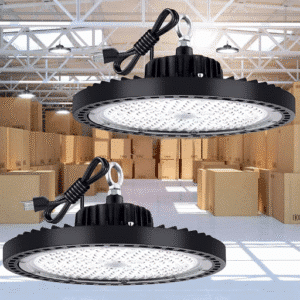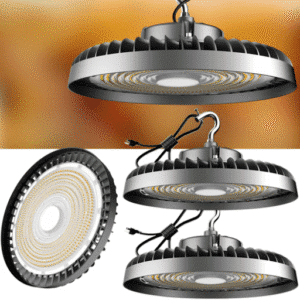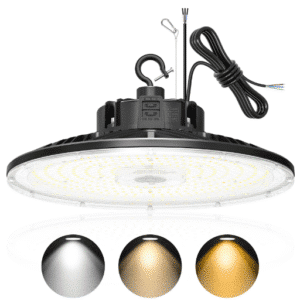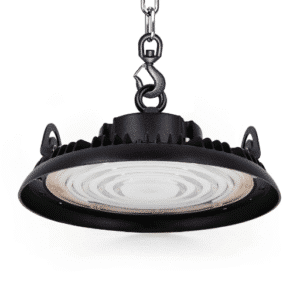

In Ohio, Marcus runs a distribution center of 100,000 square feet, quarantined by no other facility, where he thought of not adding up the numbers at one point while calculating the charges for lighting enhancement. They just did not match up. The facility had been using 400-Watt metal halide fixtures spec’d as “industrial,” or commercial grade, but his maintenance staff was changing out bulbs every 18 months.
The costs of electricity were still going up because when a fixture played out, it meant waiting (uselessly) for a lift to get it taken care of before any real productive movement down that aisle could resume.
Your eyes have likely boggled on something similar to these numbers at one time or another while managing a warehouse or factory. The central question is not whether LED is “better.” It is all about the income; how much led vs metal halide savings actually gave the bottom line.
This manual can thus walk you through a decision set of reduction in energy, reduction in maintenance, and payback in the terms you will understand. Eventually, you will know what change costs you, and what it brings in energy efforts and when you’re able to pay for it.
Want a comprehensive understanding of UFO high bay light? Check out our (UFO high bay light guide).
Why Wattage Ratings Are Misleading

Most engineers look at a 400W metal halide and conclude that it draws power of 400 watts. Considering that simplification incurs added wastage.
In actual fact, metal luminaries require ballasts for executing power regulation, trailing behind the total by anywhere from 15% off of the power drawn. Hence, a 400W metal halide approximately takes up 455 watts.
Vainly trying to catch up with the technology, a rough estimate of 150W LED High Bay is actually 150W as it is to the last watt, without any other slowers.
Adding luminaire mounting variation to the discussion widens the distance. No doubt, metal halide lamps emit their light in every which way, including straight up to the ceiling.
Reflectors are installed in fixtures in order to focus a majority of the light straight out, often picking up 15–30% of the lumen out of the process. LEDs, in their design specification, are focused with great accuracy towards their intended destination.
Any Meta-Hedit Fixture 400W can virtually generate and publish, according to the luminaire literature, 36000 initial lumens. But after losing ballasts and reflectors, this can often compare to less usable light than the 150W LED with 22500 direct lumens. Here you have paid for 455 watts to get less proficient light comparable to a 150W fixture at 120 degrees.
The Depreciation Problem
Metal halide lamps deteriorate amazingly fast. The luminaire they furnish could already have sunk by 20% within merely the first six months. By the time the lamp gets to midlife, some models may be losing 50% or more of their brightness–using equally the same quantity of power. This means that your 455W luminaire may be only giving out half as much as it produced when new, while your meter spins away.
LEDs can provide 90+ percent for 50,000-plus hours or more. The light you install is the light you get year after year.
Energy Savings: What the Numbers Actually Look Like

Let us run the math for a real facility. Assume you operate a warehouse with 100 high bay fixtures, running 12 hours per day, 300 days per year, at an average electricity rate of $0.12 per kWh.
Metal halide scenario:
- 100 fixtures × 455W = 45.5 kW
- 45.5 kW × 12 hours × 300 days = 163,800 kWh/year
- 163,800 kWh × 0.12=∗∗0.12=∗∗19,656/year**
LED scenario (150W replacement):
- 100 fixtures × 150W = 15 kW
- 15 kW × 12 hours × 300 days = 54,000 kWh/year
- 54,000 kWh × 0.12=∗∗0.12=∗∗6,480/year**
Annual energy savings: $13,176
That’s a whopping 67% of the lighting alone. And we haven’t factored in maintenance, HVAC savings, or smart control advantages.
At facades, savings multiply with a factory that has lights running for 8,760 hours per year with 200 fixtures that range around 26,000–30,000 dollars annually just because of electricity.
The Heat Factor
Metal halide lamps throw off a tremendous amount of heat. Most of the 455W is converted into radiant heat that heats your facility. In a conditioned facility, your HVAC has to work harder to counteract all that heat.
LEDs throw off around 94% less heat than fixtures. That reduction in heat will eventually cut down some hundreds toward your cooling costs, especially during the hotter months.
Maintenance Costs: The Hidden Expense
Energy savings make it to the headlines whereas savings made in maintenance are the coup de grace.
When Jessica assumed the position of administrator for the facilities of a Midwestern manufacturing complex, she was handed 150 metal halide high bays. Her initial research for the budget revealed a pattern she had not anticipated. There were charges to rent the scissor lift, assign time-and-a-half labor, and exchange light bulbs at the rate of $75-150 each every 12-18 months.
Ballast failure added another $150-300 per incident. With time, she ended up spending just under $18,000 on maintenance related to lighting.
LED staff totally change these numbers. A quality 50,000-100,000-hour-rated LED high bay is going to run 10 to 20 years inside a typical warehouse without changing a single bulb.
There is no ballast to fail, no restrike time delay, no lift-rental schedule.
Within the lifetime of a single LED luminaire, a metal halide installation usually demands 3 to 5 bulb replacements and ballast service, in addition to associated service charges. Normally, these maintenance trips start to put a big dent into the lift rental costs of 200to400 per day.
Maintenance Comparison (Per Fixture Over 10 Years)
| Cost Factor | 400W Metal Halide | 150W LED High Bay |
|---|---|---|
| Bulb replacements (3–4) | 225–225–600 | $0 |
| Ballast replacements (1–2) | 150–150–300 | $0 |
| Labor and lift rental | 800–800–1,600 | $0 |
| Total maintenance | 1,175–1,175–2,500 | $0 |
For a 100-fixture facility, that is an additional 117,500 to 117,500 to 250,000 in avoided maintenance costs over a decade.
Smart Controls and Additional Savings
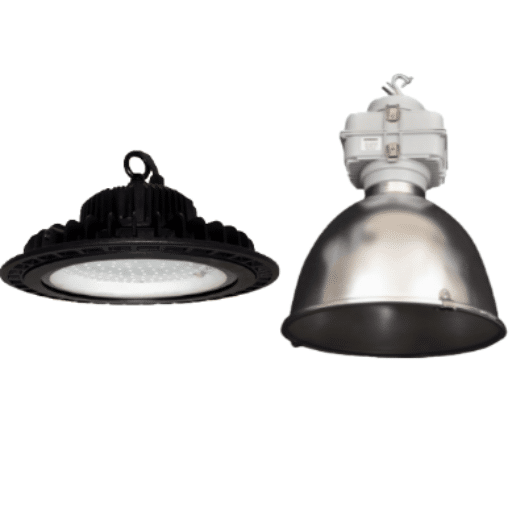
Here is where the comparison stops being close.
Metal halide lamps take 10–30 minutes to become full strength. If the power goes out, it requires another 5–10 minutes to cool off before restriking. So they are, in actuality, not much compatible at all with motion sensors, daylight harvesting or any kind of diming controls.
LEDs are practically instantaneous-this is an immense feature. They can be used in conjunction with occupancy sensors that automatically dim or shut off lighting in unoccupied and rarely occupied aisles. They fit daylight harvesting systems which decrease their load when sunlight is available. They are 0-10V dimmable and are always wireless with the purpose of turning off the Bluetooth Mesh.
These smart features enhance overall savings:
- Skylight zones can potentially save up to 60% further
- Occupancy sensors put an additional 20-30% energy savings in locations where not much traffic is present
- When both strategies are in use, the total factor in energy reduction may reach up to 80% in well-optimized facilities.
For a basic LED retrofit, a warehouse can achieve 67% energy saving by adding motion sensors, which may further increase to over 75%. Moreover, in most cases, this investment pays for itself within only a few months.
Calculating Your Payback Period
Facility managers love one number: payback period. It tells you exactly how long it takes for savings to recover the upfront investment.
The formula is simple:
Total Project Cost ÷ Annual Savings = Payback Period (Years)
Let us use a realistic example. You are retrofitting 100 fixtures. Each LED fixture costs $180 installed. Each metal halide fixture you are removing had zero resale value.
- Total project cost: 100 fixtures × 180=∗∗180=∗∗18,000**
- Annual energy savings: $13,176
- Annual maintenance savings: $3,500
- Total annual savings: $16,676
- Payback period: 18,000÷18,000÷16,676 = 1.08 years
That is roughly 13 months to break even. Every month after that is pure savings.
If your local utility offers prescriptive rebates for DLC-qualified LED fixtures, upfront costs drop further. Many facilities see payback periods fall to under 12 months after rebates.
10-Year Total Cost of Ownership
Looking at a single fixture over a decade makes the case even clearer.
| Cost Factor | 400W Metal Halide | 150W LED High Bay |
|---|---|---|
| Upfront fixture cost | ~$60 | ~$180 |
| Energy (10 years) | ~$19,656 | ~$6,480 |
| Maintenance (10 years) | ~$1,800 | ~$0 |
| Total 10-Year Cost | ~$21,516 | ~$6,660 |
| Net savings per fixture | — | ~$14,856 |
For a 100-fixture warehouse, that is nearly $1.5 million in avoided costs over ten years.
Wattage Replacement Guide
One of the most common questions we hear is: “What LED wattage do I need to replace my current metal halide fixtures?”
The answer depends on ceiling height, spacing, and task requirements. But here are the standard equivalents used in warehouse and industrial retrofits:
| Metal Halide Wattage | Actual System Draw | LED Equivalent | Typical Lumen Output |
|---|---|---|---|
| 250W | ~290W | 80–100W LED | 12,000–15,000 lm |
| 400W | ~455W | 150W LED | 22,500–27,000 lm |
| 1000W | ~1,080W | 300W LED | 45,000–52,500 lm |
| 1500W | ~1,650W | 600W LED | 90,000+ lm |
For notice, less wattage will always considerably be there in an LED replacement. A 150W LED high bay could cut a 400W metal halide to the ground, for the simple reason that the former gives us more lumens per watt and hence at that, does not shed the light on the reflectors or run into rapid degradation.
For locations with a ceiling elevation between 20 feet and 30 feet, the 150W LED high bay becomes a shoe-in replacement. It strikes a perfect balancing that accommodates proper coverage, intensity, and efficiency on most aisle and open-floor layouts. The correct selection for the spacing and the beam angle would insure that the Luminaires will endow a uniform brightness all around in the floor area.
Rebates and Incentives

The promotional policy of the utility companies should be investigated before retail purchase of light fixtures. Most American utilities propose incentives for LED commercial building retrofits, but these rebates usually necessitate a request for the fixture to meet the qualification as per the DLC standard.
A certificate of qualification by the Consortium of Designer Lights signifies a degree of testing and guarantee regarding its purpose, efficacy, and reliability, as well adding to its appeal and trustworthiness in the eyes of utility programs. Probapro fixtures comply with the rules required to be granted this kind of qualification, and therefore, the ease of applying for rebates and a shorter time of payback.
Most utility territories operate on a couple of basic rebate formats, such as:
- 1. Prescriptive Rebate: It guarantees a fixed dollar rate for each replaced fixture; and
- 2. Custom Rebate: Consequently related directly to energy reduction, specified in kilowatt hours;
- 3. Demand Responses Benefits: additional compensations for fixtures that include smart controls.
For example, a prescriptive rebate of $30 to 50 per fixture toward a simple project of 100 fixtures will reduce upfront costs by $3,000 to 5,000, pushing payback to under ten months from thirteen.
When Derek planned the lighting retrofit for his Texas logistics center, he spent 20 minutes on his utility’s website before placing his order. The prescriptive rebate he found saved his company $4,200 and cut his payback period by four months. Those 20 minutes were the highest-ROI task he completed that week.
Run your own numbers with our complete (LED high bay ROI calculator guide) to see exact payback for your facility.
Conclusion
Upgrading from metal halide to LED is much more than a lighting enhancement. It is a financial decision that can empirically pay off.
This is what the arithmetic consistently shows:
- Decrease in Energy Consumption: 60-75% (80% with smart controls)
- Complete Elimination of Maintenance: No replacement of bulbs, ballasts, or renting of lifts within 10-20 years
- Return on Investment: 1-3 years in most situations and sometimes even less than 12 months with rebates
- Total Sa 10-year Savings: Thousands of dollars per lamp
LED technology is not a mere theory anymore. It is present in your energy bill, maintenance budget, and most importantly, the quality of light that your workers are under.
Those who still have metal halide high bays are paying a hefty premium for outdated standards. So quicker the change, quicker would cost of financing such premiums be failed.