
Food processing plant lighting requires NSF certification for fixtures in food zones, IP65 or higher ratings for washdown areas, and CRI 85+ for inspection stations. Unlike standard industrial lighting, it must satisfy USDA, FDA, and FSMA requirements while surviving high-pressure sanitization, chemical exposure, and temperature extremes from -20F freezers to 100F+ production floors.
Maria is a QA manager at a poultry processing plant in Georgia. In March 2024, her facility failed a USDA inspection. The violation was not on the processing line itself. It was the lighting. Fixtures above the evisceration area were not NSF certified. The housings had corroded from years of chlorine-based sanitizers. And the inspector noted that shattered glass from a broken lens could contaminate the entire batch below. Maria had 30 days to fix it or face production shutdown.
That is the reality of food processing plant lighting. It is not just about brightness. It is about compliance, contamination prevention, and surviving conditions that would destroy standard industrial fixtures. This guide covers every standard, every zone, and every real-world challenge you will face when specifying lighting for a food production facility.
For the broader strategic framework on industrial lighting, see our complete guide to (factory lighting solutions).
Key Takeaways
- Food processing plant lighting in food zones must carry NSF/ANSI 2 certification and a minimum IP65 rating to pass USDA and FDA inspections.
- LED fixtures produce 50 to 70 percent less heat than metal halide, significantly reducing refrigeration load and HVAC costs in cold storage.
- LEDs maintain 95 percent output at -20F, while fluorescent tubes lose 30 to 40 percent brightness in freezer conditions.
- IP66 or IP69K ratings are required for direct washdown corridors; IP65 is sufficient for splash zones and general production areas.
- CRI 85 or higher is recommended at inspection stations to detect color changes that indicate spoilage or contamination.
Why Food Processing Lighting Is Different

Regulatory Complexity
Standard factory lighting answers to OSHA and the local electrical inspector. Food processing plant lighting answers to those plus the USDA, the FDA, and NSF International. Each regulator has a different focus. OSHA cares about safe illumination levels. The USDA cares about fixtures that do not contaminate product. The FDA, through the Food Safety Modernization Act, cares about preventive controls that include lighting as a potential physical hazard. NSF certifies that fixtures themselves are safe for installation in food handling areas.
Non-compliance is expensive. A failed USDA inspection can halt production for days. An FDA warning letter becomes public record and can affect customer contracts. And a product recall caused by physical contamination, glass or plastic fragments from a broken fixture, can cost millions in lost product, remediation, and brand damage.
Environmental Harshness
Food processing facilities are among the most hostile environments for electrical equipment. Daily high-pressure washdowns blast fixtures with water jets mixed with corrosive sanitizers. Chlorine, quaternary ammonium compounds, and peracetic acid attack standard powder-coated housings. Steam from cooking and pasteurization creates constant condensation. Freezers cycle between -20F and ambient temperatures during defrost, creating thermal shock. And vibration from grinders, mixers, and conveyor systems loosens mounting hardware over time.
A fixture that lasts 10 years in a warehouse might fail in 18 months above a meat processing line. The environment does not forgive shortcuts.
The Business Case
Despite the regulatory and environmental burden, food processing lighting offers one of the strongest ROI profiles in industrial retrofit. Cold storage and freezer areas run lights continuously to maintain safe working conditions. Replacing metal halide with LED cuts energy by 50 to 75 percent. More importantly, LEDs produce 50 to 70 percent less heat. In a refrigerated facility, every watt of heat the lights add is a watt the refrigeration system must remove. The savings compound: less lighting energy, less cooling load, lower HVAC costs.
Food Processing Lighting Standards and Certifications
NSF Certification Explained
NSF International is the independent organization that certifies equipment for commercial food service and processing. The relevant standard for lighting is NSF/ANSI 2, which covers food equipment. For a lighting fixture to earn NSF certification, it must pass tests for material safety, cleanability, and durability under conditions that simulate real food processing environments.
The standard defines three zones. The food zone is any area where the fixture is directly exposed to food or food contact surfaces. Fixtures here must be NSF certified, smooth, without crevices where bacteria can grow, and constructed from materials that will not leach contaminants. The splash zone is any area where the fixture might be contacted by splashing food, water, or sanitizers. Fixtures here also need NSF certification. The non-food zone includes areas like offices, dry storage, and loading docks where there is no food contact risk. Standard industrial fixtures are acceptable here.
When you see an NSF listing on a fixture, verify the listing number with the manufacturer. Counterfeit NSF marks exist, and inspectors know how to check.
IP Ratings for Washdown Areas
The Ingress Protection rating system, defined by IEC 60529, tells you how well a fixture resists dust and water. The first digit is solids protection. The second is liquids protection. For food processing, you need to understand four ratings.
IP54 means protected against dust and water splashing from any direction. It is acceptable for cold storage and areas with minimal washdown. IP65 means dust-tight and protected against low-pressure water jets. It is the minimum for splash zones and general production areas. IP66 means dust-tight and protected against powerful water jets. It is needed for direct washdown areas. IP69K means dust-tight and protected against close-range, high-pressure, high-temperature washdowns. It is the standard for facilities that use automated clean-in-place systems or high-pressure sanitation rigs.
USDA and FDA Requirements
The USDA Food Safety and Inspection Service publishes guidelines for meat and poultry facilities that include lighting requirements. Fixtures in processing areas must not create physical hazards. That means no glass lenses, no brittle plastics that can shatter, and no exposed wiring that could fray and fall into product.
The FDA Food Safety Modernization Act requires facilities to implement preventive controls for physical hazards. Lighting is explicitly identified as a potential source of glass and plastic contamination. Your HACCP plan, or Hazard Analysis Critical Control Point documentation, should address how your lighting specification prevents contamination. That documentation will be reviewed during FDA inspections.
For the baseline compliance requirements that underpin any food facility project, see our guide to (OSHA factory lighting requirements).
Certification Requirements by Zone

| Zone Type | NSF Required | Minimum IP Rating | Typical Fixture |
|---|---|---|---|
| Production floor (food zone) | Yes | IP65 | NSF-rated UFO high bay |
| Packaging area (splash zone) | Yes | IP65 | NSF-rated linear high bay |
| Cold storage / freezer | No | IP54 | Low-temp LED high bay |
| Washdown corridors | Yes | IP66/IP69K | Vapor-tight linear fixture |
| Dry storage | No | IP20 | Standard LED high bay |
Zone-by-Zone Lighting Design for Food Plants
Production and Processing Areas
According to the IES Lighting Handbook, general food processing requires 500 to 750 lux at the work surface. Inspection and sorting stations need 1,000 lux or more. Color rendering matters here. A CRI of 85 or higher lets workers detect color changes that indicate spoilage, bruising, or foreign material. For meat and poultry, 4000K to 5000K color temperature provides crisp, natural illumination that supports visual acuity without the fatigue of higher color temperatures.
Mounting height in production areas typically ranges from 16 to 25 feet. Spacing follows the standard 1 to 1.5 times mounting height rule, but pay attention to equipment shadows. Large processing machines block overhead light. Supplementary task lighting at inspection stations is often necessary regardless of how well the general lighting is designed.
Cold Storage and Freezers
Cold storage is where LED lighting delivers its most disproportionate advantages. LEDs actually perform better at low temperatures. Lumen output increases slightly, and driver lifespan extends because thermal stress is reduced. At -20F, a quality LED fixture maintains 95 percent or more of its rated output. Fluorescent tubes, by comparison, lose 30 to 40 percent of their brightness in freezer conditions and require several minutes to reach full output after start-up.
The energy savings are also compounded. A 400W metal halide fixture radiates about 280W of heat into the space. In a freezer, that heat must be removed by the refrigeration system. Replacing 20 metal halide fixtures with 150W LED fixtures in a walk-in freezer eliminates 2.6 kW of heat load. The refrigeration system runs less, extending compressor life and cutting energy costs beyond the lighting savings alone.
Robert is a facilities manager at a dairy plant in Wisconsin. His three walk-in freezers were lit by 8-foot fluorescent T8 fixtures. Every winter, ballasts failed as temperatures dropped. Every spring, condensation inside the housings corroded the contacts. In 2023, he replaced all 24 fluorescent fixtures with low-temperature-rated LED high bays. The fixtures start instantly at -15F. Energy use in the freezers dropped 60 percent. And in two years, he has had zero lighting-related maintenance calls in cold storage.
Packaging and Shipping Areas
Packaging areas require less stringent certifications than production floors because the food is typically sealed or containerized by that stage. Illuminance of 300 to 500 lux supports label reading, date code verification, and pallet identification. IP65 is still recommended because washdown protocols often extend into packaging corridors.
Shipping docks are an opportunity for smart controls. These areas are intermittently occupied. Motion sensors can dim lights to 20 percent after 10 minutes of no activity, saving 30 to 50 percent in energy. For guidance on adding controls to your facility, see our guide to (smart factory lighting).
Washdown and Sanitation Corridors
Washdown corridors are the most demanding lighting environment in a food plant. Fixtures here face direct high-pressure spray, chemical exposure, and thermal shock from hot water sanitation cycles. IP66 is the minimum. IP69K is preferred for facilities using automated clean-in-place systems.
Chemical resistance is as important as water resistance. Chlorine-based sanitizers corrode standard aluminum housings and powder-coated finishes. 304 or 316 stainless steel hardware extends fixture life. Polycarbonate lenses resist etching better than acrylic. Specify fixtures with gaskets rated for chemical exposure, not just generic rubber seals.
Dry Storage and Warehousing
Dry storage areas in food plants are functionally identical to standard warehouse storage. Standard LED high bays without NSF certification are acceptable here. Target 200 to 300 lux for pallet identification and general movement. These zones are the easiest place to start a retrofit because they require no specialty fixtures.
For layout and spacing guidance across all zones, see our (factory lighting layout design) methodology.
Fixture Selection for Food Processing Environments

NSF-Rated UFO High Bays
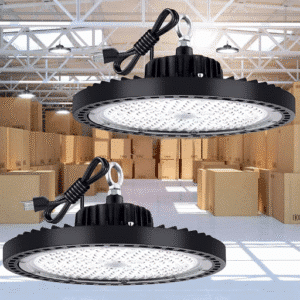
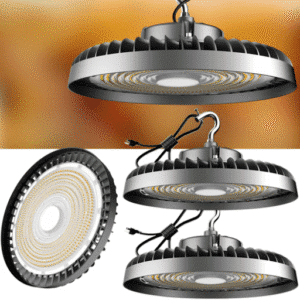
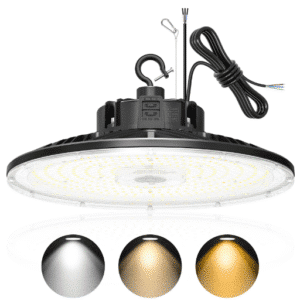
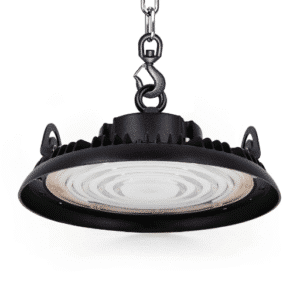
NSF-rated UFO high bays are the workhorse of open production floors. Their smooth, curved housings have no flat surfaces or crevices where food debris or bacteria can accumulate. Sealed optics prevent moisture and contaminants from entering the light engine. Mounting is typically pendant or chain, which leaves the ceiling area open for cleaning.
When selecting NSF-rated UFO fixtures, verify the NSF mark is current and specific to the exact model number you are ordering. Manufacturers sometimes have NSF certification on one model in a product family but not on another. For general manufacturing lighting guidance, see our guide to (best lighting for manufacturing plant environments).
Linear Vapor-Tight Fixtures
Linear vapor-tight fixtures are the standard for washdown corridors, low-bay processing areas, and packaging lines. Their gasketed housings create a sealed envelope around the LED module and driver. The housings are heavier than standard linear fixtures because of the additional sealing hardware, so verify that your ceiling structure can support the load.
Polycarbonate lenses are mandatory in food zones. Glass lenses shatter on impact and create contamination risk. Even in non-food zones, polycarbonate is the safer choice in facilities where vibration or accidental contact could break a glass lens.
Cold Storage LED Fixtures
Not all LED fixtures work in freezers. Standard LED drivers are rated for operation down to about -4F. Below that, electrolytic capacitors in the driver can fail. Cold storage LED fixtures use drivers with extended temperature ratings, typically -40F to 122F, and solid-state capacitors that tolerate sub-zero conditions.
Instant-on capability is another advantage. Fluorescent tubes in freezers flicker and dim at startup, creating a safety hazard when workers enter a dark freezer. LEDs reach full output immediately.
Shatterproof and Safety Features
In any food zone, shatterproof construction is non-negotiable. Polycarbonate lenses are the standard. Some facilities add protective wire guards or shatter-resistant shields as a secondary containment layer. If a fixture must use glass for optical reasons, a protective shield that captures broken fragments is required by most USDA inspectors.
Tamper-resistant mounting prevents unauthorized adjustment or removal of fixtures in high-security facilities. Security screws or locked mounting brackets are common in facilities that supply government contracts or handle high-value ingredients.
Temperature, Condensation, and Environmental Challenges
Cold Storage Performance
LED performance at low temperatures is counterintuitive. Unlike fluorescent or HID systems, which struggle in the cold, LEDs thrive. The semiconductor junction operates more efficiently at lower temperatures. Light output increases by 5 to 10 percent at -20F compared to 77F ambient.
The limitation is the driver, not the LED chip. Electrolytic capacitors in standard drivers contain liquid electrolyte that thickens and fails at extreme cold. Cold-rated drivers use solid tantalum or ceramic capacitors that tolerate -40F without degradation.
Thermal shock is a maintenance concern. When a fixture fails in a -20F freezer and a technician carries the replacement part from ambient storage into the freezer, the rapid temperature change can stress solder joints and seals. Let replacement fixtures acclimate for 15 to 30 minutes before installation.
Condensation and Humidity
High-humidity areas like cook rooms, pasteurization floors, and steam tunnels create condensation inside fixtures. Warm, moist air enters the housing during production, then condenses on the cold lens and housing surfaces when the area cools during shutdown.
Fully sealed IP65+ housings prevent moist air from entering in the first place. Some manufacturers include breather vents that allow pressure equalization while blocking liquid water. In facilities with extreme humidity swings, breather vents reduce the stress on gaskets and seals by preventing pressure differentials that pull moisture into the housing.
Chemical Exposure
The three most common sanitizers in food processing each attack fixtures differently. Chlorine compounds corrode aluminum and standard steel. Quaternary ammonium compounds are less corrosive but can degrade certain rubber gaskets over time. Peracetic acid is highly aggressive and can etch powder-coated finishes within months of exposure.
For facilities using peracetic acid or high-concentration chlorine, specify 316 stainless steel mounting hardware. The molybdenum content in 316 steel provides significantly better chemical resistance than 304 stainless steel. Powder-coated housings should carry a chemical-resistant epoxy finish rated for food plant sanitizers.
Installation and Compliance Verification

Pre-Installation Planning
Before any fixture ships, verify three things. First, confirm the NSF listing number matches the exact fixture model on the manufacturer’s NSF certificate. Second, confirm the IP rating matches or exceeds your facility’s washdown protocol. If your sanitation team uses 1,500 psi hot water spray, IP65 is not enough. Third, plan mounting locations so no fixture is positioned directly above an exposed food conveyor or open processing vessel. Even NSF-certified fixtures can fail. Mount offset from food zones where practical.
Chen is a project manager at a food processing plant in California. His layout had to satisfy two inspectors: the county health department and the fire marshal. The health department wanted 500 lux at every work surface. The fire marshal required emergency egress lighting along every exit path. Chen used IP65 fixtures with integrated emergency battery packs for the general lighting, which satisfied both requirements in a single mounting. The layout was verified with a 10-foot lux grid, and both inspectors signed off on the first visit.
Post-Installation Inspection
After installation, verify illumination levels before the inspector arrives. Create a grid of measurement points across each zone, typically every 10 feet at the work plane height. Record lux values at each point. Production areas should average 500 to 750 lux with a minimum of 350 lux. Inspection stations should average 1,000 lux with a minimum of 750 lux.
Document every fixture location, model number, NSF listing number, and IP rating. This documentation becomes part of your HACCP records and supports warranty claims if fixtures fail prematurely.
Maintenance Best Practices
LED fixtures in food plants require less maintenance than the HID or fluorescent systems they replace, but they are not maintenance-free. Inspect seals and gaskets annually for cracking or chemical degradation. Clean housings with the same food-safe cleaners you use on equipment. Never use abrasive pads on powder-coated or stainless steel surfaces. Check mounting hardware for loosening due to vibration.
When a fixture does fail, replace it promptly. A dark spot above a production line is not just a lighting problem. It is an inspection risk.
Need help specifying NSF-rated fixtures for your facility? Probapro engineers can assess your zones, recommend certified fixtures, and deliver a compliance-ready lighting plan. Request a food plant lighting assessment.
Frequently Asked Questions
What IP rating do I need for food processing lighting?
IP65 is the minimum for splash zones and general production areas. IP66 or IP69K is required for direct washdown corridors and clean-in-place zones. IP54 is sufficient for cold storage and dry storage where washdown does not occur.
Is NSF certification required for all food plant fixtures?
No. NSF certification is required only for fixtures installed in food zones and splash zones where the fixture could contact food, food contact surfaces, or washdown spray. Fixtures in dry storage, offices, and loading docks do not require NSF certification.
Can I use standard LED high bays in a food processing plant?
Only in non-food zones like dry storage and offices. In production, packaging, and washdown areas, standard fixtures lack the NSF certification, sealing, and material safety required for compliance. Using non-certified fixtures in food zones risks failed inspections and contamination liability.
How do I light a freezer or cold storage room?
Use LED fixtures with cold-temperature-rated drivers, typically rated for -40F to 122F. LEDs outperform fluorescent in cold conditions, delivering instant full output with no warm-up time. Specify fixtures with IP54 or higher to handle condensation and occasional washdown.
What color temperature is best for food inspection?
4000K to 5000K is the standard for food processing areas. It provides crisp, natural illumination that supports visual acuity. Avoid 3000K or lower, which casts a warm yellow tone that can mask color changes indicating spoilage or contamination.
Do food processing lights need to be shatterproof?
Yes, in any food zone or splash zone. Polycarbonate lenses are the standard. Glass lenses create physical contamination risk if broken. If glass must be used for optical reasons, a protective shield that captures broken fragments is required.
How much does NSF-rated lighting cost compared to standard industrial?
NSF-rated fixtures typically cost 15 to 30 percent more than equivalent standard industrial fixtures. The premium covers the certified materials, sealed construction, and additional testing. For most facilities, the cost difference is negligible compared to the risk of a failed inspection or contamination event.
Conclusion
Food processing plant lighting is not a place to cut corners. The regulatory environment is complex. The physical environment is hostile. And the consequences of getting it wrong range from failed inspections to product recalls.
The specification process is straightforward once you understand the framework. Match the fixture certification to the zone: NSF and IP65 for production and packaging, IP66 or IP69K for washdown corridors, cold-rated drivers for freezers, and standard industrial for dry storage. Specify CRI 85+ for inspection areas. Choose polycarbonate lenses in all food zones. And document every fixture, every certification number, and every lux measurement.
The ROI is real. LEDs cut energy by 50 to 75 percent. They eliminate the heat load that strains refrigeration systems. They last 50,000 hours with minimal maintenance. And they keep your facility compliant with the inspectors who can shut you down.
For the complete strategic framework on industrial lighting, from retrofit planning to layout design, see our factory lighting solutions guide.
Ready to specify lighting for your food processing facility? Probapro engineers can audit your zones, recommend NSF-certified fixtures, and deliver a documented compliance plan with lux targets and certification verification. Request your free food plant lighting assessment.