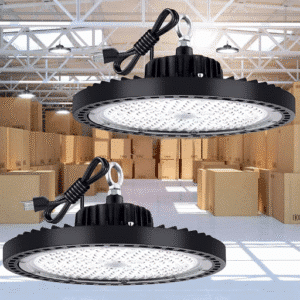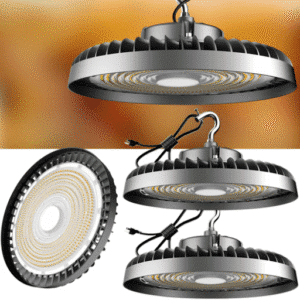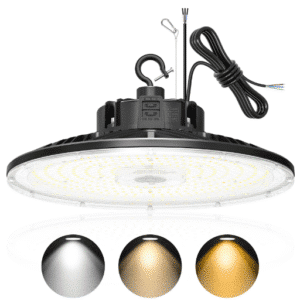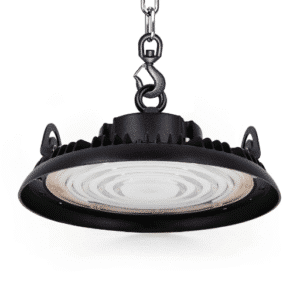

The distinction between high bay and low bay lighting, as most people know, hinges on ceiling height. When high bay vs low bay lighting for a warehouse, gym, or retail space, the first thorny issue is always measuring up your ceiling. The definition of high low bay is straightforward: high bay fixtures serve a ceiling height of 20 feet and above, while low bay fixtures are meant for low ceiling between 12 and 20 feet. Technically, high bays use more focused beam angles and higher lumen output of light for extended reach while low bays use wider optics to give even, glare-free coverage from lower hanging heights.
When the maintenance manager of a large distribution center in the Midwest installed the 200w UFO high bays in his 16-foot-high-packing hall to “future-proof the area,” he thought he was playing it safe. About two weeks later, the pickers were already complaining of having headaches from the glare. Six months later and with an $8,000 invoice in hand, it was time for him to install 80w low bays, which worked far more satisfactorily for all parties.
Now you can estimate the exact size of an industry-lighting rig with an accompanying calculus for their maintenance teams to contend for maybe years on end-and the many suitable lighting x-yst and its calculation meant to get it right from the very beginning in this guide. Topics will include the 20-foot rule, the tricky 18 to 22 foot transition zone, lumens calculation-for your space, beam angle selection, OSHA and IES compliance, installation cost differences, and our 10-year total cost comparison.
Key Takeaways
- High baying fixtures are suited for ceilings reaching at least 20 feet, while low bay fixtures are good for 18 to 22-foot-high ceilings.
- The 18 to 22-foot range is a transition zone: This completely depends upon the respective task and how racks are stored.
- With a lumen range of 15,000 to 50,000, high bays narrow the angle of the beams from 60 to 120 degrees.
- Low bays distribute light of 5,000 to 18,000 lumens with angles ranging from 100 to 120+ degrees wider.
- OSHA stipulates a minimum of 5 foot-candles in warehouses; IES recommends a higher range of 15 to 30 fc for active tasks.
What Is High Bay Lighting?

High bay lighting is lighting designed for buildings with high ceilings mainly ranging between 20 to 45 feet. These powerful lights distribute illumination extensively from a high distance, which would lose its strength in standard fixtures mounting for some time before they hit the working surface. In the selection of high bay vs. low bay lighting, the first screen is the height of the ceiling.
Want to know (what is high bay lighting)? Please see our related guide.
Typical Specifications
High bay fixtures are engineered for distance. They combine high wattage, narrow to medium beam angles, and robust thermal management to maintain output in demanding environments.
| Specification | Range |
|---|---|
| Ceiling Height | 20 to 45+ feet |
| Wattage | 100W to 400W+ |
| Lumen Output | 15,000 to 50,000+ lm |
| Beam Angle | 60 degrees, 90 degrees, 120 degrees |
| Common Replacements | 250W to 1000W+ Metal Halide |
| Fixture Weight | 8 to 20 lbs |
Yet high ceiling height negatively impacts lighting concentration. A fixture lying at 35 feet needs to maintain four times as much intensity as the one at 17 feet to achieve the same brightness on the floor. For what reason, the high bay is lumens; in simple words, it prioritizes lumen and optical control over broad-walled spaces.
Common Applications
As high bay lighting fixtures serve commercial and industrial spaces with high ceilings and wide floor trails, the light from such fixtures needs to travel a great distance without losing energy. Entrench them in:
- Warehouses and distribution centers with tall racking
- Manufacturing floors with overhead cranes or conveyors
- Gymnasiums and indoor sports facilities
- Airport hangars and maintenance bays
- Big-box retail and exhibition halls
- Cold storage facilities with high-stacked pallets
Fixture Types: UFO and Linear
Most high bay installations use one of two shapes. UFO high bays are compact, circular fixtures that focus light downward in a cone pattern. They work best in open floor areas and spaces without tall shelving. Best UFO high bay lights vary by wattage and beam angle, but the core advantage is concentrated output in a small form factor.
Linear high bays are rectangular fixtures that spread light across a wider footprint. They excel in aisle configurations, production lines, and spaces where uniform coverage matters more than raw intensity. The choice between shapes depends on your layout, not just your ceiling height.
Our guide to (UFO vs linear high bay) lighting breaks down the exact spacing and photometric differences.
What Is Low Bay Lighting?
Low bay lighting that is installed on ceilings ranging in height from 12 to 20 feet makes for the perfect solution in the present scenario. Such lighting does not produce intense hotspot glare, but instead diffuses light adequately in a radiating manner. The mounting height is reduced, meaning the distance the light has to travel is shortened. Therefore, the issue becomes more about equality and visual comfort rather than intensity.
Interested in low bay lighting? Check out our “What is Low Bay Lighting?” guide.
Typical Specifications
Low bay fixtures prioritize even coverage and reduced glare. They use lower wattage, wider optics, and often diffused lenses to soften the light at the source.
| Specification | Range |
|---|---|
| Ceiling Height | 12 to 20 feet |
| Wattage | 40W to 150W |
| Lumen Output | 5,000 to 18,000 lm |
| Beam Angle | 100 degrees to 150+ degrees |
| Common Replacements | 175W to 400W Metal Halide |
| Fixture Weight | 4 to 12 lbs |
The 12 to 20 foot range covers a wide variety of commercial and light industrial spaces. Low bays are not “weaker” versions of high bays. They are optically different tools built for a different job.
Common Applications
Low bays work anywhere the ceiling is within reach of a standard ladder and the goal is even, comfortable illumination.
- Retail stores and showrooms
- Auto repair garages and workshops
- Parking garages and covered walkways
- Classrooms and training facilities
- Stockrooms and back-of-house areas
- Small warehouses and pole barns
- Food service prep areas
For a deeper look at applications and selection criteria, see our (low bay lighting applications) guide.
Fixture Types
Several forms exist for the low bay fixtures. UFO low bays borrow the circular housing of high bays but with smaller wattage and wider optics. Troffer and panel low bays recede or suspend from the ceiling for clean lines. The low bays are sealed with a vapor-tight lens and housing for moist or dusty locales.
High Bay vs Low Bay Lighting: Side-by-Side Comparison

The fastest way to understand the difference is to see the two categories lined up across every decision factor. This table summarizes what matters when you are specifying fixtures.
| Factor | High Bay Lighting | Low Bay Lighting |
|---|---|---|
| Ceiling Height | 20 to 45+ feet | 12 to 20 feet |
| Wattage | 100W to 400W+ | 40W to 150W |
| Lumen Output | 15,000 to 50,000+ lm | 5,000 to 18,000 lm |
| Beam Angle | 60 degrees to 120 degrees | 100 degrees to 150+ degrees |
| Light Focus | Intensity, long-distance throw | Uniformity, glare control |
| Fixture Cost (LED) | 100to100to500+ | 80to80to300+ |
| Installation Labor | 150to150to300 per fixture (lift required) | 75to75to150 per fixture (ladder) |
| Maintenance Access | Harder (lift rental often needed) | Easier (standard ladder) |
| Common Uses | Warehouses, factories, gyms, hangars | Retail, garages, workshops, classrooms |
The 20-Foot Rule and Why It Matters
Twenty feet is the industry-standard dividing line. Below 20 feet, low bay fixtures generally provide better visual comfort and more uniform coverage. Above 20 feet, high bay fixtures have the output and optical control to deliver usable light to the floor.
Above logic is based on physics: Light follows an inverse-square law. Double the mounting height and you need four times the intensity at the source to enjoy the same brightness at the work surface. Indeed, stark, uneven coverage came from a 100W low bay mounted at 25 feet while glaring, uncontrolled light came from a 200W high bay mounted at 14 feet.
The 18 to 22 Foot Transition Zone
Not in either facility neatly’ falls within the range of 18-22 feet. This range presents a gray area that allows any type of fixture-and three specific factors-to deliver effective lighting.
Job requirements: illuminating work surfaces. In some instances, however, a high bay could be appreciated due to work requiring detailed inspection, label reading, or machine operations. Yet, when space is intended for general circulation or packing purposes, how to achieve ease on light is best exemplified by low bays.
Racking height. The height to rack with cast shadows. In a 20-foot-tall room with 16-foot-tall racking, a high bay with a narrow beam angle could deliver light down the aisles between the racks. Low bays would lose too much intensity between the racks.
Wall color reflects and reflects that light back upward. In the case of an input-lit or very reflective 19-foot-height space, low bays might generate enough reflected light for your purposes. For darker concrete, high bays are likely your best bet.
The machining area’s ceiling measured 20 feet, but it fell to 14 over the assembly production line. The maintenance people first thought they would choose one fixture type to cover both height specifications. When the plant engineer specialized calculation for both areas, he discovered all they needed for the machining area was 150W high bays. It turned out that 100W low bays were good enough for the assembly line. With this new double coupling reign, the engineers derived $3200 that would initially have gone to the standard machine specification.
Ceiling Height for High Bay Lighting: When to Use Each Type
Use this framework to match your ceiling height to the right fixture category.
Over 15 ft: Using Only Low Bay
At 12 to 15 feet, high bay fixtures appear very close to the work surface just for them to cause uncomfortable brightness or harsh shadows even with wide-beam high bays. It’s advised to use the low bay having 120-degree optics or lenses for diffusion. Average wattage ranges between 40W and 80W.
If you need to dig deeper into how ceiling structure affects fixture placement, our guide on (ceiling height for high bay lighting) covers the full framework.
15 to 20 Feet: Low Bay Preferred, High Bay Possible
This is the lower edge of the transition zone. Low bays are typically for use in open spaces and retail and workshop areas. It is practical for high bays if the ceiling is tall storage racks where you need very high foot candles or the floor has poor reflectance. Low bay wattage would typically be 80W to 120W. For high bay lighting, the usual range is between 100W and 150W.
20 to 30 Feet: High Bay Standard
At these heights, low bay fixtures will not push enough light to the floor with sufficient brightness. UFO and linear high bays between 90 and 120 degrees normally cover this height. The standard wattage ranges between 150W to 200W.
30 to 45+ Feet: High Bay with Specialized Optics
Optimal light intensity requires a certain light output and a directed lighting. This may demand a 60-degree narrow focus or a specialized aisle optics to get the best results. Typical wattage: 240W to 400W+. Always request an IES file and run a photometric calculation before buying at such high heights.
How Many Lumens Do You Need?
All of this may sound a bit complicated at first, but in practice it’s quite straightforward: at every foot above the pavement one is losing light intensity. This is normally offset with more lumens, a tighter beam spread, or a closer pole spacing.
Foot-Candle Targets by Application
Luminance levels, particularly with regard to foot-candles, measure the degree of light shining on any surface. However, one foot-candle is generally regarded as equivalent to 10.76 lux, which happens to be the metric unit used almost everywhere outside North America. These levels comprise the performance targets set forward by the IES. Most facilities aim for the higher levels given by IES and treat OSHA levels as the absolute minimum to comply with.
| Application | OSHA Minimum | IES Recommended |
|---|---|---|
| General warehouse storage | 5 fc | 10 to 20 fc |
| Active warehouse tasks | 5 fc | 15 to 30 fc |
| Assembly / manufacturing | 10 fc | 30 to 50 fc |
| Detailed inspection | 10 fc | 50 to 100 fc |
| Retail sales floor | 5 fc | 25 to 50 fc |
| Auto garage / workshop | 10 fc | 30 to 50 fc |
| Gymnasium | 5 fc | 30 to 50 fc |
OSHA standard 1926.56 sets the minimum illumination levels for worker safety. The Illuminating Engineering Society publishes RP-7, which provides the design targets most facilities actually use.
Worked Example: 10,000 Sq Ft Warehouse at 25 Feet
A 10,000 square foot warehouse with a 25-foot ceiling needs active task lighting at 20 foot-candles.
Step 1: Total lumens needed = Area x Target FC / Coefficient of Utilization. For a typical warehouse with light surfaces, the CU is roughly 0.6.
10,000 sq ft x 20 fc / 0.6 = 333,333 lumens needed at the source.
Step 2: Select fixtures. Probapro 150W UFO high bays deliver 22,500 lumens each at 150 lm/W efficacy.
333,333 / 22,500 = 14.8 fixtures. Round up to 15.
Step 3: Verify spacing. At 25 feet, fixtures should be spaced roughly 25 to 35 feet apart. A 10,000 sq ft building (100 ft x 100 ft) fits a 4×4 grid of 16 fixtures comfortably. This provides extra headroom above the 20 fc target.
For a deeper walkthrough of this calculation, see our lumens guide.
Worked Example: Same Space at 16 Feet with Low Bays
The same 10,000 sq ft warehouse with a 16-foot ceiling and the same 20 fc target.
Step 1: Total lumens needed. The CU improves slightly at lower mounting heights because less light is lost to absorption. Use 0.65.
10,000 x 20 / 0.65 = 307,692 lumens.
Step 2: Select fixtures. Probapro 100W low bays deliver 15,000 lumens each.
307,692 / 15,000 = 20.5 fixtures. Round up to 21, or use a 5×5 grid of 25 for cleaner spacing.
Step 3: Verify spacing. At 16 feet, low bays should be spaced 16 to 24 feet apart. A 5×5 grid at 20-foot spacing works perfectly in a 100×100 building.
Notice that the lower-ceiling space needs more fixtures but lower wattage per fixture. The total system wattage is roughly comparable, but the installation is simpler because no lift is required.
Beam Angle Selection

Beam angle determines how wide or narrow the light spreads from the fixture. The wrong angle creates dark spots between fixtures or wastes light on walls and aisles.
High Bay Beam Angles
| Beam Angle | Best For | Typical Ceiling Height |
|---|---|---|
| 60 degrees | Narrow aisles, tall racking, high ceilings | 30 to 45+ feet |
| 90 degrees | General warehouse, open manufacturing | 20 to 30 feet |
| 120 degrees | Open floor plans, wide areas | 20 to 25 feet |
With a beam spread of 60 degrees and a 25-foot installation height, it throws a tight oval pool of light squarely down on the floor with a diameter of about 27 feet. This is fine for racked aisles as you don’t want light on the top of the racks; light should be targeted on the pick faces instead.
Check out our (beam angle for high bay lights guide) to find out what wattage of high bay lights you should buy.
With a 120-degree beam from the same ceiling, light will illuminate a pool with a diameter of some eighty-six feet. That seems good, but it considerably reduces intensity by spreading light very thin. One hundred twenty degrees fit open areas, but with the light thrown to the top of the pallets in racked aisles, it is a waste.
Low Bay Beam Angles
Low bays almost always use 120-degree or wider optics. The goal is broad, even coverage without hot spots. Diffused lenses or prismatic reflectors spread the light further. In a 15-foot ceiling, a 120-degree beam covers a 42-foot diameter at the floor. Two fixtures spaced 30 feet apart overlap slightly, creating uniform illumination.
High Bay vs Low Bay LED Lights: Technology Comparison
When evaluating high bay vs low bay LED lights, technology choice matters as much as fixture category. LED dominates both categories in 2026, but many facilities still run legacy systems.
| Factor | LED | Fluorescent | Metal Halide |
|---|---|---|---|
| Wattage (equiv. output) | 100W to 200W | 4 to 8 lamp T5/T8 | 250W to 400W |
| Lumen Output | 15,000 to 30,000+ lm | 10,000 to 20,000 lm | 20,000 to 36,000 lm |
| Lifespan | 50,000 to 100,000 hours | 20,000 to 30,000 hours | 10,000 to 20,000 hours |
| Energy Cost (annual, 24/7) | 105to105to210 | 280to280to560 | 350to350to560 |
| Warm-Up Time | Instant | Instant | 5 to 15 minutes |
| Cold Performance | Improves | Degrades | Degrades |
| Dimming | 0 to 10V standard | Limited | Poor |
Most high and low bay LEDs are retrofit projects. LED fixtures provide expensive upfront and require more money than T5 fluorescent tubes, a price difference that has significantly narrowed. In energy savings alone LED, when taken against Metal Halide, pays itself back in 12-24 months. Maintenance savings are an added strength. A Metal Halide lamp needs to be replaced every 2-3 years in a 24/7 facility. By this time, a 10-year-old LED fixture still has some life.
If you’re unsure whether to buy an LED high bay or a fluorescent high bay, please see our (LED vs. fluorescent high bay) guide.
Applications: Where Each Type Excels
The best fixture for your facility depends on what happens under the lights. Ceiling height sets the category. The application fine-tunes the specification.
Warehouses and Distribution Centers
Warehouses with 20 to 40 foot ceilings and tall racking need high bays with narrow beam angles. Aisle lighting is the critical challenge. Light must reach the vertical faces of pallets so pickers can read labels. UFO fixtures with 60-degree optics or linear fixtures with aisle-specific lenses outperform wide-beam options.
For layout guidance, see our warehouse lighting design guide.
Manufacturing and Assembly Plants
Manufacturing floors vary. Machining areas with overhead cranes need high bays at 25 to 35 feet. Assembly stations at 14 to 18 feet need low bays or high bays with wide optics. The transition zone is common here. Most plants use a mix.
Gymnasiums and Sports Facilities
Gymnasiums should boast fairly high bays off the floor, generally around 20 to 30 feet with 90 degrees to 120-degree beams in order to pull off the necessary coverage. Glare control has paramount importance as a sportsman will normally take a glimpse of the upper region. Basically it is a soft-indirect light fixture with a lens spread very widely but parallel to the ceiling.
Retail Stores and Showrooms
The typical ceiling height of a retail store is under 18 feet. Low bay fixtures have the highest color rendering index and might have a color temperature of around 3000-4000K to make the merchandise look enticing. There is a balance between product light supporting good color rendering and uniformity meant to underscore object uniformity over mere intensity. Dark spots make for an unattractive, cheap store.
Auto Garages and Workshops
Garages are normally 12 to 18 feet high, with various high or low bays that double as work-mounting grease buckets. The luminaires should have vapor-tight housings to avoid oil and dust or other elements contamination. IP65-rated fixtures are powerful against high-pressure water jets and they are also available for purchase. The high CRI high bay is important in allowing mechanics to easily and correctly see the color of fluids when fixing vehicles.
Cold Storage Facilities
Refrigerators and cold storage warehouses have sky-rocketing temperatures. Typically, LED drivers compromise at below negative 20°C. Hardened LED drivers to the levels of below negative 40°C are mandatory. For wash-down or condensation, proper IP65 or higher is important.
OSHA and IES Compliance Requirements
Lighting is regulated. OSHA sets minimums to prevent accidents. IES sets targets to support productivity. Your design should exceed OSHA and aim for IES.
OSHA 1926.56 Minimum Illumination
OSHA standard 1926.56 requires minimum illumination for indoor work areas. These are legal floors, not design targets.
| Area | Minimum Foot-Candles |
|---|---|
| General construction areas | 5 fc |
| General shops and plants | 10 fc |
| Active warehouses | 5 fc |
| Hallways, exits, passageways | 5 fc |
| Loading platforms | 3 fc |
| First aid and medical stations | 30 fc |
OSHA also requires that exit routes maintain at least 1 foot-candle at floor level during emergencies, with battery backup lasting 90 minutes or more.
If you are setting up lighting for your warehouse, please check out our (OSHA Warehouse Lighting Requirements Guide).
IES RP-7 Recommended Foot-Candles
IES RP-7 provides the design standards most engineers follow. These targets support visual comfort, accuracy, and safety.
| Task | IES Recommended |
|---|---|
| Inactive storage | 5 to 10 fc |
| Active bulk storage | 15 to 20 fc |
| Shipping and receiving | 20 to 30 fc |
| Rough assembly | 30 to 50 fc |
| Medium assembly | 50 to 100 fc |
| Fine inspection | 100 to 200 fc |
ASHRAE 90.1 and Energy Codes
ASHRAE 90.1 sets maximum Lighting Power Density (LPD) for commercial buildings. Warehouse LPD limits typically range from 0.45 to 0.65 watts per square foot depending on the space type and jurisdiction. LED high bays at 150 lm/W easily meet these limits. Metal Halide systems often exceed them.
Installation Considerations
The fixture type affects installation cost, timeline, and safety requirements.
Mounting Methods
Both high bay and low bay fixtures typically mount via hook, chain, or U-bracket. High bays in high-ceiling spaces often use pendant drops to position the fixture at the optimal height. Low bays usually mount directly to the ceiling or a short drop for clearance.
Electrical Load and Circuit Planning
High-bays consume more power per fixture but have more headroom. Low-bays consume less power per fixture but have more surface area. The total circuit load depends on your configuration rather than just being a matter of fixture category. So, a 10,000 square foot warehouse at 25 feet might use 16 units of high-bays, each 150 watts for a total of 2400W; the same space at 16 feet might use 25 units of low-bays, each 100 watts for 2500W – almost exactly the same total.
Always verify panel capacity before retrofitting. Older facilities with 400W Metal Halide fixtures may actually reduce circuit load when switching to LED, even if fixture counts increase.
Lift Requirements and Labor Costs
High bay installation requires aerial lifts or scaffolding. Lift rental costs 200to200to400 per day. An experienced crew installs 15 to 25 high bays per day. Low bay installation uses standard ladders. A crew installs 30 to 50 low bays per day. The labor cost difference is significant on large projects.
Cost Comparison and ROI

The decision between high bay and low bay has cost implications beyond the fixture price.
Fixture Cost Per Unit
| Fixture Type | Budget Range | Premium Range |
|---|---|---|
| LED High Bay (100W to 200W) | 80to80to150 | 200to200to500+ |
| LED Low Bay (40W to 100W) | 50to50to120 | 150to150to300+ |
Budget fixtures work for basic applications. Premium fixtures offer better optics, longer warranties, higher efficacy, and smarter controls. For a 24/7 facility, the premium pays for itself through energy savings and reduced failure rates.
Total Installed Cost
| Cost Factor | High Bay | Low Bay |
|---|---|---|
| Fixture | 100to100to500 | 80to80to300 |
| Installation labor | 150to150to300 | 75to75to150 |
| Lift/equipment rental | 200to200to400/day | Not required |
| Total per fixture | 250to250to800 | 155to155to450 |
10-Year Total Cost of Ownership
Consider a 10,000 sq ft facility running lights 12 hours per day, 250 days per year, at $0.12 per kWh.
High Bay Option (25-foot ceiling): 16 fixtures at 150W each.
- Initial cost: 16 x 350=350=5,600
- Installation: 16 x 225=225=3,600
- Annual energy: 16 x 150W x 3,000 hours x 0.12/kWh=0.12/kWh=8,640
- 10-year energy: $86,400
- 10-year TCO: $95,600
Low Bay Option (16-foot ceiling): 25 fixtures at 100W each.
- Initial cost: 25 x 200=200=5,000
- Installation: 25 x 100=100=2,500
- Annual energy: 25 x 100W x 3,000 hours x 0.12/kWh=0.12/kWh=9,000
- 10-year energy: $90,000
- 10-year TCO: $97,500
When comparing high bay vs low bay lighting costs, the totals are often close because the lower-ceiling space needs more fixtures. The high bay installation costs more upfront but uses slightly less energy over time due to fewer fixtures. The real savings come from switching to LED regardless of category.
Payback Period
Most LED retrofits pay back in 12 to 24 months. Adding motion sensors or occupancy sensors can cut runtime by 30 to 50 percent and shorten payback further. Facilities with high utility rates or long operating hours see payback in under 12 months. Utility rebates for DLC-listed fixtures can accelerate payback by 20 to 40 percent.
A big-box retailer renovated a 1980s store with 18-foot ceilings. The contractor recommended low bays for the sales floor and high bays for the stockroom. The retailer instead chose low bays for both areas to simplify ordering. Within three months, stockroom pickers complained they could not read labels on upper shelves. A partial retrofit with high bays in the stockroom solved the problem at twice the initial labor cost.
Looking to retrofit your high bay lights? Check out our (high bay lighting retrofit guide) before you start.
Frequently Asked Questions
Is it correct to say high bay lights can be used on low ceiling?
No. Lights of high bay are spot lights of concentrated light below 20 feet that cast harsh shadows and cause lots of glare. Working under this usually comes out with headaches and eye strain. In order for a ceiling that is less than or around 20 feet to be properly illuminated, the use of low bay design fixtures with wide beams is dictated.
What happens to its use if you accidentally get the wrong one?
Applying high bays to low ceilings results in adventitious glare and floodlighting. The use of low bays on tall ceilings causes the floors to be dimly lit with little foot-candle light. In both cases, productivity and safety of workers are compromised. Making the wrong choice also means that energy is being wasted, and overall costs are increased.
What is the best angle for racking up the warehouse?
Narrow aisles with high storage rackings are suitable for 60-degree beams or aisle-specific linear optics. And open floors could do better with 90-degree to 120-degree beams. Make sure to ask for an IES file and do a photometric layout prior to specifying your beam spread.
How far apart should high bay lights be placed?
Place high end fixtures at a distance equal to 1-1.5 times mounting height. At 25′, place them every 25′-35′ apart. At 35′, place them every 35′-50′ apart. For accurate spacing, use a photometric calculator.
Are LED bay lights worth the investment?
Yes. An LED has been offering around 50 to 75 percent in energy reduction, and more than a 50,000-hour lifespan. They switch on instantly and require little maintenance. Most projects generate tangible ROI in between 12 to 24 months. Metal Halide, comparison screens with paybacks usually under 18 months.
Conclusion
Deciding to use a high bay or low bay lighting system starts with a tape measure. The simplicity of the edifice makes it hit-or-miss as to what constitutes high bay lighting vis-à-vis low bay lighting, so the answer boils down to a difference in ceiling height. High bay light fixtures are for 20 feet and above. Low bay lights are for 12 to 20 feet. In the case of an 18 to 22 foot height, your selection comes down to your task requirements, glare, and beam decay rate, among other things.
In this guide, we talked about the key differences between high bay and low bay fixtures, including not only the ceiling height thresholds but also the beam angles, lumens, and OSHA dictates. With high bay versus low bay LED lights or their traditionally run counterparts, the right type of fixture deals with the issue of proper visibility, less energy cost, and fewer complaints from workers. The problem with other types is they produce glarea, dead spots, and expensive refit issues.
For ceilings above 20 feet, explore our high bay LED lights to find fixtures rated for your application. Need help selecting the right high bay vs low bay lighting for your facility? Contact our team for a free lighting assessment tailored to your space.