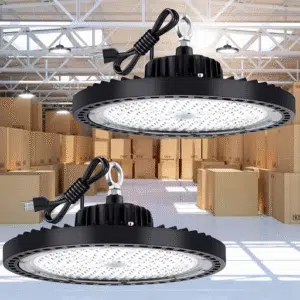
Placement of lights in high spaces is a major concern for the building and one will not be able to think about a warehouse, a factory, a gym, or even a supermarket without it. Due to the ceiling in the places being above 20 feet, common lighting practices do not cover all the lighting, energy saving, and light moods controlling requirements of these places. Thus, the high bay lights are in use at these places. Department of Energy is making a selection of the top high bay lights of the year, but so far, it is only for the 20-foot ceilings. The factors which will be discussed are product features, the reason why they are much better, and why they are better than the rest of the market in terms of lighting. Whether it will be the case that the employee is seeing better, or the municipal bills are lower because of less energy used, or the factory lighting is perfect, this article will help the reader to make a good decision through the cited power consumption and light output facts in the text.
Understanding High Bay Lights

What is a High Bay Light?
There are LED high bay lights that can serve as a more energy-efficient and quality kind replacement for both metal halide and fluorescent high bay lights. Probably one of the most energy-efficient and reliable commercial lighting systems available is this one. These lights are designed to reverse all the energy-saving measures of the warehouse without affecting the lit area in any way. And with the replacement, the energy cost per Watt will be less. Light that takes up 33% of the total energy bill will still be able to consume the same number of watts per period but at one-third the cost.
Benefits of Using LED High Bay Lights
Key Advantages:
Energy Efficiency: LED high bay lights require much less energy than traditional lighting technologies such as metal halides or fluorescent lamps, which in turn leads to a remarkable cut in total operational costs.
Extended Lifespan: LED high bay lights are normally long-lasting to around 50,000 hours or more, which basically means the maintenance and replacement charges will not be as huge as their counterparts.
Uniform Light Distribution: Engineered specifically for large open spaces, these lights provide uniformly distributed and visually pleasing illumination without dark spots or excessive shadowing.
Environmental Benefits: When the use of electricity is lower, the carbon footprint is also lower, which makes the choice of LED high bay lights as an eco-friendly one for sustainable operations.
Minimal Heat Production: The low heat output reduces the burden on HVAC systems and thus helps in the establishment of a more comfortable working environment.
LED high bay lights are the perfect solution for heavy-duty, high output lighting needs and therefore are best suited for any industrial applications that have a requirement for this type of lighting.
Applications of High Bay Lighting
High bay lighting is a common sight in places of business and industry characterized by a minimum ceiling height of 20 feet. The ceiling itself does part of the work as by simply being high it helps to uniformly spread the light and reduce the total number of fixtures needed. Hence, the fixtures are so spread out that it is not uncommon to see the high bay light fixture in such high ceiling spaces. With the remote location of the light source, the luminaire will be able to cover a larger area at the same time without any brightness reduction happening.
Moreover, with the help of motion sensors, daylight harvesting, and scheduling, using LED fixtures, many lighting control systems with a wide set of functions can be implemented. Because LED provides even better luminous efficacy and service life, this technology is mostly used with these features, causing energy saving to be the key benefit accordingly. By the same token, since the LED contributes drastically to the total energy savings, the operation costs will be the lowest. Such lights are well-suited for places where the constant and efficient illumination of a large area is needed for safety and productivity.
Types of High Bay Lights

LED High Bays vs. Traditional Lighting
| Feature | LED High Bay Lights | Traditional Lighting |
|---|---|---|
| Energy Efficiency | Very high – minimal power consumption for maximum brightness | Lower – requires more power for same light output |
| Lifespan | 50,000+ hours | Significantly shorter lifespan |
| Light Quality | Higher CRI values, uniform distribution | Variable quality, potential for uneven lighting |
| Environmental Impact | Eco-friendly, no mercury or hazardous materials | May contain mercury and other dangerous elements |
| Maintenance Costs | Minimal – fewer replacements needed | Higher – frequent maintenance required |
| Durability | Excellent performance in harsh conditions | Less reliable in challenging environments |
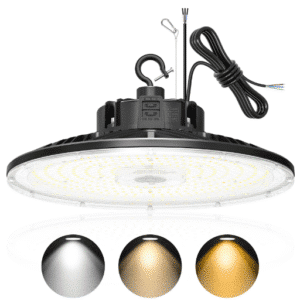
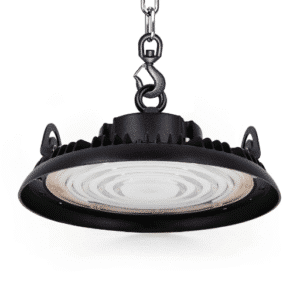
UFO High Bay Lights
UFO High Bay Lights have continuously gained immense popularity since the time of their introduction to the market mainly because of their unmatched efficacy, solid build, and suitability for industrial applications. According to which a considerable number of users fundamentally cite the energy-saving feature of these lights, shows a strong preference for lights that only consume 25% of the electricity when compared to traditional metal halide or fluorescent lighting systems.
✓ Key Features:
It only consumes 25% of the electricity that traditional lighting consumes.
It is rated up to more than 50,000 hours of operation.
Replacement and maintenance costs are lower.
It is environmentally friendly since it is designed to be conscious of the environment.
The investment will be paid back in a short period of time.
Dimmable options are also available.
Linear High Bay Lights
The aim of Linear High Bay Lights is to provide efficient and focused lighting in large indoor spaces such as warehouses, manufacturing facilities, and gymnasiums. Linear High Bay Lights are not the same as UFO High Bay Lights, on the one hand, those produced radiated light in a circular manner mostly and were of a completely different shape and much longer than their width on the other. In order to be able to concentrate light on an area that is especially narrow or aisle-like, High Bay Lights have to be correctly directed and baffled otherwise, the light will be scattered in all directions.
A massive increase in demand for energy-efficient lighting solutions, and thus the industries’ elevated consciousness to the issue of energy reduction, are the two major trends visible today. In other words, “LED efficiency,” “long lifespan,” and “dimming capabilities” are the most common search terms indicating that sustainable lighting is the main consumer choice. Light Emitting Diode (LED) lights have received the biggest attention from industries because they are the greatest choice for energy-efficient facilities; they have the highest lumen output consumption ratio among lighting solutions, hence, the least wattage needed.
Choosing the Right High Bay Light for 20-Foot Ceilings

Determining the Right Lumens Output
Determining the right lumens output is essential to guarantee adequate space illumination and energy conservation when choosing high bay lights for a 20-foot ceiling. The most frequently searched questions from customers are regarding the best lumen ranges for various ceiling heights and application types. Light output for a 20-foot ceiling in places like warehouses, gymnasiums, or industrial facilities is, for the most part, between 10,000 and 20,000 lumens, depending on the level of light intensity and uniformity wished.
💡 Important Considerations:
The duration during which a lamp burns in the course of a day is one among many factors to take into account when choosing a lamp. Natural and pleasant as the spectrum of the day should be the quality of man-made light sources too, in order to reduce the strain on the human eyes as much as possible. The general ambient light and the local illumination of the workplaces are realms where it is necessary to have the workers’ health, comfort, and safety in mind in the first place. However, in the case of the general ambient light, lower lumen levels near 10,000 might be sufficient to meet the requirements.
These lumen outputs can be attained using the new LED technologies; and that will lead to low levels of wasted energy as well. Another necessity is to investigate beam angles because narrower ones could magnify the vertical space lighting effect while wider angles might give more overall illumination.
Comparing Different Types of High Bay LED Lights
High Bay LED lighting consists of a wide range of lights that differ not only by their design but also by their application:
Linear High Bay Lights
Most fit for very large spaces like warehouses or gyms. Provide even lighting across all that space with their thin and long shape that features large beam angles.
Round (UFO) High Bay Lights
Visually more complete with narrower beam angles that direct the light. Perfect for certain areas such as factories or workshops with tall ceilings.
Panel High Bay Lights
Sleek in design and visually appealing. Used for places where aesthetic appeal is important besides function.
Each type of high bay LED light is used for a particular area of application through the combination of lumens output, beam angle, and coverage area while maintaining energy consumption efficiency.
Factors to Consider for Warehouse Lighting
Essential Factors Checklist:
Luminous Output: The brightness of the light should be sufficiently high and so that one can work legally and efficiently in the workspace meanwhile adapting the light intensity as per the particular task requirements.
Beam Angle: It is an extremely important factor that influences light layout – areas with wide beams will require uniform lighting, while racking aisles or focus zones are best illuminated with narrow angles.
Mounting Height Compatibility: One of the most important factors to consider is the height of the ceiling on which the light is meant to be installed, since the most powerful illumination is needed in places with the highest ceilings.
Energy Efficiency: The cost of operation should always be near zero and the best way to do that is to opt for LEDs as they require very little energy and have a long lifetime.
Color Temperature: In order to enhance visibility and productivity in the warehouse environment, the color temperature should be cool (around 4000-5000K).
Best LED High Bay Lights for Industrial Use

High Performance LED Options
When it comes to choosing LEDs that are high-performance/high bay and suitable for industrial applications, it is important to take into account a few significant factors:
🏭 Performance Criteria:
Lumen Output: A benchmark for lightening up huge places properly. Choose lighting fixtures with a lumen output of 15,000 lumens and more for the best visibility.
Energy Efficiency: When the goal is to cut down on power usage and lower costs, look for the high lumens per watt ratio in LEDs as the prime factor. LEDs with 130 lumen per watt or higher ratio are highly suggested.
Durability: In the case of industrial locations, the lighting fixtures should be extremely rugged. They must undergo all the tests of shock (IK ratings) and ingress protection (IP ratings) in order to stand up to such conditions as dust, moisture and vibrations.
Color Temperature: The zone between 4000K and 5000K is the right one to ask for, as it combines the two aspects, being very clear and, at the same time, not eye-straining that creates a productive atmosphere.
Cost-Effectiveness and Energy Efficiency
Purchasing energy-saving light bulbs is a very critical step in a person’s economic endeavor for the long term. LED light fixtures can be the best target which can save you a noticeable portion of your energy consumption bill expenses when the common incandescent or fluorescent varieties are very much less energy efficient, hence, reducing operation costs. Furthermore, the longer warranty of the lamps helps in reducing the need for replacements to the minimum hence a fall in maintenance costs, too.
By choosing lighting apparatuses of the highest luminous efficacy, expressed in lumens per watt, lighting environments can be optimized more than ever such that energy is conserved to the utmost. At the same time, the involvement of highly-developed controls like motion sensors and dimmers is making it possible for the lighting system to consume less power through the given example or one alike due to the fact that the system’s light intensity is (automatically) regulated according to the occupancy and the ambient light level. It is impossible to deny that the employment of the energy-saving lights leads to fewer overall energy con-sump-tion, in turn, wherefore the lights are going to be the sustainable solution and that they will mean a huge economic saving for any business still.
Lighting Layout and Installation Tips

Optimal Placement for Maximum Light Distribution
Placing the light fixtures evenly throughout the room is a favorable act that can be done. It’s a very clever method of avoiding “no light spots” while at the same time not having one area that’s overly lit. Conversely, if the lamps are all the exact same height, then the design will come off as rather unpleasant. In the case of task areas like workbenches and others, the light should be positioned in such a way that the work surface or the task should be at an angle that the light would come from above.
💡 Why LEDs Excel in Visibility:
The reason LEDs stand out the most from any other kind of lighting is due to their very strong light emission which is unidirectional in nature with the added bonus of color temperature adjustability. LEDs are opposite in lighting quality to incandescent bulbs as they give out light only to the marked area with almost no dispersion. This level of light is so accurate that it automatically makes it perfect for the activities such as reading and art making which demand no shadow and much less eye fatigue, thus offering the benefits of no flickering.
Additionally, LED lighting can go through a smooth color temperature change from the warm white spectrum to the daylight one, so it allows for a complete change of the lighting style to fit the mood of the place or the occasion. The possibility of reflecting light among other potential ways for the use of LED fixtures is immense; the primarily direct light that would be handled by the said reflective material would be made to provide more light than it would have and this would also be saving energy.
Maintenance Tips for LED Longevity and Best Performance
🔧 Regular Maintenance Guidelines:
Clean Fixture Surfaces Regularly: Do not let the dust and debris accumulation situation go out of hands as it could impact the light output and performance of the luminaires significantly. Cleaning regularly is the foremost step to the maintenance of maximum output.
Check Connections and Wiring: Checking at intervals can be a good way to find the loose and frayed connections which might turn to the faulty wiring.
Minimize On/Off Cycling: LEDs that are often switched on and off can have a shorter lifespan. It is best to operate them for long durations whenever it is possible.
Ensure Adequate Airflow: Proper ventilation is the best way to create a cool environment around the fixtures. Too much heat might greatly hamper the performance and durability of the components.
Prompt Replacement: The soon-to-fail or already failing LEDs should be replaced immediately so that the highest functionality and lighting consistency of the system are maintained.
Frequently Asked Questions (FAQ)
What high ceiling fixtures work best for a 20 ft ceiling?
This particular case discusses plans to have LED hanging light fixtures and round high bay lights mounted on the ceiling of a 20-foot-high room. The decision to go with LEDs was made because their usage is associated with less heat emission which will protect the room’s walls and floors from getting discolored and the lights can be mounted near the ceiling so the light seems to be not so direct and not showing the excessive height as well. LED lights are available in different color temperatures like the most common cool white and the warm white, which is the most relaxing and cozy of them all.
How do types of LED high bay compare for taller ceilings?
There are various types of LED high bay lights and among them three of the most famous in the market are the linear high bay LED lights, round high bay LED lights, and ufo high bay led fixtures. Each of them offers different beam patterns and luminous efficacy that play a very critical role in the placement of the luminaries. The linear high bay luminaries, for example, generate a very large rectangular beam spread which is great for long aisles, on the contrary, the round LED high bay lights put a circular light beam on the floor of the space. For a lighting site of about 20 feet distance from the floor, a choice of high-wattage lamps or energy efficient LEDs can be made to decrease the use of luminaries. Nevertheless, the total area of the facility and the mounting height are the main factors which influence the uniformity of the light.
Which ceiling lights layout will provide sufficient light in a 20 foot ceiling space?
Adjusting light in not only lumens but also the distance from the fixtures is very important when it comes to 20 ft high ceiling spaces. Your first step is finding the right lux level for the place you chose whether a gym, a shop, or a warehouse. After that, the best thing to do is to go with a mixture of linear and round fixtures that both satisfy the requirements. Spotlights that are installed at a 90-degree angle are the most appropriate ones for the 20-ft high ceiling. To provide more light to the task areas and better accessibility to the other zones, the choice of a shop LED high bay or a fluorescent high bay will also be helpful depending on your needs.
Which of the two options, shop lights or industrial LED high bay, is the best choice for 20ft ceilings?
Both the LED industrial and LED high bay fixtures would suffice for a 20 ft space according to the traditional rule. However, the final choice is usually affected by the room’s function: for a shop, the shop lights or linear LED high fixtures will make a long and bright milieu along the aisles and benches, whereas round high bay with high CRI options is the best choice for areas where the only general light and color accuracy are critical. Power saving, luminaries’ life, and maintenance intervals are the top points to pay attention for when comparing the new to the old system of the LED fixtures display and the conventional lighting or the fluorescent high bay systems. A mixed lighting system using bay fixtures and selected task lights will create the top each-softly less illumination performance-cost ratio than in any cases.
How would I figure out the number of fixtures for ceilings that are around 20 ft in height?
It’s probably safe to say that we can all agree on one thing; working in a room with a 20 feet ceiling height is not an easy task, and ceiling lights are not your best friends in this case. You will see shadows everywhere even when the ceiling lights are really close to the edge of the room, not to mention them being located in the middle part. Light spread in a room with 20′ high ceiling is a key aspect, keeping in mind the costs that LED lighting might save in the long term. I would also recommend the implementation of a system that includes qualifications based on the amount of lighting manufacturers must provide in order not to“over-light” the space. The above solution is just one of the many ways that the system can be used to minimize the “over-lighting” issue. In addition to the above examples — an important term — one that often is most effective when discussed in the context of energy waste is “over-illumination”. Other attributes that must equally not be “overdone” include: glare, fixtures setup,larget areas lighting, and brightness.