
The best factory lighting solutions in 2026 combine high-output LED high bay fixtures (150 to 240 watts, 22,000 to 36,000 lumens), zone-specific foot-candle targets, and smart controls that cut energy use by 50 to 75 percent versus metal halide. Here is how to specify, compare, and deploy them.
When Marcus took over operations at a 120,000 square foot auto parts plant in Michigan, he inherited 240 metal halide 400W fixtures and a $58,000 annual lighting bill. Six fixtures were burned out, dark zones near the CNC area were producing rework, and OSHA had flagged inadequate task lighting on the assembly line. The fix was not more lumens. It was the right lumens, in the right zones, with the right specifications.
Lighting represents 5 to 10 percent of typical U. S. manufacturing electricity use, according to the U. S. Department of Energy, and aging metal halide systems waste up to 70 percent of that. Factory managers face a real choice: keep paying for legacy inefficiency, or design an upgrade that lowers cost, improves safety, and unlocks utility rebates.
This guide walks you through the framework Probapro uses with facility teams every week.
Key Takeaways
- Modern LED factory lighting solutions cut energy use 50 to 75 percent versus 400W metal halide and pay back in 12 to 24 months with utility rebates.
- Assembly and machining zones need 50 to 100 foot-candles; warehouse and shipping zones need 20 to 30. One uniform lighting layout wastes money.
- UFO LED high bays (150W to 240W) handle most factory floors at 15 to 40 foot ceilings; linear high bays suit aisles; explosion-proof fixtures are required for hazardous zones.
- Look for DLC Premium, ETL listing, IP65 or better, 130 to 170 lumens per watt, and LM-80/TM-21 data before you buy.
- Most U. S. utilities offer 25to25to100 per fixture rebates on DLC Premium products, often funding 20 to 40 percent of project cost.
What Are Factory Lighting Solutions?

Factory lighting solutions are engineered LED systems designed for manufacturing environments where performance, durability, and safety matter more than aesthetics. They combine high-output fixtures (typically UFO or linear LED high bays), zone-specific illumination targets, and smart controls to meet IES and OSHA requirements while reducing energy and maintenance costs. Unlike generic commercial lighting, they are built for heat, dust, vibration, and 24/7 duty cycles.
Modern systems replace legacy metal halide (HID) and T5/T8 fluorescent fixtures with LED platforms rated 50,000 hours or longer. The shift is not just about energy. It is about consistent light quality, instant-on operation, and the ability to integrate motion sensors, daylight harvesting, and Bluetooth Mesh control.
Why Factory Lighting Upgrades Drive Real ROI
A factory lighting retrofit is one of the fastest infrastructure projects to justify on a balance sheet. Four cost lines move at once: energy, maintenance, productivity, and compliance risk.
Energy Cost Reduction (50 to 75 Percent vs. Metal Halide)
A 400W metal halide fixture, including ballast draw, consumes roughly 460 watts. A 150W UFO LED with the same useable light output cuts that to about 150 watts. Across a 100-fixture facility running 4,000 hours a year at 0.12 per kWh, that swing is roughly 0.12 per kWh, that swing is roughly 14,880 in annual energy savings, before rebates.
Maintenance Savings
Metal halide lamps deliver 10,000 to 20,000 hours before lumen depreciation forces replacement. Quality LED high bays are rated 50,000 to 100,000 hours at L70 per IES TM-21 calculations. For a single-shift facility, that means eliminating lamp changes for a decade or more, plus the lift truck, labor, and downtime costs each change demands.
Productivity and Error Reduction
CIE and industrial ergonomics research links proper task lighting to error reductions of up to 30 percent in inspection and assembly work. Better uniformity also reduces eye strain across long shifts, which lowers fatigue-related incidents.
Safety and OSHA Compliance
OSHA 29 CFR 1910 sets general industry lighting minimums, and the Illuminating Engineering Society (IES) RP-7 standard defines task-specific foot-candle targets. Underlit zones are a documented contributor to slip, trip, and machinery accidents. For the full regulatory deep-dive, see our guide to (OSHA factory lighting requirements).
Lighting Requirements by Factory Zone
The biggest mistake in factory lighting is treating every square foot the same. A single 30 foot-candle blanket either under-lights inspection benches or wastes energy over racking. The fix is zone-based design.
Assembly and Production Lines (50 to 75 fc)
Workers at assembly stations need consistent, glare-free light at 50 to 75 foot-candles measured at the work plane. Aim for color rendering index (CRI) of 80 or higher so color-coded parts and wiring read accurately. UFO LED high bays at 150W to 200W on 15 to 25 foot spacing typically meet the target on 20 to 30 foot ceilings.
CNC, Machining, and Inspection (75 to 100 fc)
Precision tasks demand the highest illumination on the floor. CNC operators reading micrometers, weld inspectors checking joins, and quality control benches need 75 to 100 foot-candles with CRI 90 plus where color accuracy matters. Supplemental task lighting at the bench level is often the right call alongside overhead high bays. For CRI, glare control, and UGR guidance tailored to medical device, electronics, and automotive work, see our (precision manufacturing lighting guide).
Warehouse, Racking, and Storage (20 to 30 fc)
Storage zones inside the factory do not need assembly-level light. 20 to 30 foot-candles is plenty for pick-and-pack and visual inventory. Linear LED high bays often outperform UFOs here because the rectangular beam matches racking aisles.
Shipping, Receiving, and Loading Docks (20 to 30 fc)
Loading dock interiors need 20 to 30 foot-candles plus exterior LED flood lights covering trailers and yard space. Wet or washdown zones near docks call for IP66 rated fixtures and stainless steel mounting hardware.
Hazardous or Wet Areas (Explosion-Proof and IP66)
Paint booths, solvent storage, flour mills, and chemical handling zones require explosion-proof fixtures rated for the specific Class and Division (typically Class I Div 2 or Class II Div 1). Never substitute a standard IP65 fixture for a hazardous location rating. The certification is non-negotiable. For ATEX, IECEx, and NEC selection details, see our (explosion proof lighting for factories guide). Food and beverage facilities have a separate set of rules; our (food processing plant lighting primer) covers IP69K, NSF, and shatterproof requirements.
Types of LED Factory Lighting Fixtures

Four fixture families cover almost every factory layout. Picking the right one comes down to ceiling height, beam pattern needs, and environmental rating. For a deeper buyer-focused walkthrough, see our guide to the (best lighting for manufacturing plants).
UFO High Bay Lights
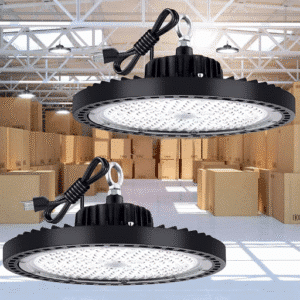
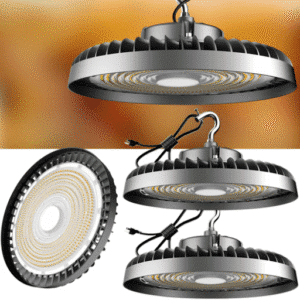
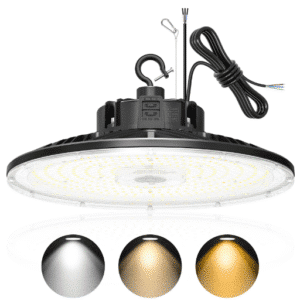
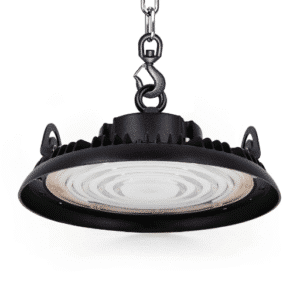
UFO LED high bays are the workhorse of LED factory lighting. The compact circular form factor delivers 130 to 170 lumens per watt with beam angles from 60 degrees (high ceiling, focused) to 120 degrees (broad coverage). They mount with hooks, U-brackets, or conduit and suit open floor plans from 15 to 40 feet.
A typical Probapro industrial-grade UFO LED high bay at 150W delivers 22,500 lumens, carries IP65 rating, and operates from minus 40 to 122 degrees Fahrenheit. That envelope covers nearly every conditioned and unconditioned production space.
Linear High Bays
Linear LED high bays produce a wider, rectangular light footprint, which suits aisles, conveyor lines, and racking. They are usually 4 or 8 feet long and pair well with pendant or surface mounting. For aisle-heavy floor plans, linear fixtures often need fewer units than UFOs to hit uniformity targets. Our UFO vs. linear high bay comparison breaks down the photometric trade-offs in detail.
LED Flood Lights
Flood lights cover loading docks, exterior yards, perimeter security, and tall vertical walls inside the factory. Choose IP66 rated fixtures with adjustable yokes and beam angles of 30 to 120 degrees depending on throw distance.
Explosion-Proof and Hazardous Location Fixtures
These are purpose-built for Class I and Class II hazardous environments. They cost more but are mandatory wherever combustible gases, vapors, or dusts can accumulate. Verify the certification (UL 844, ATEX, or IECEx) matches your facility classification before specifying.
How to Specify Factory Lighting: Key Performance Criteria
Spec sheets are full of numbers. These are the ones that matter on a procurement decision.
Lumen Output and Lumens Per Watt
Lumen output (total light) drives coverage. Lumens per watt (efficacy) drives operating cost. Look for 130 lumens per watt minimum on factory grade fixtures. Premium models reach 160 to 175 lm/W.
Color Temperature (CCT) and CRI
5000K is the industrial standard. It reads neutral white, supports alertness, and renders colors accurately. CRI 80 is the floor for most manufacturing. CRI 90 plus is worth the premium for inspection, paint matching, or printing.
Beam Angle and Uniformity
Higher ceilings need narrower beams (60 to 90 degrees) to deliver punch at the work plane. Lower ceilings benefit from wider beams (110 to 120 degrees) for better uniformity. Target a uniformity ratio (min to average) of 0.6 or better. To run worked photometric calculations for your floor plan, see our (factory lighting layout design guide).
IP Rating, IK Rating, and Operating Temperature
IP65 is the baseline for typical factory floors. IP66 is required for washdown zones. IK08 or higher protects against impact in active production areas. Verify the temperature range covers your hottest and coldest operating conditions, not just standard room temperature.
Certifications: DLC Premium, ETL, UL
DLC Premium qualification matters for two reasons: it confirms verified efficacy and lifetime data, and it qualifies the fixture for nearly every U. S. utility rebate program. ETL or UL listing is required for safe installation under most jurisdictions. Confirm LM-80 and TM-21 reports are available; if a vendor cannot produce them, walk away.
Smart Controls and Sensor Integration

Lighting controls turn a good retrofit into a great one. A typical factory recovers an additional 20 to 35 percent on top of LED conversion when controls are added. For manufacturing-specific automation, including shift scheduling, zone-based dimming, and machine-integrated controls, see our (smart factory lighting systems guide).
Motion and Occupancy Sensors
Storage aisles, loading docks, restrooms, and break areas rarely need full light when empty. PIR or microwave sensors with adjustable timeout cut runtime by 40 to 60 percent in these zones.
Daylight Harvesting
Skylights and perimeter windows make daylight harvesting a high-value option. Sensors dim or shut off fixtures near windows when ambient light is sufficient.
Networked Controls (Bluetooth Mesh, Wired)
Bluetooth Mesh enabled fixtures let facility teams group, schedule, and tune lighting from a tablet. No new wiring, no central controller. For a full breakdown of Bluetooth Mesh and sensor control systems, see our (smart industrial lighting guide). For larger sites, wired controls and DALI systems remain the gold standard for integration with building management systems.
Calculating ROI and Payback for Factory Lighting Solutions
This is where the project gets approved or shelved. Run the math on your real numbers. For deeper case studies and demand-charge analysis, see our (factory lighting energy savings guide).
Worked Example: 100-Fixture Metal Halide to LED Retrofit
When Linda, a plant engineer at a Midwest metal fabrication shop, modeled her 100-fixture retrofit, she used these inputs: 400W metal halide (460W with ballast), 4,000 annual runtime hours, 0.11 per kWh, 0.11 per kWh,35 per lamp change every 18 months including labor. Switching to 150W UFO LEDs delivered 13,640 in annual energy savings and 13,640 in annual energy savings and 7,800 in eliminated maintenance, for 21,440 total. With a 21,440 total. With a 7,500 DLC Premium rebate and 42,000 net project cost (after the 42,000 net project cost(after the 7,500 rebate), her payback came in at 19.6 months.
For deeper analysis, see our lifetime cost-of-ownership comparison of LED versus metal halide retrofits, or follow our step-by-step (factory LED lighting retrofit playbook) for project planning, phased rollouts, and disposal logistics.
Utility Rebates and DLC Premium Qualification
The DesignLights Consortium Qualified Products List is the gateway to U. S. utility rebates. Most utilities offer 25to25to100 per qualifying DLC Premium fixture, and many add bonuses for networked controls. Your local utility account rep or rebate portal will confirm current incentive levels.
Typical Payback: 12 to 24 Months
Most U. S. factory LED retrofits land between 12 and 24 months payback after rebates. Sites with longer operating hours (multi-shift or 24/7) and higher electricity rates fall on the shorter end.
Common Mistakes When Choosing Factory Lighting

Even experienced facility teams trip on these.
Under-Specifying Lumens for Ceiling Height
A 100W UFO at 35 foot mounting height delivers great spec-sheet numbers and disappointing reality. Run a photometric layout before buying. Match lumen output and beam angle to the actual mounting height and spacing.
Ignoring Heat and Vibration Ratings
Factories run hot and shake. A consumer-grade LED rated for 95 degrees Fahrenheit will fail early in a foundry, weld shop, or stamping operation. Look for at least 122 degrees Fahrenheit upper operating range and confirmed vibration ratings.
Mixed CCT Across the Facility
A patchwork of 3500K, 4000K, and 5000K fixtures looks unprofessional and signals quality issues to auditors and customers. Standardize on one CCT (5000K is the industrial default) at the start of the project.
Buying on Price, Not Total Cost of Ownership
Sarah, a procurement manager at a food packaging plant, learned this lesson the hard way. She approved a 240-fixture order from an unbranded ecommerce supplier at 30 percent below the engineering spec. Within 14 months, 38 fixtures had failed, the vendor stopped responding, and none of the units qualified for utility rebates because they lacked DLC listing. The “savings” became a $48,000 replacement project, plus the rebate she had left on the table. Cheap LEDs without LM-80/TM-21 data fail early and disqualify you from utility rebates.
Want a procurement-grade fixture comparison? Probapro can match any spec sheet, ship from U. S. inventory, and back it with a 5-year warranty. Get a quote on industrial-grade UFO LED high bays →
Bringing It All Together
Factory lighting solutions are not just fixtures. They are a system of fixtures, controls, and design choices mapped to how each zone of your plant actually operates. Get the framework right and the ROI follows.
Three things separate a successful retrofit from a forgettable one. First, design zone by zone instead of one-size-fits-all. Second, specify on certifications, lumens per watt, and environmental ratings, not on price alone. Third, build the ROI case with real utility rates, real runtime, and real rebate values from your local utility.
The DOE, IES, and DLC frameworks are your reference. Probapro is the engineering partner that translates them into a deployed system. Whether you are retrofitting 50 fixtures or 5,000, the right LED factory lighting plan pays for itself, and then keeps paying back every shift for the next decade.
Ready to take the next step? Pull together your existing fixture count, ceiling heights, and a recent electric bill. With those three inputs, Probapro can deliver a custom zone map, fixture recommendation, and ROI projection that is ready to walk into your next budget meeting.
Request a free factory lighting plan and quote from Probapro →