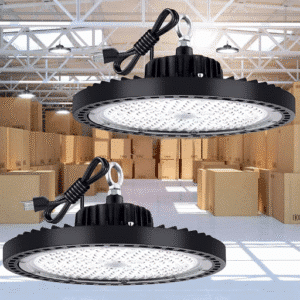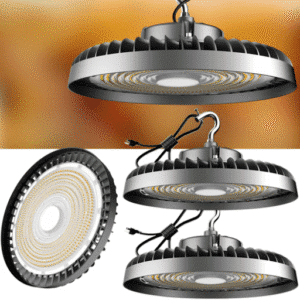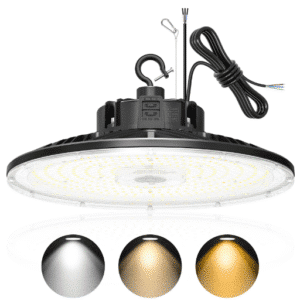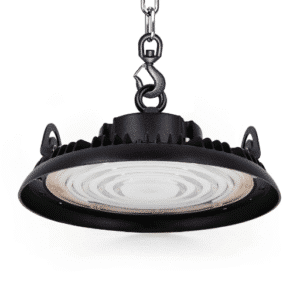

The best lighting for a manufacturing plant is DLC Premium LED high bay fixtures rated 140+ lumens per watt, CRI 80 or higher, IP65, with integrated controls. UFO high bays suit open floors with 20 to 40 ft ceilings. Linear high bays fit aisles and conveyors. The right fixture depends on ceiling height, task type, and contamination level.
That answer is simple. The decision behind it isn’t.
Most “best of” buying guides treat plant lighting like a product catalog. They list three fixtures, claim 75% energy savings, and call it done. Real facility managers know that picking the wrong fixture for a CNC bay or a food line costs far more than the energy savings recover. You need a framework, not a shopping list.
This guide gives you one. We’ll walk through six buying criteria that work for any vendor, an application matrix that tells you exactly which fixture belongs in each zone of your plant, a spec-sheet literacy primer, and worked ROI math from a real 100-fixture retrofit. By the end, you’ll know how to evaluate any “best LED lights for manufacturing plant” pitch on your own terms. For the broader strategic framework behind the cluster, start with our pillar guide on (factory lighting solutions).
Key Takeaways
- The best lighting for a manufacturing plant is DLC Premium LED high bay, 140+ lm/W, CRI 80+, IP65, with integrated controls.
- Don’t pick one fixture for the whole plant. Match output, optics, and ingress to each zone: CNC, assembly, welding, hazardous, food, outdoor.
- A typical 100-fixture metal halide to LED retrofit saves 22,000to22,000to30,000 per year and pays back in 18 to 30 months after rebates.
- Controls add 20 to 35 percent more savings on top of LED conversion when sensors and scheduling are deployed correctly.
- DLC Premium listing, L70 hours, and delivered (not nominal) lumens are the three spec numbers that actually matter.
What Counts as “Best” in a Manufacturing Plant?

“Best” is contextual. A CNC machining bay and a logistics dispatch line need different fixtures, even if both are inside the same plant. So before you compare products, fix the six criteria you’ll evaluate every vendor against.
The 6 buying criteria:
- Light output. Total delivered lumens at the fixture, not nominal LED chip output. Match this to your zone’s target foot-candles.
- Efficacy. Lumens per watt. Anything under 130 lm/W in 2026 is obsolete. DLC Premium starts at 150 lm/W.
- Optics. Beam angle, distribution curve, and glare control (UGR). A 120-degree beam is wrong for a 35 ft ceiling.
- Controls. 0 to 10V dimming at minimum. Bluetooth Mesh or DALI if you want zone scheduling.
- Durability. IP65 for general plant floors. IP66 or IP69K for food, washdown, or wet areas. IK08+ for impact zones.
- Warranty. Five years minimum on the fixture and driver. Ten years is becoming standard for DLC Premium products.
Score every fixture you’re shown against these six. You’ll cut through marketing language fast.
When Linda, a plant engineer at a Midwest metal fabrication shop, started her retrofit research in 2024, she scored 11 vendor proposals against these six criteria. Three vendors failed on efficacy. Two passed on the fixture spec but used drivers with two-year warranties. Only four made the shortlist. The rubric saved her two months of back-and-forth.
The Five Fixture Types You’ll Actually Choose Between
You don’t need to know every fixture in the IES handbook. For 95 percent of manufacturing plant zones, you’ll pick from five categories.
UFO LED High Bay
Round, compact fixtures with 20,000 to 35,000 lumen output. Designed for open floors with 20 to 40 ft ceilings. Best for assembly halls, machining shops, and any wide-open production floor. Easy to install on a hook or pendant. Compact thermal management means longer life in hot plants.
Linear LED High Bay
Rectangular fixtures, 10,000 to 25,000 lumen output. Best for aisles, racking, and conveyor lines where you want light spread along a corridor rather than focused down. Lower mounting heights (14 to 30 ft) work well.
LED Panel or Troffer
Flat fixtures for drop ceilings. Use these in offices, QC labs, packing areas with finished ceilings, and break rooms. Outputs of 3,000 to 6,000 lumens. Not for production floors with exposed deck.
LED Vapor-Tight Strip
Sealed linear fixtures rated IP65 or IP66. The right pick for wet, dusty, or washdown areas: brewing, food prep, pharma corridors, exterior storage. They handle moisture and contamination that would destroy a standard high bay.
LED Explosion-Proof
Class I and Class II hazardous-location fixtures. Required wherever flammable vapors, dusts, or fibers exist. Spray booths, solvent storage, grain handling, and chemical processing rooms all need these. For ATEX, IECEx, and NEC selection details, see our (explosion-proof lighting for factories guide).
Quick decision rule: If the ceiling is open deck above 20 ft, default to UFO high bay. Then check each specific zone for exceptions (hazardous, wet, drop ceiling, low bay).
Match the Fixture to the Zone (Application Matrix)

A single plant rarely needs one fixture type. Walk your floor, mark each zone, and apply this matrix.
Assembly Lines and Workbenches
Target: 50 to 75 foot-candles. CRI 80 or higher. UGR under 22 to control glare on shiny metal.
Fixture: UFO high bay for open assembly halls. Linear high bay over long conveyor lines.
CNC Machining, Inspection, and Quality Control
Target: 75 to 100 foot-candles. CRI 90 or higher for accurate color discrimination. UGR under 19.
Fixture: UFO high bay with high-CRI driver option, or panel fixtures in dedicated inspection booths.
This is the zone where most plants under-invest, and it shows up in defect rates. When a precision optics manufacturer in Rochester upgraded their visual inspection station from standard 4,000K high bays to CRI 90+ 5000K UFO fixtures with UGR 16 optics in early 2025, inspection-stage rejects dropped 11 percent within three months. The lighting cost $34,000. The recovered yield was worth more than that per quarter. For CRI, glare control, and UGR guidance tailored to medical device, electronics, and automotive work, see our (precision manufacturing lighting guide).
Welding and Fabrication Bays
Target: 50 foot-candles ambient, with task lighting at workstations. Glare control matters more than raw output. Workers wear hoods, so don’t over-light.
Fixture: UFO high bay with frosted lens or refractive optic. Avoid bare-LED clear lenses.
Warehouse, Racking, and Material Handling
Target: 20 to 30 foot-candles in aisles. Vertical illuminance on rack faces matters as much as floor lux.
Fixture: Linear high bay over aisles. UFO high bay over open staging areas.
Food and Pharma Production
Target: 30 to 75 foot-candles depending on task. IP69K rating. NSF certification for direct food zones.
Fixture: Sealed vapor-tight strips or food-grade UFOs. Smooth, gasketed housings only. Our (food processing plant lighting) primer covers the regulatory chain in detail.
Hazardous Locations
Target: 50 foot-candles. NEC Class I Division 1 or 2 compliance, ATEX zone rating, or IECEx as required.
Fixture: Listed explosion-proof high bay or vapor-tight strip. Never substitute “rugged” non-rated fixtures.
Outdoor Yards, Docks, and Loading Areas
Target: 5 to 20 foot-candles. IP66 minimum. Cold-weather driver rating if your climate demands it.
Fixture: Flood lights, wall packs, or outdoor-rated UFO high bays on pole mounts.
How to Read a Spec Sheet Without Getting Burned
Three numbers on a manufacturing plant lighting spec sheet matter most. The rest is detail.
1. Delivered lumens (not nominal). Nominal lumens describe what the LED chip produces in lab conditions. Delivered lumens describe what actually exits the fixture after optical and thermal losses. A 30,000 nominal chip might deliver 22,000 lumens in the field. Always ask for the DLC-listed delivered output.
2. DLC listing. DLC Premium products meet stricter efficacy, lumen maintenance, and warranty thresholds than DLC Standard. Premium is the floor for any serious 2026 industrial retrofit. Unlisted fixtures rarely qualify for utility rebates.
3. L70 hours. The number of operating hours before light output drops to 70 percent of initial. DLC Premium high bays typically rate 50,000 to 100,000 hours at L70. At 8,760 hours of annual operation, even the low end means roughly six years before noticeable depreciation.
Ignore claims that don’t tie back to these three numbers. “Up to 150 lm/W” with no DLC listing is marketing. CRI 80 with a 2-year driver warranty is a maintenance trap.
Controls Turn a Good Retrofit Into a Great One

Lighting controls turn a good retrofit into a great one. A typical factory recovers an additional 20 to 35 percent on top of LED conversion when controls are layered on. The math works in three places:
- Occupancy sensors in low-traffic zones (warehouses, mezzanines, restrooms) cut burn time by 30 to 60 percent.
- Daylight harvesting in plants with skylights or perimeter glazing dims fixtures when ambient light is adequate.
- Zone scheduling matches shift patterns so lights aren’t burning at full output during 3 a.m. cleaning crews.
Bluetooth Mesh has become the dominant protocol in industrial retrofits because it’s wireless (no conduit pulls), self-healing, and integrates with building management systems. DALI remains common where the plant already has a wired control backbone.
For manufacturing-specific automation, including shift scheduling, zone-based dimming, and machine-integrated controls, see our (smart factory lighting systems guide). For the broader warehouse perspective on (Bluetooth Mesh and sensor control systems), our smart warehouse playbook covers the protocol comparison.
ROI Math: What a 100-Fixture Retrofit Actually Pays Back
This is where the project gets approved or shelved. Most vendor pitches give you a one-line “save 50 percent on energy.” That isn’t enough to brief your CFO. Here’s a real-numbers worked example.
The plant: 80,000 sq ft metal fabrication shop. 24 hours a day, five days a week. 100 fixtures of 400W metal halide currently installed.
The retrofit: 100 UFO LED high bays at 150W each, DLC Premium, 5000K, 27,000 delivered lumens, with occupancy sensors in low-traffic zones.
| Line item | Before (MH) | After (LED) | Savings |
|---|---|---|---|
| Connected load | 100 × 458W = 45.8 kW | 100 × 158W = 15.8 kW | 30 kW |
| Annual run hours | 6,240 (24/5) | 6,240 base, 4,500 with sensors | n/a |
| Annual kWh | 285,800 | 71,100 | 214,700 kWh |
| Annual cost @ $0.12/kWh | $34,300 | $8,530 | $25,770 |
| Relamping labor | $4,800/yr | $0 | $4,800 |
| Productivity uplift (defects) | baseline | 2% improvement | $6,000 (est.) |
| Total annual benefit | $36,570 |
Project cost: 100 fixtures at 280each=280each=28,000. Installation labor: 14,000.Sensorsandcommissioning:14,000.Sensorsandcommissioning:6,500. Total: $48,500.
Utility rebate (typical mid-Atlantic): $18,000.
Net project cost: $30,500. Simple payback: 10 months.
That number changes with rate, hours, and labor cost. Run your own with our LED high bay ROI calculator, and for deeper case studies and demand-charge analysis read our (factory lighting energy savings guide). For a side-by-side technology comparison, our lifetime cost-of-ownership comparison covers LED versus metal halide in depth.
OSHA, ANSI, and IES Compliance Quick Reference
Lighting isn’t just an energy decision. It’s a regulated workplace condition. Three frameworks set the rules every plant manager should know.
OSHA 29 CFR 1910.22 mandates that floors and work areas be “kept in a clean and, so far as possible, a dry condition” and that walking surfaces be “adequately illuminated.” OSHA doesn’t publish foot-candle minimums in this regulation, but inspectors lean on industry consensus (the ANSI/IES values below) when judging adequacy.
ANSI/IES RP-7 is the consensus standard for industrial lighting. Typical recommended values:
- General storage: 10 foot-candles
- Rough assembly: 30 foot-candles
- Medium assembly: 50 foot-candles
- Fine assembly and inspection: 100 foot-candles
- Exacting inspection: 200+ foot-candles
NFPA 70 (NEC) covers hazardous-location fixture selection (Class I/II/III, Division 1/2). Get this wrong in a hazardous zone and you’re looking at far worse than a lighting failure.
For the full regulatory deep dive, see our guide to (OSHA factory lighting requirements). Don’t treat compliance as the ceiling. RP-7 values are minimums, and most plants benefit from operating well above them in task zones.
A Phased Rollout Plan for Risk-Averse Plants

Most retrofits fail in execution, not in fixture selection. Risk-averse plants follow a four-phase rollout.
Phase 1: Baseline. Take photometric readings across every zone with a calibrated light meter. Map current fixtures, ages, and failure rates. Document utility rates and demand charges.
Phase 2: Pilot. Replace fixtures in one self-contained zone (a single bay, a corridor, or a low-risk storage area). Run for 30 to 60 days. Measure energy, light levels, worker feedback, and any control issues.
Phase 3: Scale. Use pilot data to refine fixture spec, controls programming, and installation procedure. Roll out by zone, not all at once. Coordinate with shift schedules to minimize disruption.
Phase 4: Verify. Re-measure foot-candles 90 days after install. Confirm utility rebate documentation. Document warranty registration. Schedule annual cleaning and re-aim.
For the full project planning playbook with phased timelines and disposal logistics, follow our step-by-step (factory LED lighting retrofit playbook). To run worked photometric calculations on each zone before you order fixtures, see our (factory lighting layout design guide).
When the Maple Grove distribution and light-manufacturing facility ran this phased process across a 220,000 sq ft floor in 2025, they piloted in a single packing zone first. The pilot exposed a control commissioning issue (sensors set to the wrong timeout) that would have cost them 7 percent of expected savings if rolled out plant-wide. Catching it on 12 fixtures saved them the headache on 380.
Conclusion: The Best Lighting Is the One That Fits Your Plant
The best lighting for a manufacturing plant isn’t a single product. It’s a system: the right fixture for each zone, sized to your foot-candle target, controlled to your shift pattern, and selected against the six buying criteria we walked through. Get those decisions right and you’ll see energy savings of 60 to 75 percent (per DOE Solid-State Lighting industrial retrofit benchmarks), payback inside 12 to 30 months (ENERGY STAR Industrial average for rebated retrofits), and measurable gains in safety and productivity.
Recap the six criteria one more time:
- Light output matched to zone target
- Efficacy of 140+ lm/W (DLC Premium floor)
- Optics with appropriate beam and UGR
- Controls integrated, not bolted on
- Durability rated for the actual environment
- Warranty of five years or more on fixture and driver
That’s your filter. Apply it to every “best LED lights for manufacturing plant” pitch you see and you’ll separate the serious vendors from the catalog dumpers in 10 minutes. For the broader strategic framework on lighting your entire facility, including layout, smart controls, and compliance, our pillar guide on factory lighting solutions is your next read.